SUBSCRIBE TO OUR FREE NEWSLETTER
Daily news & progressive opinion—funded by the people, not the corporations—delivered straight to your inbox.
5
#000000
#FFFFFF
To donate by check, phone, or other method, see our More Ways to Give page.
Daily news & progressive opinion—funded by the people, not the corporations—delivered straight to your inbox.
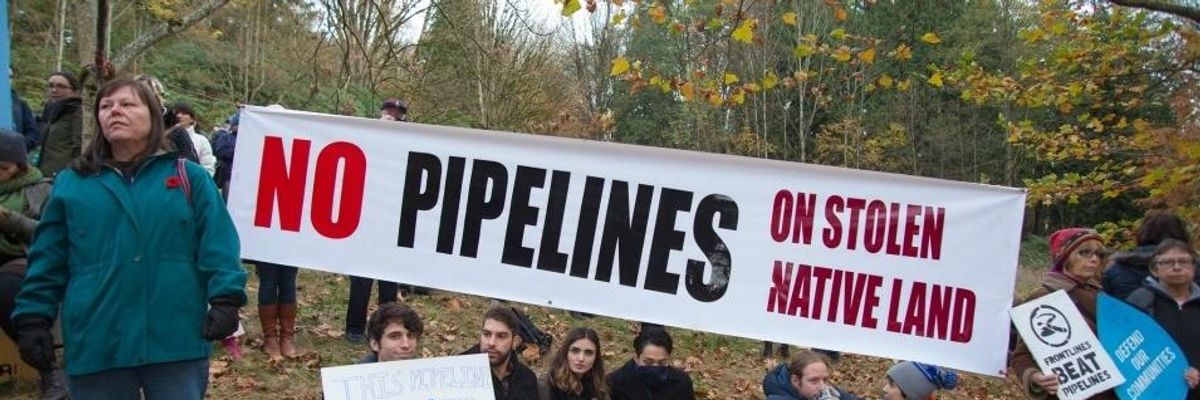
Climate campaigners and Indigenous peoples across Canada have spent the past several years protesting the Trans Mountain pipeline. (Photo: Mark Klotz/flickr/cc)
Climate and Indigenous activists reiterated their dedication to blocking the planned expansion of the Trans Mountain tar sands pipeline after Canada's Federal Court of Appeal on Tuesday unanimously rejected four challenges from First Nations in British Columbia to the government's approval of the project.
"We always said that we'd do what it takes to stop this pipeline," declared Rueben George, speaking on behalf of the Tsleil-Waututh Nation. "This government is incapable of making sound decisions for our future generations--so we are and we will. Even for their children."
The Trans Mountain Pipeline can currently carry about 300,000 barrels of petroleum products daily through Alberta and British Columbia in Canada and Washington state in the U.S.; the long-delayed and widely contested expansion project, or TMX, would nearly triple the pipeline's capacity.
Despite Canadian Prime Minister Justin Trudeau's supposed commitment to battling the climate crisis--which scientists worldwide warn requires a rapid transition to 100% renewable energy alongside other global reforms--his government purchased the pipeline from Kinder Morgan in 2018.
In a statement Tuesday, Trans Mountain Corporation president and CEO Ian Anderson welcomed the 3-0 court decision, which centered on whether Canada adequately consulted with Indigenous groups along the pipeline route. Anderson said that "the government of Canada's additional Indigenous consultation represented an immense undertaking by many parties. The government was committed to a specific and focused dialogue with affected Indigenous communities to ensure Canada, and the company heard their concerns and responded."
Natural Resources Minister Seamus O'Regan echoed that sentiment. According to the Associated Press, O'Regan said, "The courts have acknowledged that we listened and that we want to do things right."
However, leaders of the Tsleil-Waututh, Squamish, and Coldwater nations disagree and expressed frustration about the court's decision Tuesday. The Indigenous groups now have 60 days to appeal the decision to the Supreme Court of Canada, which they are now discussing with their legal teams.
CBC reported that "there is also an outstanding appeal to the Supreme Court of Canada on the project re-approval, filed by Squamsih, Tsleil-Waututh, and three environment groups." Although that appeal is outstanding, last month the high court rejected an appeal from the province of British Columbia to halt TMX.
"There are two potential options when it comes to the Supreme Court," Khelsilem, spokesperson and elected councilor for the Squamish Nation, said Tuesday. Noting that the fight against the pipeline hasn't been contained to the courts, Khelsilem added that "it's important to recognize that B.C. has a long history of civil disobedience when it comes to environmental issues. There have been instances in B.C.'s history where hundreds of people were willing to face arrest."
Speaking on behalf of the Union of B.C. Indian Chiefs (UBCIC), Chief Don Tom predicted that Tuesday's decision will lead to "an increase in land defenders."
"We are saddened that Canada and B.C. continue to rally around the TMX--it represents an environmental liability that we simply cannot afford in the age of climate emergency," the chief added in a statement. "Canada has bulldozered a pathway forward on this unsustainable project that is in no way honorable, in the interest of the public, or aligned with its commitment to implement federal legislation on the United Nations Declaration on the Rights of Indigenous Peoples."
"Canada's adversarial approach in dealing with Indigenous Nations concerned about the still inconclusive environmental risks the TMX poses, displays an alarming lack of respect for Indigenous Title and Rights and is inconsistent with the historic Supreme Court of Canada's Tsilhqot'in judgement," he said. "Canada continues to ignore and minimize the severe environmental risks of the TMX: an oil leak could disastrously contaminate the main source of drinking water for the Coldwater Indian Band, and a seven-fold increase tanker traffic would raise the threat of an oil spill in sensitive habitat that lies within traditional territories of the Tsleil-Waututh and Squamish Nations."
Grand Chief Stewart Phillip, president of UBCIC, charged that "the court's ruling rests upon discriminatory and hypocritical foundations; their rejection of the Nations' appeal rests on the claim that when it comes to a project of public interests, 'the law does not require the interests of Indigenous peoples prevail,' and that Indigenous peoples cannot veto projects such as the TMX."
Phillip explained that "Indigenous peoples are not seeking a veto," but rather "to have our human rights upheld." The battle against the project "is about more than the superficial duty to consult process, it is about the duty to the environment and to our grandchildren," he said. "We are resolute in our commitment to uphold inherent Indigenous Title and Rights and self-determination, and to protect the lands and waters."
"The fossil fuel industry is culpable in the climate crisis and represents an era of greenhouse gas emitting infrastructure that is for dinosaurs, not for a world struggling to combat climate change; Canada needs to treat this as an incontrovertible fact," emphasized UBCIC secretary-treasurer Kukpi7 Judy Wilson. "It is alarming that Canada is so dead-set on pursuing the TMX when oil prices are declining, forests are burning, and more and more animal species are on the edge of extinction."
Tzeporah Berman, international program director at the nonprofit environmental group Stand.earth, decried the Canadian government's treatment of Indigenous critics of the project in a statement Tuesday.
"Canada is broken. For too long, we've treated First Nations as second-class citizens. This federal court decision reinforces that colonialism is alive in Canada and that reconciliation is a lie," Berman said. "We stand with our Indigenous allies as they consider whether to appeal today's disappointing ruling to the Supreme Court. As long as Prime Minister Justin Trudeau tries to build the Trans Mountain Pipeline, we will continue to fight."
Dear Common Dreams reader, It’s been nearly 30 years since I co-founded Common Dreams with my late wife, Lina Newhouser. We had the radical notion that journalism should serve the public good, not corporate profits. It was clear to us from the outset what it would take to build such a project. No paid advertisements. No corporate sponsors. No millionaire publisher telling us what to think or do. Many people said we wouldn't last a year, but we proved those doubters wrong. Together with a tremendous team of journalists and dedicated staff, we built an independent media outlet free from the constraints of profits and corporate control. Our mission has always been simple: To inform. To inspire. To ignite change for the common good. Building Common Dreams was not easy. Our survival was never guaranteed. When you take on the most powerful forces—Wall Street greed, fossil fuel industry destruction, Big Tech lobbyists, and uber-rich oligarchs who have spent billions upon billions rigging the economy and democracy in their favor—the only bulwark you have is supporters who believe in your work. But here’s the urgent message from me today. It's never been this bad out there. And it's never been this hard to keep us going. At the very moment Common Dreams is most needed, the threats we face are intensifying. We need your support now more than ever. We don't accept corporate advertising and never will. We don't have a paywall because we don't think people should be blocked from critical news based on their ability to pay. Everything we do is funded by the donations of readers like you. When everyone does the little they can afford, we are strong. But if that support retreats or dries up, so do we. Will you donate now to make sure Common Dreams not only survives but thrives? —Craig Brown, Co-founder |
Climate and Indigenous activists reiterated their dedication to blocking the planned expansion of the Trans Mountain tar sands pipeline after Canada's Federal Court of Appeal on Tuesday unanimously rejected four challenges from First Nations in British Columbia to the government's approval of the project.
"We always said that we'd do what it takes to stop this pipeline," declared Rueben George, speaking on behalf of the Tsleil-Waututh Nation. "This government is incapable of making sound decisions for our future generations--so we are and we will. Even for their children."
The Trans Mountain Pipeline can currently carry about 300,000 barrels of petroleum products daily through Alberta and British Columbia in Canada and Washington state in the U.S.; the long-delayed and widely contested expansion project, or TMX, would nearly triple the pipeline's capacity.
Despite Canadian Prime Minister Justin Trudeau's supposed commitment to battling the climate crisis--which scientists worldwide warn requires a rapid transition to 100% renewable energy alongside other global reforms--his government purchased the pipeline from Kinder Morgan in 2018.
In a statement Tuesday, Trans Mountain Corporation president and CEO Ian Anderson welcomed the 3-0 court decision, which centered on whether Canada adequately consulted with Indigenous groups along the pipeline route. Anderson said that "the government of Canada's additional Indigenous consultation represented an immense undertaking by many parties. The government was committed to a specific and focused dialogue with affected Indigenous communities to ensure Canada, and the company heard their concerns and responded."
Natural Resources Minister Seamus O'Regan echoed that sentiment. According to the Associated Press, O'Regan said, "The courts have acknowledged that we listened and that we want to do things right."
However, leaders of the Tsleil-Waututh, Squamish, and Coldwater nations disagree and expressed frustration about the court's decision Tuesday. The Indigenous groups now have 60 days to appeal the decision to the Supreme Court of Canada, which they are now discussing with their legal teams.
CBC reported that "there is also an outstanding appeal to the Supreme Court of Canada on the project re-approval, filed by Squamsih, Tsleil-Waututh, and three environment groups." Although that appeal is outstanding, last month the high court rejected an appeal from the province of British Columbia to halt TMX.
"There are two potential options when it comes to the Supreme Court," Khelsilem, spokesperson and elected councilor for the Squamish Nation, said Tuesday. Noting that the fight against the pipeline hasn't been contained to the courts, Khelsilem added that "it's important to recognize that B.C. has a long history of civil disobedience when it comes to environmental issues. There have been instances in B.C.'s history where hundreds of people were willing to face arrest."
Speaking on behalf of the Union of B.C. Indian Chiefs (UBCIC), Chief Don Tom predicted that Tuesday's decision will lead to "an increase in land defenders."
"We are saddened that Canada and B.C. continue to rally around the TMX--it represents an environmental liability that we simply cannot afford in the age of climate emergency," the chief added in a statement. "Canada has bulldozered a pathway forward on this unsustainable project that is in no way honorable, in the interest of the public, or aligned with its commitment to implement federal legislation on the United Nations Declaration on the Rights of Indigenous Peoples."
"Canada's adversarial approach in dealing with Indigenous Nations concerned about the still inconclusive environmental risks the TMX poses, displays an alarming lack of respect for Indigenous Title and Rights and is inconsistent with the historic Supreme Court of Canada's Tsilhqot'in judgement," he said. "Canada continues to ignore and minimize the severe environmental risks of the TMX: an oil leak could disastrously contaminate the main source of drinking water for the Coldwater Indian Band, and a seven-fold increase tanker traffic would raise the threat of an oil spill in sensitive habitat that lies within traditional territories of the Tsleil-Waututh and Squamish Nations."
Grand Chief Stewart Phillip, president of UBCIC, charged that "the court's ruling rests upon discriminatory and hypocritical foundations; their rejection of the Nations' appeal rests on the claim that when it comes to a project of public interests, 'the law does not require the interests of Indigenous peoples prevail,' and that Indigenous peoples cannot veto projects such as the TMX."
Phillip explained that "Indigenous peoples are not seeking a veto," but rather "to have our human rights upheld." The battle against the project "is about more than the superficial duty to consult process, it is about the duty to the environment and to our grandchildren," he said. "We are resolute in our commitment to uphold inherent Indigenous Title and Rights and self-determination, and to protect the lands and waters."
"The fossil fuel industry is culpable in the climate crisis and represents an era of greenhouse gas emitting infrastructure that is for dinosaurs, not for a world struggling to combat climate change; Canada needs to treat this as an incontrovertible fact," emphasized UBCIC secretary-treasurer Kukpi7 Judy Wilson. "It is alarming that Canada is so dead-set on pursuing the TMX when oil prices are declining, forests are burning, and more and more animal species are on the edge of extinction."
Tzeporah Berman, international program director at the nonprofit environmental group Stand.earth, decried the Canadian government's treatment of Indigenous critics of the project in a statement Tuesday.
"Canada is broken. For too long, we've treated First Nations as second-class citizens. This federal court decision reinforces that colonialism is alive in Canada and that reconciliation is a lie," Berman said. "We stand with our Indigenous allies as they consider whether to appeal today's disappointing ruling to the Supreme Court. As long as Prime Minister Justin Trudeau tries to build the Trans Mountain Pipeline, we will continue to fight."
Climate and Indigenous activists reiterated their dedication to blocking the planned expansion of the Trans Mountain tar sands pipeline after Canada's Federal Court of Appeal on Tuesday unanimously rejected four challenges from First Nations in British Columbia to the government's approval of the project.
"We always said that we'd do what it takes to stop this pipeline," declared Rueben George, speaking on behalf of the Tsleil-Waututh Nation. "This government is incapable of making sound decisions for our future generations--so we are and we will. Even for their children."
The Trans Mountain Pipeline can currently carry about 300,000 barrels of petroleum products daily through Alberta and British Columbia in Canada and Washington state in the U.S.; the long-delayed and widely contested expansion project, or TMX, would nearly triple the pipeline's capacity.
Despite Canadian Prime Minister Justin Trudeau's supposed commitment to battling the climate crisis--which scientists worldwide warn requires a rapid transition to 100% renewable energy alongside other global reforms--his government purchased the pipeline from Kinder Morgan in 2018.
In a statement Tuesday, Trans Mountain Corporation president and CEO Ian Anderson welcomed the 3-0 court decision, which centered on whether Canada adequately consulted with Indigenous groups along the pipeline route. Anderson said that "the government of Canada's additional Indigenous consultation represented an immense undertaking by many parties. The government was committed to a specific and focused dialogue with affected Indigenous communities to ensure Canada, and the company heard their concerns and responded."
Natural Resources Minister Seamus O'Regan echoed that sentiment. According to the Associated Press, O'Regan said, "The courts have acknowledged that we listened and that we want to do things right."
However, leaders of the Tsleil-Waututh, Squamish, and Coldwater nations disagree and expressed frustration about the court's decision Tuesday. The Indigenous groups now have 60 days to appeal the decision to the Supreme Court of Canada, which they are now discussing with their legal teams.
CBC reported that "there is also an outstanding appeal to the Supreme Court of Canada on the project re-approval, filed by Squamsih, Tsleil-Waututh, and three environment groups." Although that appeal is outstanding, last month the high court rejected an appeal from the province of British Columbia to halt TMX.
"There are two potential options when it comes to the Supreme Court," Khelsilem, spokesperson and elected councilor for the Squamish Nation, said Tuesday. Noting that the fight against the pipeline hasn't been contained to the courts, Khelsilem added that "it's important to recognize that B.C. has a long history of civil disobedience when it comes to environmental issues. There have been instances in B.C.'s history where hundreds of people were willing to face arrest."
Speaking on behalf of the Union of B.C. Indian Chiefs (UBCIC), Chief Don Tom predicted that Tuesday's decision will lead to "an increase in land defenders."
"We are saddened that Canada and B.C. continue to rally around the TMX--it represents an environmental liability that we simply cannot afford in the age of climate emergency," the chief added in a statement. "Canada has bulldozered a pathway forward on this unsustainable project that is in no way honorable, in the interest of the public, or aligned with its commitment to implement federal legislation on the United Nations Declaration on the Rights of Indigenous Peoples."
"Canada's adversarial approach in dealing with Indigenous Nations concerned about the still inconclusive environmental risks the TMX poses, displays an alarming lack of respect for Indigenous Title and Rights and is inconsistent with the historic Supreme Court of Canada's Tsilhqot'in judgement," he said. "Canada continues to ignore and minimize the severe environmental risks of the TMX: an oil leak could disastrously contaminate the main source of drinking water for the Coldwater Indian Band, and a seven-fold increase tanker traffic would raise the threat of an oil spill in sensitive habitat that lies within traditional territories of the Tsleil-Waututh and Squamish Nations."
Grand Chief Stewart Phillip, president of UBCIC, charged that "the court's ruling rests upon discriminatory and hypocritical foundations; their rejection of the Nations' appeal rests on the claim that when it comes to a project of public interests, 'the law does not require the interests of Indigenous peoples prevail,' and that Indigenous peoples cannot veto projects such as the TMX."
Phillip explained that "Indigenous peoples are not seeking a veto," but rather "to have our human rights upheld." The battle against the project "is about more than the superficial duty to consult process, it is about the duty to the environment and to our grandchildren," he said. "We are resolute in our commitment to uphold inherent Indigenous Title and Rights and self-determination, and to protect the lands and waters."
"The fossil fuel industry is culpable in the climate crisis and represents an era of greenhouse gas emitting infrastructure that is for dinosaurs, not for a world struggling to combat climate change; Canada needs to treat this as an incontrovertible fact," emphasized UBCIC secretary-treasurer Kukpi7 Judy Wilson. "It is alarming that Canada is so dead-set on pursuing the TMX when oil prices are declining, forests are burning, and more and more animal species are on the edge of extinction."
Tzeporah Berman, international program director at the nonprofit environmental group Stand.earth, decried the Canadian government's treatment of Indigenous critics of the project in a statement Tuesday.
"Canada is broken. For too long, we've treated First Nations as second-class citizens. This federal court decision reinforces that colonialism is alive in Canada and that reconciliation is a lie," Berman said. "We stand with our Indigenous allies as they consider whether to appeal today's disappointing ruling to the Supreme Court. As long as Prime Minister Justin Trudeau tries to build the Trans Mountain Pipeline, we will continue to fight."