SUBSCRIBE TO OUR FREE NEWSLETTER
Daily news & progressive opinion—funded by the people, not the corporations—delivered straight to your inbox.
5
#000000
#FFFFFF
To donate by check, phone, or other method, see our More Ways to Give page.
Daily news & progressive opinion—funded by the people, not the corporations—delivered straight to your inbox.
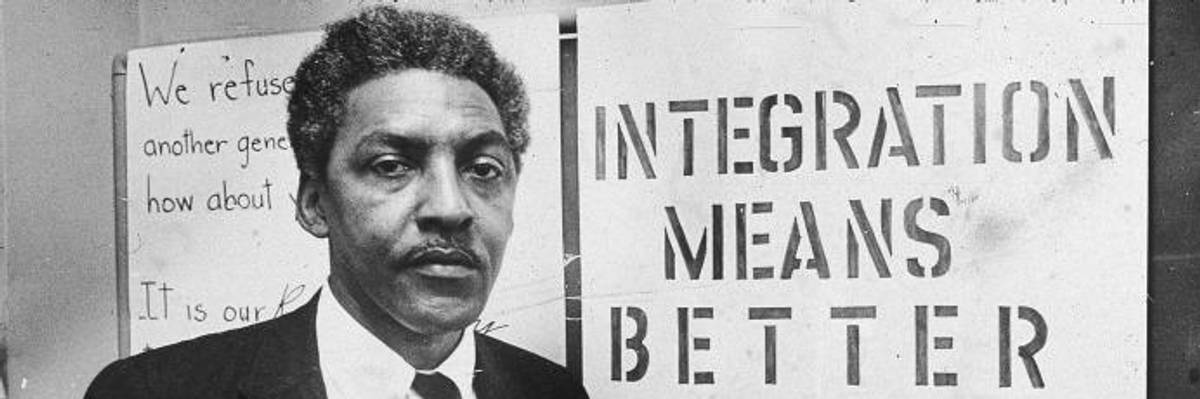
American civil rights activist Bayard Rustin (1912 - 1987), spokesman for the Citywide Committee for Integration, at the organization's headquarters at Silcam Presbyterian Church, Brooklyn, New York City. (Photo: Patrick A. Burns/New York Times Co./Getty Images)
California Gov. Gavin Newsom drew praise from progressives Wednesday for posthumously pardoning civil rights icon and lead architect of the 1963 March on Washington for Jobs and Freedom Bayard Rustin.
A victim of the state's then-"vagrancy" law that criminalized the LGTBQ community, Rustin in 1953 was arrested--and spent roughly two months in jail--for engaging in consensual sexual activities with men. He also had to register as a sex offender.
Newsom on Wednesday also unveiled (pdf) a clemency process for others who, like Rustin, "were subjected to discriminatory and unjust arrest and prosecution for engaging in consensual adult sexual conduct." The efforts, said Newsom, could help right an "egregious wrong."
State Sen. Sen. Scott Wiener, chair of the California legislative LGBTQ Caucus, called the news a "big win for justice."
"In California and across the country, many laws have been used as legal tools of oppression, and to stigmatize and punish LGBTQ people and communities and warn others what harm could await them for living authentically," Newsom said in a statement. "I thank those who advocated for Bayard Rustin's pardon, and I want to encourage others in similar situations to seek a pardon to right this egregious wrong."
Wiener and the Legislative Black Caucus had pushed for the posthumous pardon.
"To be clear, the criminalization of the LGBTQ community has never been about preventing harm to anyone but rather an effort to eradicate and erase LGBTQ people from the face of the planet," wrote Weiner and Black Caucus chair Assemblymember Shirley Weber. "Mr. Rustin's arrest and prosecution was purely about this history."
"Rustin was no stranger to time behind bars," they continued. "He was also incarcerated for violating dehumanizing and racist segregation laws and was even beaten for refusing to move from the 'whites-only' section of a bus."
In a new statement, Weber said, "The Arc of Justice is long," noting that "it took nearly 70 years for Bayard Rustin to have his legacy in the Civil Rights movement uncompromised by this incident."
"Rustin was a great American who was both gay and black at a time when the sheer fact of being either or both could land you in jail," said Weber.
Rustin was posthumously awarded a Presidential Medal of Freedom in 2013 by then-President Barack Obama. Rustin is also on the Labor Department's Hall of Honor.
In a 2012 article commemorating what would have been Rustin's 100th birthday, Matt Meyer wrote, "his legacy, like his entire life, was a beacon of the power of positive action."
Dear Common Dreams reader, It’s been nearly 30 years since I co-founded Common Dreams with my late wife, Lina Newhouser. We had the radical notion that journalism should serve the public good, not corporate profits. It was clear to us from the outset what it would take to build such a project. No paid advertisements. No corporate sponsors. No millionaire publisher telling us what to think or do. Many people said we wouldn't last a year, but we proved those doubters wrong. Together with a tremendous team of journalists and dedicated staff, we built an independent media outlet free from the constraints of profits and corporate control. Our mission has always been simple: To inform. To inspire. To ignite change for the common good. Building Common Dreams was not easy. Our survival was never guaranteed. When you take on the most powerful forces—Wall Street greed, fossil fuel industry destruction, Big Tech lobbyists, and uber-rich oligarchs who have spent billions upon billions rigging the economy and democracy in their favor—the only bulwark you have is supporters who believe in your work. But here’s the urgent message from me today. It's never been this bad out there. And it's never been this hard to keep us going. At the very moment Common Dreams is most needed, the threats we face are intensifying. We need your support now more than ever. We don't accept corporate advertising and never will. We don't have a paywall because we don't think people should be blocked from critical news based on their ability to pay. Everything we do is funded by the donations of readers like you. When everyone does the little they can afford, we are strong. But if that support retreats or dries up, so do we. Will you donate now to make sure Common Dreams not only survives but thrives? —Craig Brown, Co-founder |
California Gov. Gavin Newsom drew praise from progressives Wednesday for posthumously pardoning civil rights icon and lead architect of the 1963 March on Washington for Jobs and Freedom Bayard Rustin.
A victim of the state's then-"vagrancy" law that criminalized the LGTBQ community, Rustin in 1953 was arrested--and spent roughly two months in jail--for engaging in consensual sexual activities with men. He also had to register as a sex offender.
Newsom on Wednesday also unveiled (pdf) a clemency process for others who, like Rustin, "were subjected to discriminatory and unjust arrest and prosecution for engaging in consensual adult sexual conduct." The efforts, said Newsom, could help right an "egregious wrong."
State Sen. Sen. Scott Wiener, chair of the California legislative LGBTQ Caucus, called the news a "big win for justice."
"In California and across the country, many laws have been used as legal tools of oppression, and to stigmatize and punish LGBTQ people and communities and warn others what harm could await them for living authentically," Newsom said in a statement. "I thank those who advocated for Bayard Rustin's pardon, and I want to encourage others in similar situations to seek a pardon to right this egregious wrong."
Wiener and the Legislative Black Caucus had pushed for the posthumous pardon.
"To be clear, the criminalization of the LGBTQ community has never been about preventing harm to anyone but rather an effort to eradicate and erase LGBTQ people from the face of the planet," wrote Weiner and Black Caucus chair Assemblymember Shirley Weber. "Mr. Rustin's arrest and prosecution was purely about this history."
"Rustin was no stranger to time behind bars," they continued. "He was also incarcerated for violating dehumanizing and racist segregation laws and was even beaten for refusing to move from the 'whites-only' section of a bus."
In a new statement, Weber said, "The Arc of Justice is long," noting that "it took nearly 70 years for Bayard Rustin to have his legacy in the Civil Rights movement uncompromised by this incident."
"Rustin was a great American who was both gay and black at a time when the sheer fact of being either or both could land you in jail," said Weber.
Rustin was posthumously awarded a Presidential Medal of Freedom in 2013 by then-President Barack Obama. Rustin is also on the Labor Department's Hall of Honor.
In a 2012 article commemorating what would have been Rustin's 100th birthday, Matt Meyer wrote, "his legacy, like his entire life, was a beacon of the power of positive action."
California Gov. Gavin Newsom drew praise from progressives Wednesday for posthumously pardoning civil rights icon and lead architect of the 1963 March on Washington for Jobs and Freedom Bayard Rustin.
A victim of the state's then-"vagrancy" law that criminalized the LGTBQ community, Rustin in 1953 was arrested--and spent roughly two months in jail--for engaging in consensual sexual activities with men. He also had to register as a sex offender.
Newsom on Wednesday also unveiled (pdf) a clemency process for others who, like Rustin, "were subjected to discriminatory and unjust arrest and prosecution for engaging in consensual adult sexual conduct." The efforts, said Newsom, could help right an "egregious wrong."
State Sen. Sen. Scott Wiener, chair of the California legislative LGBTQ Caucus, called the news a "big win for justice."
"In California and across the country, many laws have been used as legal tools of oppression, and to stigmatize and punish LGBTQ people and communities and warn others what harm could await them for living authentically," Newsom said in a statement. "I thank those who advocated for Bayard Rustin's pardon, and I want to encourage others in similar situations to seek a pardon to right this egregious wrong."
Wiener and the Legislative Black Caucus had pushed for the posthumous pardon.
"To be clear, the criminalization of the LGBTQ community has never been about preventing harm to anyone but rather an effort to eradicate and erase LGBTQ people from the face of the planet," wrote Weiner and Black Caucus chair Assemblymember Shirley Weber. "Mr. Rustin's arrest and prosecution was purely about this history."
"Rustin was no stranger to time behind bars," they continued. "He was also incarcerated for violating dehumanizing and racist segregation laws and was even beaten for refusing to move from the 'whites-only' section of a bus."
In a new statement, Weber said, "The Arc of Justice is long," noting that "it took nearly 70 years for Bayard Rustin to have his legacy in the Civil Rights movement uncompromised by this incident."
"Rustin was a great American who was both gay and black at a time when the sheer fact of being either or both could land you in jail," said Weber.
Rustin was posthumously awarded a Presidential Medal of Freedom in 2013 by then-President Barack Obama. Rustin is also on the Labor Department's Hall of Honor.
In a 2012 article commemorating what would have been Rustin's 100th birthday, Matt Meyer wrote, "his legacy, like his entire life, was a beacon of the power of positive action."