SUBSCRIBE TO OUR FREE NEWSLETTER
Daily news & progressive opinion—funded by the people, not the corporations—delivered straight to your inbox.
5
#000000
#FFFFFF
To donate by check, phone, or other method, see our More Ways to Give page.
Daily news & progressive opinion—funded by the people, not the corporations—delivered straight to your inbox.
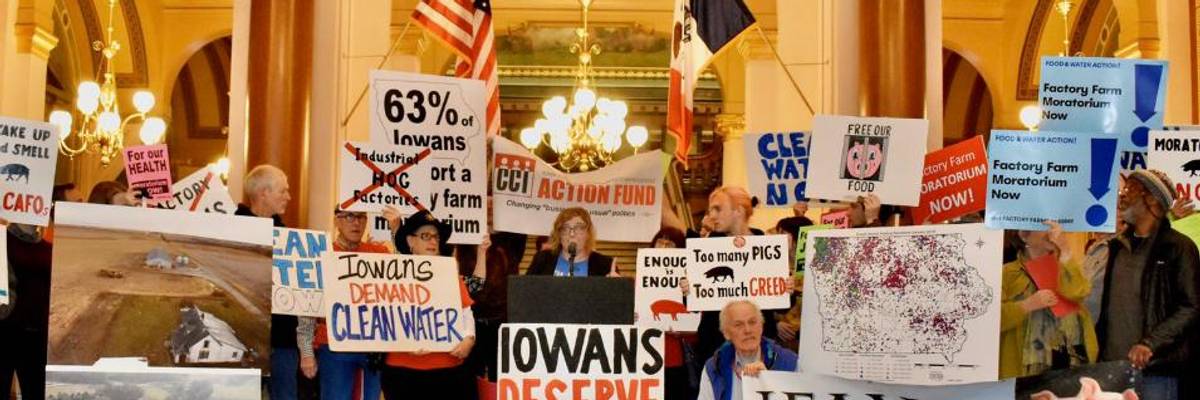
A large coalition of residents and public interest groups lobbied the state legislature in Des Moines, Iowa to demand support for a moratorium on building new, and expanding existing, factory farms--also known as concentrated animal feeding operations (CAFOs). The coalition of factory farm opponents also presented a petition to all 2020 presidential candidates calling on them to support the state moratorium as well as federal legislation to curtail factory farms. (Photo: Citizens for Community Improvement Action)
With less than two weeks until the Iowa caucuses, a coalition of local and national groups is calling on lawmakers in the state and the field of Democratic 2020 presidential candidates to put an end to the building of new factory farms in the state as part of a national push to curtail the animal cruelty, environmental destruction, and harm to farming communities that go hand in hand with such operations.
The coalition--which includes Food & Water Action (FWA), Iowa Citizens for Community Improvement Action (CCI Action), and Iowa Alliance for Responsible Agriculture (IARA)--spent the day in Iowa's capitol of Des Moines on Thursday lobbying legislators and also delivered a petition calling on 2020 hopefuls to back the call for the moratorium. In addition to blocking new factory farms, the moratorium would bar the expansion of existing ones.
"It's time to take a zero-tolerance approach when it comes to factory farming. The Farm System Reform Act outlines a solution that covers all of our bases to protect Americans from corporate agriculture once and for all."
--Adam Mason, Iowa Citizens for Community Improvement Action Fund
The groups also want lawmakers and candidates to support federal legislation, introduced by Sen. Cory Booker (D-NY) as the Farm System Reform Act of 2019 (FSRA), which farming reform advocates have characterized as the "bold approach we need" to solve the crisis.
According to the groups, with Iowa adding factory farms--also known as concentrated animal feeding operations (or CAFOs)--at a rate of 300 to 600 each year, the state could be a proving ground to show the nation there is a better, more sustainable way of farming that doesn't devastate the lives of livestock, water and soil resources, and local communities.
"As a rural resident and an independent farmer I see the devastating impacts of a runaway building boom of factory farms not only on independent family farms (94% of independent pig farmers are gone), but also on the environment," said Chris Petersen, an IARA members who also sits on the Board of Directors of the Iowa Farmer's Union. "We're talking about water quality, human health, rural neighborhoods, and even rural social structure."
Youth activist Tatiana Schaapherder said the climate impacts of factory farming only intensify the need for urgency. "You, the adults, open your eyes, become the role models that we as the children have had to take on," Schaapherder said. "Show us, your children that you see us, that you care. Give us that future that we deserve, the future that we are fighting for."
Krissy Kasserman, factory farm organizing manager for Food & Water Action, said the presidential candidates now spending so much time in the state cannot avoid the question of agriculture in their campaigns and must show voters they are willing to acting boldly to address the serious concerns of farmers, climate activists, and consumers.
"Any agricultural platform that does not adequately address the worsening factory farm crisis we're facing across the country, is half baked and majorly flawed," Kasserman said in a statement. "With the presidential primary approaching, Americans want candidates that prove they will be bold on agriculture and commit to stopping factory farming."
The groups are pushing candidates to embrace Sen. Booker's legislation as a key step.
"It's time to take a zero-tolerance approach when it comes to factory farming. The Farm System Reform Act outlines a solution that covers all of our bases to protect Americans from corporate agriculture once and for all," said Adam Mason, the state policy director for Iowa Citizens for Community Improvement Action Fund. "Voters in Iowa and across the country are urging you to prove you would lead in favor of public health and rural communities."
Booker, who ended his presidentual run several weeks ago, has made food and agriculture policy one of his signature issues and noted, when he introduced in December, the country alarming and dramatic rise in the number of CAFOs nationwide in recent years.
"Large factory farms are harmful to rural communities, public health, and the environment," Booker said, "and we must immediately begin to transition to a more sustainable and humane system."
Dear Common Dreams reader, It’s been nearly 30 years since I co-founded Common Dreams with my late wife, Lina Newhouser. We had the radical notion that journalism should serve the public good, not corporate profits. It was clear to us from the outset what it would take to build such a project. No paid advertisements. No corporate sponsors. No millionaire publisher telling us what to think or do. Many people said we wouldn't last a year, but we proved those doubters wrong. Together with a tremendous team of journalists and dedicated staff, we built an independent media outlet free from the constraints of profits and corporate control. Our mission has always been simple: To inform. To inspire. To ignite change for the common good. Building Common Dreams was not easy. Our survival was never guaranteed. When you take on the most powerful forces—Wall Street greed, fossil fuel industry destruction, Big Tech lobbyists, and uber-rich oligarchs who have spent billions upon billions rigging the economy and democracy in their favor—the only bulwark you have is supporters who believe in your work. But here’s the urgent message from me today. It's never been this bad out there. And it's never been this hard to keep us going. At the very moment Common Dreams is most needed, the threats we face are intensifying. We need your support now more than ever. We don't accept corporate advertising and never will. We don't have a paywall because we don't think people should be blocked from critical news based on their ability to pay. Everything we do is funded by the donations of readers like you. When everyone does the little they can afford, we are strong. But if that support retreats or dries up, so do we. Will you donate now to make sure Common Dreams not only survives but thrives? —Craig Brown, Co-founder |
With less than two weeks until the Iowa caucuses, a coalition of local and national groups is calling on lawmakers in the state and the field of Democratic 2020 presidential candidates to put an end to the building of new factory farms in the state as part of a national push to curtail the animal cruelty, environmental destruction, and harm to farming communities that go hand in hand with such operations.
The coalition--which includes Food & Water Action (FWA), Iowa Citizens for Community Improvement Action (CCI Action), and Iowa Alliance for Responsible Agriculture (IARA)--spent the day in Iowa's capitol of Des Moines on Thursday lobbying legislators and also delivered a petition calling on 2020 hopefuls to back the call for the moratorium. In addition to blocking new factory farms, the moratorium would bar the expansion of existing ones.
"It's time to take a zero-tolerance approach when it comes to factory farming. The Farm System Reform Act outlines a solution that covers all of our bases to protect Americans from corporate agriculture once and for all."
--Adam Mason, Iowa Citizens for Community Improvement Action Fund
The groups also want lawmakers and candidates to support federal legislation, introduced by Sen. Cory Booker (D-NY) as the Farm System Reform Act of 2019 (FSRA), which farming reform advocates have characterized as the "bold approach we need" to solve the crisis.
According to the groups, with Iowa adding factory farms--also known as concentrated animal feeding operations (or CAFOs)--at a rate of 300 to 600 each year, the state could be a proving ground to show the nation there is a better, more sustainable way of farming that doesn't devastate the lives of livestock, water and soil resources, and local communities.
"As a rural resident and an independent farmer I see the devastating impacts of a runaway building boom of factory farms not only on independent family farms (94% of independent pig farmers are gone), but also on the environment," said Chris Petersen, an IARA members who also sits on the Board of Directors of the Iowa Farmer's Union. "We're talking about water quality, human health, rural neighborhoods, and even rural social structure."
Youth activist Tatiana Schaapherder said the climate impacts of factory farming only intensify the need for urgency. "You, the adults, open your eyes, become the role models that we as the children have had to take on," Schaapherder said. "Show us, your children that you see us, that you care. Give us that future that we deserve, the future that we are fighting for."
Krissy Kasserman, factory farm organizing manager for Food & Water Action, said the presidential candidates now spending so much time in the state cannot avoid the question of agriculture in their campaigns and must show voters they are willing to acting boldly to address the serious concerns of farmers, climate activists, and consumers.
"Any agricultural platform that does not adequately address the worsening factory farm crisis we're facing across the country, is half baked and majorly flawed," Kasserman said in a statement. "With the presidential primary approaching, Americans want candidates that prove they will be bold on agriculture and commit to stopping factory farming."
The groups are pushing candidates to embrace Sen. Booker's legislation as a key step.
"It's time to take a zero-tolerance approach when it comes to factory farming. The Farm System Reform Act outlines a solution that covers all of our bases to protect Americans from corporate agriculture once and for all," said Adam Mason, the state policy director for Iowa Citizens for Community Improvement Action Fund. "Voters in Iowa and across the country are urging you to prove you would lead in favor of public health and rural communities."
Booker, who ended his presidentual run several weeks ago, has made food and agriculture policy one of his signature issues and noted, when he introduced in December, the country alarming and dramatic rise in the number of CAFOs nationwide in recent years.
"Large factory farms are harmful to rural communities, public health, and the environment," Booker said, "and we must immediately begin to transition to a more sustainable and humane system."
With less than two weeks until the Iowa caucuses, a coalition of local and national groups is calling on lawmakers in the state and the field of Democratic 2020 presidential candidates to put an end to the building of new factory farms in the state as part of a national push to curtail the animal cruelty, environmental destruction, and harm to farming communities that go hand in hand with such operations.
The coalition--which includes Food & Water Action (FWA), Iowa Citizens for Community Improvement Action (CCI Action), and Iowa Alliance for Responsible Agriculture (IARA)--spent the day in Iowa's capitol of Des Moines on Thursday lobbying legislators and also delivered a petition calling on 2020 hopefuls to back the call for the moratorium. In addition to blocking new factory farms, the moratorium would bar the expansion of existing ones.
"It's time to take a zero-tolerance approach when it comes to factory farming. The Farm System Reform Act outlines a solution that covers all of our bases to protect Americans from corporate agriculture once and for all."
--Adam Mason, Iowa Citizens for Community Improvement Action Fund
The groups also want lawmakers and candidates to support federal legislation, introduced by Sen. Cory Booker (D-NY) as the Farm System Reform Act of 2019 (FSRA), which farming reform advocates have characterized as the "bold approach we need" to solve the crisis.
According to the groups, with Iowa adding factory farms--also known as concentrated animal feeding operations (or CAFOs)--at a rate of 300 to 600 each year, the state could be a proving ground to show the nation there is a better, more sustainable way of farming that doesn't devastate the lives of livestock, water and soil resources, and local communities.
"As a rural resident and an independent farmer I see the devastating impacts of a runaway building boom of factory farms not only on independent family farms (94% of independent pig farmers are gone), but also on the environment," said Chris Petersen, an IARA members who also sits on the Board of Directors of the Iowa Farmer's Union. "We're talking about water quality, human health, rural neighborhoods, and even rural social structure."
Youth activist Tatiana Schaapherder said the climate impacts of factory farming only intensify the need for urgency. "You, the adults, open your eyes, become the role models that we as the children have had to take on," Schaapherder said. "Show us, your children that you see us, that you care. Give us that future that we deserve, the future that we are fighting for."
Krissy Kasserman, factory farm organizing manager for Food & Water Action, said the presidential candidates now spending so much time in the state cannot avoid the question of agriculture in their campaigns and must show voters they are willing to acting boldly to address the serious concerns of farmers, climate activists, and consumers.
"Any agricultural platform that does not adequately address the worsening factory farm crisis we're facing across the country, is half baked and majorly flawed," Kasserman said in a statement. "With the presidential primary approaching, Americans want candidates that prove they will be bold on agriculture and commit to stopping factory farming."
The groups are pushing candidates to embrace Sen. Booker's legislation as a key step.
"It's time to take a zero-tolerance approach when it comes to factory farming. The Farm System Reform Act outlines a solution that covers all of our bases to protect Americans from corporate agriculture once and for all," said Adam Mason, the state policy director for Iowa Citizens for Community Improvement Action Fund. "Voters in Iowa and across the country are urging you to prove you would lead in favor of public health and rural communities."
Booker, who ended his presidentual run several weeks ago, has made food and agriculture policy one of his signature issues and noted, when he introduced in December, the country alarming and dramatic rise in the number of CAFOs nationwide in recent years.
"Large factory farms are harmful to rural communities, public health, and the environment," Booker said, "and we must immediately begin to transition to a more sustainable and humane system."