SUBSCRIBE TO OUR FREE NEWSLETTER
Daily news & progressive opinion—funded by the people, not the corporations—delivered straight to your inbox.
5
#000000
#FFFFFF
To donate by check, phone, or other method, see our More Ways to Give page.
Daily news & progressive opinion—funded by the people, not the corporations—delivered straight to your inbox.
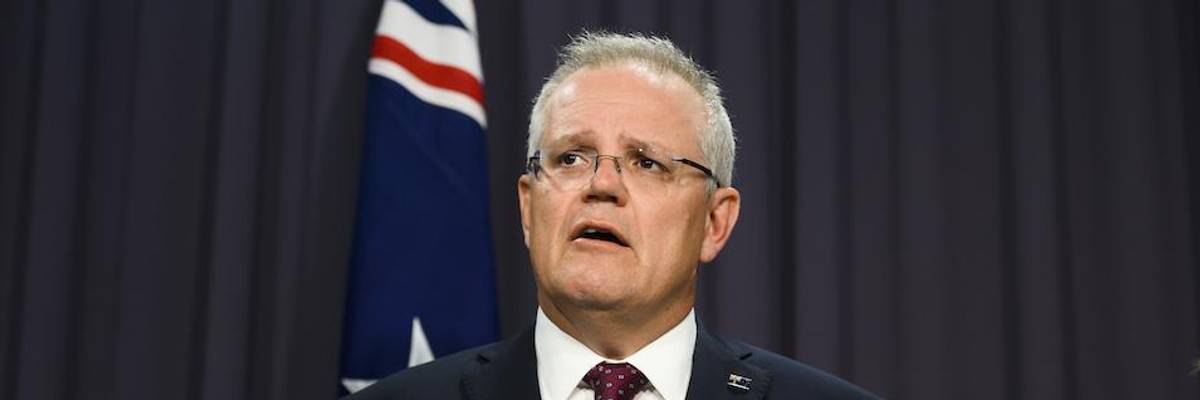
Australian Prime Minister Scott Morrison speaks during a press conference at Parliament House on January 05, 2020 in Canberra, Australia. (Photo by Rohan Thomson/Getty Images)
Climate advocates are calling on fossil fuel companies to pay for the damage caused by Australia's unprecedented bushfires rather than that country's taxpayers forking over an additional $2 billion for those affected by the crisis.
"Regular Australians should not be forced to pay while fossil fuel producers are being let off scot-free," the Australia Institute's deputy director Ebony Bennett said in a statement.
"It's disappointing that the Australian community will be left to pick up the tab for a climate-fueled disaster," she added.
Bennett, whose group is pushing for the Australian government to impose a "modest levy" on fossil fuel producing companies to cover the cost of bushfire recovery and first introduced the proposal in December, added that taxing those responsible for the climate crisis to provide the funds for disaster mitigation would "shift the economic burden of these disasters from regular Australians to the coal and gas companies that are fueling the climate crisis."
Prime Minister Scott Morrison announced Monday that the government would obtain the additional $2 billion from the country's projected $5 billion surplus for the year.
"The surplus is of no focus for me," said Morrison, whose response to the fires has been seen as, at best, insufficient by critics.
Monday's news of more aid from the government came as energy giant Chevron announced it would provide $1 million to the Australian Red Cross to aid in the group's recovery efforts.
A donation--a fraction of the company's annual revenue--is not what's needed from Chevron, tweeted TIME editor-at-large Anand Giridharadas.
"We need you to stop making a killing at the planet's expense," said Giridharadas.
In her comments, the Australia Institute's Bennett said that putting fossil fuel companies on the hook for the damage from the fires was the best way to ensure those behind the climate crisis pay for the damage.
"The government has now acknowledged the link between global warming and these disasters, so placing a modest climate disaster levy on the companies that are responsible is an important next step," said Bennett.
Dear Common Dreams reader, It’s been nearly 30 years since I co-founded Common Dreams with my late wife, Lina Newhouser. We had the radical notion that journalism should serve the public good, not corporate profits. It was clear to us from the outset what it would take to build such a project. No paid advertisements. No corporate sponsors. No millionaire publisher telling us what to think or do. Many people said we wouldn't last a year, but we proved those doubters wrong. Together with a tremendous team of journalists and dedicated staff, we built an independent media outlet free from the constraints of profits and corporate control. Our mission has always been simple: To inform. To inspire. To ignite change for the common good. Building Common Dreams was not easy. Our survival was never guaranteed. When you take on the most powerful forces—Wall Street greed, fossil fuel industry destruction, Big Tech lobbyists, and uber-rich oligarchs who have spent billions upon billions rigging the economy and democracy in their favor—the only bulwark you have is supporters who believe in your work. But here’s the urgent message from me today. It's never been this bad out there. And it's never been this hard to keep us going. At the very moment Common Dreams is most needed, the threats we face are intensifying. We need your support now more than ever. We don't accept corporate advertising and never will. We don't have a paywall because we don't think people should be blocked from critical news based on their ability to pay. Everything we do is funded by the donations of readers like you. When everyone does the little they can afford, we are strong. But if that support retreats or dries up, so do we. Will you donate now to make sure Common Dreams not only survives but thrives? —Craig Brown, Co-founder |
Climate advocates are calling on fossil fuel companies to pay for the damage caused by Australia's unprecedented bushfires rather than that country's taxpayers forking over an additional $2 billion for those affected by the crisis.
"Regular Australians should not be forced to pay while fossil fuel producers are being let off scot-free," the Australia Institute's deputy director Ebony Bennett said in a statement.
"It's disappointing that the Australian community will be left to pick up the tab for a climate-fueled disaster," she added.
Bennett, whose group is pushing for the Australian government to impose a "modest levy" on fossil fuel producing companies to cover the cost of bushfire recovery and first introduced the proposal in December, added that taxing those responsible for the climate crisis to provide the funds for disaster mitigation would "shift the economic burden of these disasters from regular Australians to the coal and gas companies that are fueling the climate crisis."
Prime Minister Scott Morrison announced Monday that the government would obtain the additional $2 billion from the country's projected $5 billion surplus for the year.
"The surplus is of no focus for me," said Morrison, whose response to the fires has been seen as, at best, insufficient by critics.
Monday's news of more aid from the government came as energy giant Chevron announced it would provide $1 million to the Australian Red Cross to aid in the group's recovery efforts.
A donation--a fraction of the company's annual revenue--is not what's needed from Chevron, tweeted TIME editor-at-large Anand Giridharadas.
"We need you to stop making a killing at the planet's expense," said Giridharadas.
In her comments, the Australia Institute's Bennett said that putting fossil fuel companies on the hook for the damage from the fires was the best way to ensure those behind the climate crisis pay for the damage.
"The government has now acknowledged the link between global warming and these disasters, so placing a modest climate disaster levy on the companies that are responsible is an important next step," said Bennett.
Climate advocates are calling on fossil fuel companies to pay for the damage caused by Australia's unprecedented bushfires rather than that country's taxpayers forking over an additional $2 billion for those affected by the crisis.
"Regular Australians should not be forced to pay while fossil fuel producers are being let off scot-free," the Australia Institute's deputy director Ebony Bennett said in a statement.
"It's disappointing that the Australian community will be left to pick up the tab for a climate-fueled disaster," she added.
Bennett, whose group is pushing for the Australian government to impose a "modest levy" on fossil fuel producing companies to cover the cost of bushfire recovery and first introduced the proposal in December, added that taxing those responsible for the climate crisis to provide the funds for disaster mitigation would "shift the economic burden of these disasters from regular Australians to the coal and gas companies that are fueling the climate crisis."
Prime Minister Scott Morrison announced Monday that the government would obtain the additional $2 billion from the country's projected $5 billion surplus for the year.
"The surplus is of no focus for me," said Morrison, whose response to the fires has been seen as, at best, insufficient by critics.
Monday's news of more aid from the government came as energy giant Chevron announced it would provide $1 million to the Australian Red Cross to aid in the group's recovery efforts.
A donation--a fraction of the company's annual revenue--is not what's needed from Chevron, tweeted TIME editor-at-large Anand Giridharadas.
"We need you to stop making a killing at the planet's expense," said Giridharadas.
In her comments, the Australia Institute's Bennett said that putting fossil fuel companies on the hook for the damage from the fires was the best way to ensure those behind the climate crisis pay for the damage.
"The government has now acknowledged the link between global warming and these disasters, so placing a modest climate disaster levy on the companies that are responsible is an important next step," said Bennett.