SUBSCRIBE TO OUR FREE NEWSLETTER
Daily news & progressive opinion—funded by the people, not the corporations—delivered straight to your inbox.
5
#000000
#FFFFFF
To donate by check, phone, or other method, see our More Ways to Give page.
Daily news & progressive opinion—funded by the people, not the corporations—delivered straight to your inbox.
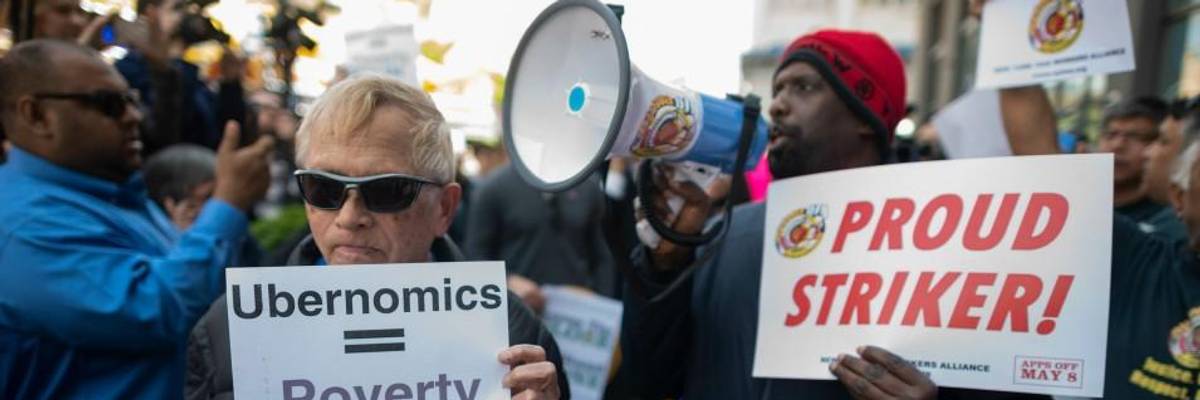
Drivers take part in a rally demanding more job security and livable incomes at Uber and Lyft New York City headquarters on May 8, 2019. (Photo: Johannes Eisele/AFP/Getty Images)
Pro-labor state lawmakers in California derided the Silicon Valley companies Uber and Postmates as "greedy" on Tuesday after the corporations filed a federal lawsuit to block the state's new law protecting freelancers from taking effect.
Assembly Bill 5 is set to enter into force on Wednesday, but the two companies are seeking an injunction and asking for more time to negotiate a deal with the state regarding how they must treat their workers.
Under the bill, all companies in California would be required to classify their workers as employees rather than independent contractors in most cases. Companies in the "gig economy-- including Uber, Postmates, and Lyft--would have to provide their drivers with the state minimum wage of $12 per hour, protect them with overtime rules, workers' compensation, and unemployment insurance, and contribute payroll taxes for Medicare and Social Security.
The attempt by Uber and Postmates to block the law amounts to "nothing but a greedy scheme to avoid paying workers the wages and benefits they are owed," said state Assembly Speaker Anthony Rendon on Tuesday.
Uber and Postmates, along with two of their workers who joined the suit, argued in court filings that A.B. 5 is unfair because certain companies are exempt from the law; the rules would apply to companies which control when and how their employees work and to employees whose work is essential to the companies' business.
The companies claimed that state Assemblywoman Lorena Gonzalez, the author of A.B. 5, acted "irrationally" when she "attacked" the gig economy, in which poverty wages have forced some Uber drivers into homelessness.
"This hostility toward the on-demand economy held by Assemblywoman Gonzalez and many of her colleagues in the California legislature ultimately led to the passage of A.B. 5," Uber and Postmates said in their lawsuit.
Gonzalez embraced the accusation on Twitter, writing, "I did, and do" call the companies "bad employers."
The characterization of Gonzalez as "irrational" was "kind of a strange way to characterize a lawmaker doing public policy," tweeted Avi Asher-Schapiro of the Committee to Protect Journalists.
In a statement, Gonzalez condemned the "bizarre" effort by Uber and Postmates to portray A.B. 5 as unconstitutional.
"The one clear thing we know about Uber is they will do anything to try to exempt themselves from state regulations that make us all safer and their driver employees self-sufficient," Gonzalez said, an apparent reference to Uber's claim shortly after A.B. 5 passed in September that the law would not apply to the company.
The United Food and Commercial Workers Western States Council, which represents more than 200,000 workers in California, Nevada, Utah, and Arizona, said the lawsuit was an attempt by the companies "to delay accountability."
"Gig companies like Uber and Postmates are literally banking on the exploitation of workers who live beneath the poverty line, who sleep in their cars, and who worry about having enough money for their next meal," said Andrea Zinder, president of the Council. "Workers showed their strength when they stood together to pass this landmark law, and UFCW members will continue to stand behind A.B. 5 to ensure workers across California can protect their workplace rights."
Dear Common Dreams reader, It’s been nearly 30 years since I co-founded Common Dreams with my late wife, Lina Newhouser. We had the radical notion that journalism should serve the public good, not corporate profits. It was clear to us from the outset what it would take to build such a project. No paid advertisements. No corporate sponsors. No millionaire publisher telling us what to think or do. Many people said we wouldn't last a year, but we proved those doubters wrong. Together with a tremendous team of journalists and dedicated staff, we built an independent media outlet free from the constraints of profits and corporate control. Our mission has always been simple: To inform. To inspire. To ignite change for the common good. Building Common Dreams was not easy. Our survival was never guaranteed. When you take on the most powerful forces—Wall Street greed, fossil fuel industry destruction, Big Tech lobbyists, and uber-rich oligarchs who have spent billions upon billions rigging the economy and democracy in their favor—the only bulwark you have is supporters who believe in your work. But here’s the urgent message from me today. It's never been this bad out there. And it's never been this hard to keep us going. At the very moment Common Dreams is most needed, the threats we face are intensifying. We need your support now more than ever. We don't accept corporate advertising and never will. We don't have a paywall because we don't think people should be blocked from critical news based on their ability to pay. Everything we do is funded by the donations of readers like you. When everyone does the little they can afford, we are strong. But if that support retreats or dries up, so do we. Will you donate now to make sure Common Dreams not only survives but thrives? —Craig Brown, Co-founder |
Pro-labor state lawmakers in California derided the Silicon Valley companies Uber and Postmates as "greedy" on Tuesday after the corporations filed a federal lawsuit to block the state's new law protecting freelancers from taking effect.
Assembly Bill 5 is set to enter into force on Wednesday, but the two companies are seeking an injunction and asking for more time to negotiate a deal with the state regarding how they must treat their workers.
Under the bill, all companies in California would be required to classify their workers as employees rather than independent contractors in most cases. Companies in the "gig economy-- including Uber, Postmates, and Lyft--would have to provide their drivers with the state minimum wage of $12 per hour, protect them with overtime rules, workers' compensation, and unemployment insurance, and contribute payroll taxes for Medicare and Social Security.
The attempt by Uber and Postmates to block the law amounts to "nothing but a greedy scheme to avoid paying workers the wages and benefits they are owed," said state Assembly Speaker Anthony Rendon on Tuesday.
Uber and Postmates, along with two of their workers who joined the suit, argued in court filings that A.B. 5 is unfair because certain companies are exempt from the law; the rules would apply to companies which control when and how their employees work and to employees whose work is essential to the companies' business.
The companies claimed that state Assemblywoman Lorena Gonzalez, the author of A.B. 5, acted "irrationally" when she "attacked" the gig economy, in which poverty wages have forced some Uber drivers into homelessness.
"This hostility toward the on-demand economy held by Assemblywoman Gonzalez and many of her colleagues in the California legislature ultimately led to the passage of A.B. 5," Uber and Postmates said in their lawsuit.
Gonzalez embraced the accusation on Twitter, writing, "I did, and do" call the companies "bad employers."
The characterization of Gonzalez as "irrational" was "kind of a strange way to characterize a lawmaker doing public policy," tweeted Avi Asher-Schapiro of the Committee to Protect Journalists.
In a statement, Gonzalez condemned the "bizarre" effort by Uber and Postmates to portray A.B. 5 as unconstitutional.
"The one clear thing we know about Uber is they will do anything to try to exempt themselves from state regulations that make us all safer and their driver employees self-sufficient," Gonzalez said, an apparent reference to Uber's claim shortly after A.B. 5 passed in September that the law would not apply to the company.
The United Food and Commercial Workers Western States Council, which represents more than 200,000 workers in California, Nevada, Utah, and Arizona, said the lawsuit was an attempt by the companies "to delay accountability."
"Gig companies like Uber and Postmates are literally banking on the exploitation of workers who live beneath the poverty line, who sleep in their cars, and who worry about having enough money for their next meal," said Andrea Zinder, president of the Council. "Workers showed their strength when they stood together to pass this landmark law, and UFCW members will continue to stand behind A.B. 5 to ensure workers across California can protect their workplace rights."
Pro-labor state lawmakers in California derided the Silicon Valley companies Uber and Postmates as "greedy" on Tuesday after the corporations filed a federal lawsuit to block the state's new law protecting freelancers from taking effect.
Assembly Bill 5 is set to enter into force on Wednesday, but the two companies are seeking an injunction and asking for more time to negotiate a deal with the state regarding how they must treat their workers.
Under the bill, all companies in California would be required to classify their workers as employees rather than independent contractors in most cases. Companies in the "gig economy-- including Uber, Postmates, and Lyft--would have to provide their drivers with the state minimum wage of $12 per hour, protect them with overtime rules, workers' compensation, and unemployment insurance, and contribute payroll taxes for Medicare and Social Security.
The attempt by Uber and Postmates to block the law amounts to "nothing but a greedy scheme to avoid paying workers the wages and benefits they are owed," said state Assembly Speaker Anthony Rendon on Tuesday.
Uber and Postmates, along with two of their workers who joined the suit, argued in court filings that A.B. 5 is unfair because certain companies are exempt from the law; the rules would apply to companies which control when and how their employees work and to employees whose work is essential to the companies' business.
The companies claimed that state Assemblywoman Lorena Gonzalez, the author of A.B. 5, acted "irrationally" when she "attacked" the gig economy, in which poverty wages have forced some Uber drivers into homelessness.
"This hostility toward the on-demand economy held by Assemblywoman Gonzalez and many of her colleagues in the California legislature ultimately led to the passage of A.B. 5," Uber and Postmates said in their lawsuit.
Gonzalez embraced the accusation on Twitter, writing, "I did, and do" call the companies "bad employers."
The characterization of Gonzalez as "irrational" was "kind of a strange way to characterize a lawmaker doing public policy," tweeted Avi Asher-Schapiro of the Committee to Protect Journalists.
In a statement, Gonzalez condemned the "bizarre" effort by Uber and Postmates to portray A.B. 5 as unconstitutional.
"The one clear thing we know about Uber is they will do anything to try to exempt themselves from state regulations that make us all safer and their driver employees self-sufficient," Gonzalez said, an apparent reference to Uber's claim shortly after A.B. 5 passed in September that the law would not apply to the company.
The United Food and Commercial Workers Western States Council, which represents more than 200,000 workers in California, Nevada, Utah, and Arizona, said the lawsuit was an attempt by the companies "to delay accountability."
"Gig companies like Uber and Postmates are literally banking on the exploitation of workers who live beneath the poverty line, who sleep in their cars, and who worry about having enough money for their next meal," said Andrea Zinder, president of the Council. "Workers showed their strength when they stood together to pass this landmark law, and UFCW members will continue to stand behind A.B. 5 to ensure workers across California can protect their workplace rights."