SUBSCRIBE TO OUR FREE NEWSLETTER
Daily news & progressive opinion—funded by the people, not the corporations—delivered straight to your inbox.
5
#000000
#FFFFFF
To donate by check, phone, or other method, see our More Ways to Give page.
Daily news & progressive opinion—funded by the people, not the corporations—delivered straight to your inbox.
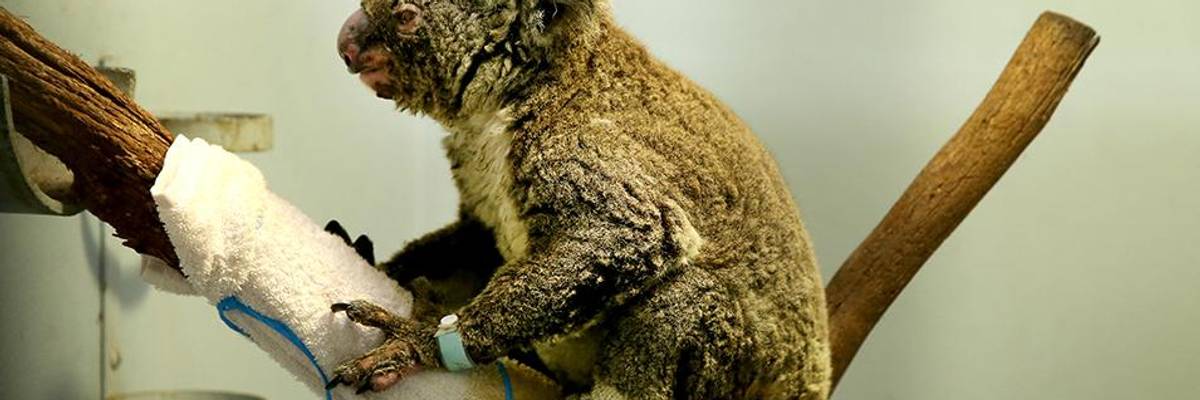
Female koala Anwen recovering from burns at The Port Macquarie Koala Hospital in Port Macquarie, Australia. Volunteers from the Koala Hospital have been working alongside National Parks and Wildlife Service crews searching for koalas following weeks of devastating bushfires across New South Wales and Queensland. Koalas rescued from fire grounds have been brought back to the hospital for treatment. An estimated million hectares of land has been burned by bushfire across Australia following catastrophic fire conditions in recent weeks, killing thousands of koalas along with other wildlife. (Photo by Nathan Edwards/Getty Images)
Australia is still on fire.
And now thousands of koalas are feared to have died in a wildfire-ravaged area north of Sydney.
"Up to 30 percent of their habitat has been destroyed," Environment Minister Sussan Ley told the Australian Broadcasting Corporation Friday. "We'll know more when the fires are calmed down and a proper assessment can be made." Land clearing and development over time has meant a loss of habitat for the tree-dwelling koalas.
Last year, a World Wide Fund for Nature (WWF) Australia report said there were fewer than 20,000 koalas left in New South Wales and they risked becoming extinct as early as 2050, largely because of "excessive tree-clearing for farming." Minister Ley said up to 30% of the koalas in the region had been killed in recent days.
Australia has just endured a heatwave that broke records for highest temperature ever for consecutive days. And the fires accelerated on Saturday in the country's east as temperatures soared.
"I think this is the single loudest alarm bell I've ever heard on global heating," said Kees van der Leun, a director at the American consultancy firm Navigant.
Common Dreams has reported that Australian Prime Minister Scott Morrison attacked environmental activists in a November speech, warning of a "new breed of radical activism" that was "apocalyptic in tone" and pledging to outlaw boycott campaigns that he argued could hurt the country's mining industry.
"We are working to identify mechanisms that can successfully outlaw these indulgent and selfish practices that threaten the livelihoods of fellow Australians, especially in rural and regional areas," Morrison said. "New threats to the future of the resources sector have emerged," he said. "A new breed of radical activism is on the march. Apocalyptic in tone. It brooks no compromise. It's all or nothing."
Dear Common Dreams reader, It’s been nearly 30 years since I co-founded Common Dreams with my late wife, Lina Newhouser. We had the radical notion that journalism should serve the public good, not corporate profits. It was clear to us from the outset what it would take to build such a project. No paid advertisements. No corporate sponsors. No millionaire publisher telling us what to think or do. Many people said we wouldn't last a year, but we proved those doubters wrong. Together with a tremendous team of journalists and dedicated staff, we built an independent media outlet free from the constraints of profits and corporate control. Our mission has always been simple: To inform. To inspire. To ignite change for the common good. Building Common Dreams was not easy. Our survival was never guaranteed. When you take on the most powerful forces—Wall Street greed, fossil fuel industry destruction, Big Tech lobbyists, and uber-rich oligarchs who have spent billions upon billions rigging the economy and democracy in their favor—the only bulwark you have is supporters who believe in your work. But here’s the urgent message from me today. It's never been this bad out there. And it's never been this hard to keep us going. At the very moment Common Dreams is most needed, the threats we face are intensifying. We need your support now more than ever. We don't accept corporate advertising and never will. We don't have a paywall because we don't think people should be blocked from critical news based on their ability to pay. Everything we do is funded by the donations of readers like you. When everyone does the little they can afford, we are strong. But if that support retreats or dries up, so do we. Will you donate now to make sure Common Dreams not only survives but thrives? —Craig Brown, Co-founder |
Australia is still on fire.
And now thousands of koalas are feared to have died in a wildfire-ravaged area north of Sydney.
"Up to 30 percent of their habitat has been destroyed," Environment Minister Sussan Ley told the Australian Broadcasting Corporation Friday. "We'll know more when the fires are calmed down and a proper assessment can be made." Land clearing and development over time has meant a loss of habitat for the tree-dwelling koalas.
Last year, a World Wide Fund for Nature (WWF) Australia report said there were fewer than 20,000 koalas left in New South Wales and they risked becoming extinct as early as 2050, largely because of "excessive tree-clearing for farming." Minister Ley said up to 30% of the koalas in the region had been killed in recent days.
Australia has just endured a heatwave that broke records for highest temperature ever for consecutive days. And the fires accelerated on Saturday in the country's east as temperatures soared.
"I think this is the single loudest alarm bell I've ever heard on global heating," said Kees van der Leun, a director at the American consultancy firm Navigant.
Common Dreams has reported that Australian Prime Minister Scott Morrison attacked environmental activists in a November speech, warning of a "new breed of radical activism" that was "apocalyptic in tone" and pledging to outlaw boycott campaigns that he argued could hurt the country's mining industry.
"We are working to identify mechanisms that can successfully outlaw these indulgent and selfish practices that threaten the livelihoods of fellow Australians, especially in rural and regional areas," Morrison said. "New threats to the future of the resources sector have emerged," he said. "A new breed of radical activism is on the march. Apocalyptic in tone. It brooks no compromise. It's all or nothing."
Australia is still on fire.
And now thousands of koalas are feared to have died in a wildfire-ravaged area north of Sydney.
"Up to 30 percent of their habitat has been destroyed," Environment Minister Sussan Ley told the Australian Broadcasting Corporation Friday. "We'll know more when the fires are calmed down and a proper assessment can be made." Land clearing and development over time has meant a loss of habitat for the tree-dwelling koalas.
Last year, a World Wide Fund for Nature (WWF) Australia report said there were fewer than 20,000 koalas left in New South Wales and they risked becoming extinct as early as 2050, largely because of "excessive tree-clearing for farming." Minister Ley said up to 30% of the koalas in the region had been killed in recent days.
Australia has just endured a heatwave that broke records for highest temperature ever for consecutive days. And the fires accelerated on Saturday in the country's east as temperatures soared.
"I think this is the single loudest alarm bell I've ever heard on global heating," said Kees van der Leun, a director at the American consultancy firm Navigant.
Common Dreams has reported that Australian Prime Minister Scott Morrison attacked environmental activists in a November speech, warning of a "new breed of radical activism" that was "apocalyptic in tone" and pledging to outlaw boycott campaigns that he argued could hurt the country's mining industry.
"We are working to identify mechanisms that can successfully outlaw these indulgent and selfish practices that threaten the livelihoods of fellow Australians, especially in rural and regional areas," Morrison said. "New threats to the future of the resources sector have emerged," he said. "A new breed of radical activism is on the march. Apocalyptic in tone. It brooks no compromise. It's all or nothing."