

SUBSCRIBE TO OUR FREE NEWSLETTER
Daily news & progressive opinion—funded by the people, not the corporations—delivered straight to your inbox.
5
#000000
#FFFFFF
To donate by check, phone, or other method, see our More Ways to Give page.
Daily news & progressive opinion—funded by the people, not the corporations—delivered straight to your inbox.
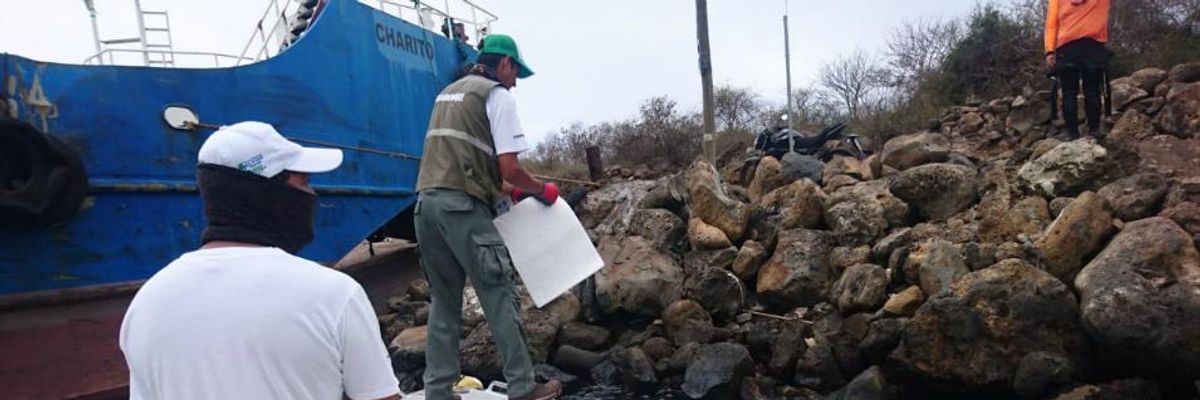
Ecuadorian officials took emergency action Sunday to contain an oil spill in the Galapagos Islands. (Photo: Nacional Galapagos/Twitter)
A ship carrying 600 gallons of diesel fuel sank in the Galapagos Islands Sunday, sparking widespread concerns about the impact on local wildlife and the environment as Ecuadorian officials took emergency action to contain the spill.
"A crane collapsed onto an oil barge in a port off San Cristobal Island on Sunday, destabilizing the vessel and causing it to sink," reported German broadcaster DW, citing local media. "Crew members jumped from the ship into the ocean to save themselves. One person was injured."
The presidential communications office said in a statement that "the situation is under control, and a series of actions have been deployed to mitigate the possible effects."
Watch the moment the barge capsized:
The Galapagos National Park tweeted Sunday afternoon that its officials were working with the Ecuadorian Navy to use "containment barriers and absorbent cloths to reduce the environmental risk from sinking of the Orca barge."
In response, local advocacy group SOS Galapagos wrote that "the illegal and dangerous logistics operation carried out on the property must be moved to another site. Fuels and oils spilled in this accident will reach Mann beach, the only beach in the urban area of [Puerto] Baquerizo."
A UNESCO World Heritage site, the Galapagos Islands are part of Ecuador and recognized worldwide for the role they played in Charles Darwin's research that informed his theory of evolution. The ecosystem on the more than 100 islands is highly fragile.
"The Galapagos Island are home to some of the highest levels of endemism (species found nowhere else on Earth) anywhere on the planet," according to Galapagos Conservancy. "About 80% of the land birds you will see, 97% of the reptiles and land mammals, and more than 30% of the plants are endemic. More than 20% of the marine species in Galapagos are found nowhere else on earth."
Those species include the giant Galapagos tortoise, marine iguana, and various birds. Reporting on the oil spill Monday, CNN noted that the site of the incident, San Cristobal, "is home to playful sea lions, giant tortoises, and finches, and idyllic beaches. Like most of the islands in the archipelago, travelers there must abide by strict rules in order to protect the flora and fauna."
Dear Common Dreams reader, It’s been nearly 30 years since I co-founded Common Dreams with my late wife, Lina Newhouser. We had the radical notion that journalism should serve the public good, not corporate profits. It was clear to us from the outset what it would take to build such a project. No paid advertisements. No corporate sponsors. No millionaire publisher telling us what to think or do. Many people said we wouldn't last a year, but we proved those doubters wrong. Together with a tremendous team of journalists and dedicated staff, we built an independent media outlet free from the constraints of profits and corporate control. Our mission has always been simple: To inform. To inspire. To ignite change for the common good. Building Common Dreams was not easy. Our survival was never guaranteed. When you take on the most powerful forces—Wall Street greed, fossil fuel industry destruction, Big Tech lobbyists, and uber-rich oligarchs who have spent billions upon billions rigging the economy and democracy in their favor—the only bulwark you have is supporters who believe in your work. But here’s the urgent message from me today. It's never been this bad out there. And it's never been this hard to keep us going. At the very moment Common Dreams is most needed, the threats we face are intensifying. We need your support now more than ever. We don't accept corporate advertising and never will. We don't have a paywall because we don't think people should be blocked from critical news based on their ability to pay. Everything we do is funded by the donations of readers like you. When everyone does the little they can afford, we are strong. But if that support retreats or dries up, so do we. Will you donate now to make sure Common Dreams not only survives but thrives? —Craig Brown, Co-founder |
A ship carrying 600 gallons of diesel fuel sank in the Galapagos Islands Sunday, sparking widespread concerns about the impact on local wildlife and the environment as Ecuadorian officials took emergency action to contain the spill.
"A crane collapsed onto an oil barge in a port off San Cristobal Island on Sunday, destabilizing the vessel and causing it to sink," reported German broadcaster DW, citing local media. "Crew members jumped from the ship into the ocean to save themselves. One person was injured."
The presidential communications office said in a statement that "the situation is under control, and a series of actions have been deployed to mitigate the possible effects."
Watch the moment the barge capsized:
The Galapagos National Park tweeted Sunday afternoon that its officials were working with the Ecuadorian Navy to use "containment barriers and absorbent cloths to reduce the environmental risk from sinking of the Orca barge."
In response, local advocacy group SOS Galapagos wrote that "the illegal and dangerous logistics operation carried out on the property must be moved to another site. Fuels and oils spilled in this accident will reach Mann beach, the only beach in the urban area of [Puerto] Baquerizo."
A UNESCO World Heritage site, the Galapagos Islands are part of Ecuador and recognized worldwide for the role they played in Charles Darwin's research that informed his theory of evolution. The ecosystem on the more than 100 islands is highly fragile.
"The Galapagos Island are home to some of the highest levels of endemism (species found nowhere else on Earth) anywhere on the planet," according to Galapagos Conservancy. "About 80% of the land birds you will see, 97% of the reptiles and land mammals, and more than 30% of the plants are endemic. More than 20% of the marine species in Galapagos are found nowhere else on earth."
Those species include the giant Galapagos tortoise, marine iguana, and various birds. Reporting on the oil spill Monday, CNN noted that the site of the incident, San Cristobal, "is home to playful sea lions, giant tortoises, and finches, and idyllic beaches. Like most of the islands in the archipelago, travelers there must abide by strict rules in order to protect the flora and fauna."
A ship carrying 600 gallons of diesel fuel sank in the Galapagos Islands Sunday, sparking widespread concerns about the impact on local wildlife and the environment as Ecuadorian officials took emergency action to contain the spill.
"A crane collapsed onto an oil barge in a port off San Cristobal Island on Sunday, destabilizing the vessel and causing it to sink," reported German broadcaster DW, citing local media. "Crew members jumped from the ship into the ocean to save themselves. One person was injured."
The presidential communications office said in a statement that "the situation is under control, and a series of actions have been deployed to mitigate the possible effects."
Watch the moment the barge capsized:
The Galapagos National Park tweeted Sunday afternoon that its officials were working with the Ecuadorian Navy to use "containment barriers and absorbent cloths to reduce the environmental risk from sinking of the Orca barge."
In response, local advocacy group SOS Galapagos wrote that "the illegal and dangerous logistics operation carried out on the property must be moved to another site. Fuels and oils spilled in this accident will reach Mann beach, the only beach in the urban area of [Puerto] Baquerizo."
A UNESCO World Heritage site, the Galapagos Islands are part of Ecuador and recognized worldwide for the role they played in Charles Darwin's research that informed his theory of evolution. The ecosystem on the more than 100 islands is highly fragile.
"The Galapagos Island are home to some of the highest levels of endemism (species found nowhere else on Earth) anywhere on the planet," according to Galapagos Conservancy. "About 80% of the land birds you will see, 97% of the reptiles and land mammals, and more than 30% of the plants are endemic. More than 20% of the marine species in Galapagos are found nowhere else on earth."
Those species include the giant Galapagos tortoise, marine iguana, and various birds. Reporting on the oil spill Monday, CNN noted that the site of the incident, San Cristobal, "is home to playful sea lions, giant tortoises, and finches, and idyllic beaches. Like most of the islands in the archipelago, travelers there must abide by strict rules in order to protect the flora and fauna."

