SUBSCRIBE TO OUR FREE NEWSLETTER
Daily news & progressive opinion—funded by the people, not the corporations—delivered straight to your inbox.
5
#000000
#FFFFFF
To donate by check, phone, or other method, see our More Ways to Give page.
Daily news & progressive opinion—funded by the people, not the corporations—delivered straight to your inbox.
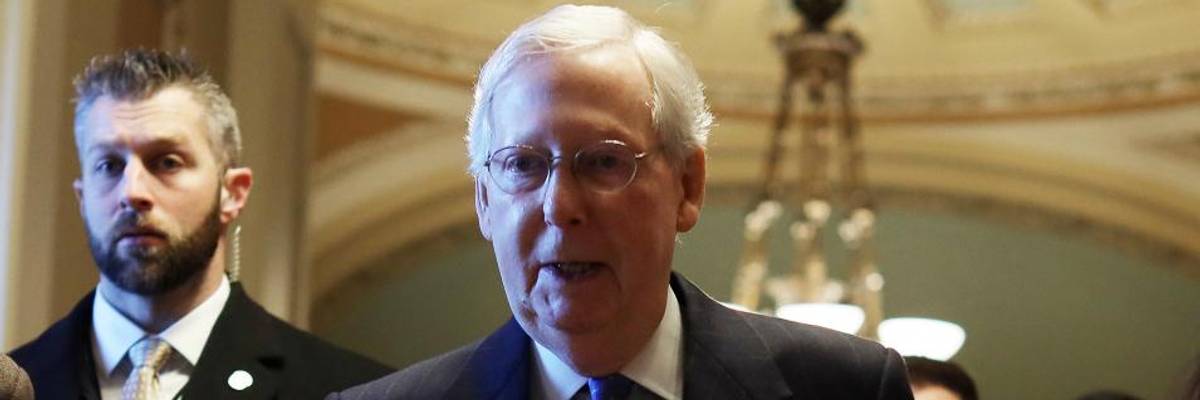
U.S. Senate Majority Leader Sen. Mitch McConnell (R-KY) (C) walks back to his office after he gave remarks in the Senate chamber December 19, 2019 at the U.S. Capitol in Washington, DC. McConnell criticized Speaker of the House Rep. Nancy Pelosi (D-CA) of delaying to send the Senate the impeachment articles charging President Donald Trump with abuse of power and obstruction of Congress. (Photo: Alex Wong/Getty Images)
What was issued as a warning could just as well be taken as a threat.
Republican Senate Majority Leader Mitch McConnell on Thursday morning openly signaled his party's willingness to engage in an "endless parade" of meaningless impeachment efforts against future Democratic presidents as he defended his insistence that there are no substantive grounds for Wednesday night's historic impeachment vote against President Donald Trump.
McConnell accused Democrats of carrying out a "slapdash impeachment" process in the House, and oddly--given the overtly partisan nature of the Bill Clinton impeachment process--called the Wednesday night's passage "the first purely partisan presidential impeachment since the wake of the civil war."
"Frankly, if either of these articles is blessed by the Senate, we could easily see the impeachment of every future president of either party," McConnell said. "Let me say that again: If the Senate blesses this historically low bar, we will invite the impeachment of every future president."
The Republican leader added that impeaching Trump would create a "toxic new precedent that will echo well into the future" and subsequently warned "an endless parade of impeachment trials" was likely to follow if Republicans do not get their way and the president was held to account for his alleged misconduct.
In his response to McConnell, Senate Minority Leader Chuck Schumer (D-N.Y.) argued the position taken so far by his Republican colleagues was an affront to their constitutional obligations.
If Trump can commit "crimes with impunity," said Schumer, "others can" as well. "I have little doubt that if we tell the president he can escape scrutiny in this instance," Schumer warned, "he will do it again and again and again."
Over 750 legal scholars on Tuesday said Trump's violations represent a "clear and present danger" to the U.S. Constitution and in a letter stated without equivocation that if the president's blatant "misconduct does not rise to the level of impeachment, then virtually nothing does."
In terms of McConnell's commitment to partisan norms, he remains the Republican Senator who said his party's legislative commitment during President Barack Obama's first term was to make sure it was his only term. In Obama's second term, it was McConnell as Senate Majority Leader who refused to allow a vote on Obama's Supreme Court nominee, Merrick Garland, for 293 days.
Meanwhile, McConnell remains under intense scrutiny about the kind of trial he would run in the Senate.
According to Politico:
The Kentucky Republican has rejected Schumer's demands to agree on witnesses and trial debate structure simultaneously. And his vow to coordinate closely with the White House has infuriated [House Speaker Nancy] Pelosi and House Democrats.
Shortly after the House impeached Trump Wednesday night, Pelosi refused to commit to sending McConnell the articles charging abuse of power and obstruction of Congress, arguing that Democrats "haven't seen anything that looks fair to us."
At a press conference following McConnell's Thursday morning Senate floor speech, Pelosi said she will continue to refrain from sending the articles of impeachment formally to the U.S. Senate until she has a better idea of how the rules for the trial will look.
After a reporter asked Pelosi whether or not she was concerned over the Republican's accusation that she is playing politics with impeachment, the Speaker said: "Frankly, I don't care what the Republicans say."
Directly referencing McConnell's remarks, Pelosi said, "It reminded me that our founders, when they wrote the Constitution, they suspected there could be a rogue president."
But, she added, "I don't think they suspected we could have a rogue president and a rogue leader in the senate at the same time."
Dear Common Dreams reader, It’s been nearly 30 years since I co-founded Common Dreams with my late wife, Lina Newhouser. We had the radical notion that journalism should serve the public good, not corporate profits. It was clear to us from the outset what it would take to build such a project. No paid advertisements. No corporate sponsors. No millionaire publisher telling us what to think or do. Many people said we wouldn't last a year, but we proved those doubters wrong. Together with a tremendous team of journalists and dedicated staff, we built an independent media outlet free from the constraints of profits and corporate control. Our mission has always been simple: To inform. To inspire. To ignite change for the common good. Building Common Dreams was not easy. Our survival was never guaranteed. When you take on the most powerful forces—Wall Street greed, fossil fuel industry destruction, Big Tech lobbyists, and uber-rich oligarchs who have spent billions upon billions rigging the economy and democracy in their favor—the only bulwark you have is supporters who believe in your work. But here’s the urgent message from me today. It's never been this bad out there. And it's never been this hard to keep us going. At the very moment Common Dreams is most needed, the threats we face are intensifying. We need your support now more than ever. We don't accept corporate advertising and never will. We don't have a paywall because we don't think people should be blocked from critical news based on their ability to pay. Everything we do is funded by the donations of readers like you. When everyone does the little they can afford, we are strong. But if that support retreats or dries up, so do we. Will you donate now to make sure Common Dreams not only survives but thrives? —Craig Brown, Co-founder |
What was issued as a warning could just as well be taken as a threat.
Republican Senate Majority Leader Mitch McConnell on Thursday morning openly signaled his party's willingness to engage in an "endless parade" of meaningless impeachment efforts against future Democratic presidents as he defended his insistence that there are no substantive grounds for Wednesday night's historic impeachment vote against President Donald Trump.
McConnell accused Democrats of carrying out a "slapdash impeachment" process in the House, and oddly--given the overtly partisan nature of the Bill Clinton impeachment process--called the Wednesday night's passage "the first purely partisan presidential impeachment since the wake of the civil war."
"Frankly, if either of these articles is blessed by the Senate, we could easily see the impeachment of every future president of either party," McConnell said. "Let me say that again: If the Senate blesses this historically low bar, we will invite the impeachment of every future president."
The Republican leader added that impeaching Trump would create a "toxic new precedent that will echo well into the future" and subsequently warned "an endless parade of impeachment trials" was likely to follow if Republicans do not get their way and the president was held to account for his alleged misconduct.
In his response to McConnell, Senate Minority Leader Chuck Schumer (D-N.Y.) argued the position taken so far by his Republican colleagues was an affront to their constitutional obligations.
If Trump can commit "crimes with impunity," said Schumer, "others can" as well. "I have little doubt that if we tell the president he can escape scrutiny in this instance," Schumer warned, "he will do it again and again and again."
Over 750 legal scholars on Tuesday said Trump's violations represent a "clear and present danger" to the U.S. Constitution and in a letter stated without equivocation that if the president's blatant "misconduct does not rise to the level of impeachment, then virtually nothing does."
In terms of McConnell's commitment to partisan norms, he remains the Republican Senator who said his party's legislative commitment during President Barack Obama's first term was to make sure it was his only term. In Obama's second term, it was McConnell as Senate Majority Leader who refused to allow a vote on Obama's Supreme Court nominee, Merrick Garland, for 293 days.
Meanwhile, McConnell remains under intense scrutiny about the kind of trial he would run in the Senate.
According to Politico:
The Kentucky Republican has rejected Schumer's demands to agree on witnesses and trial debate structure simultaneously. And his vow to coordinate closely with the White House has infuriated [House Speaker Nancy] Pelosi and House Democrats.
Shortly after the House impeached Trump Wednesday night, Pelosi refused to commit to sending McConnell the articles charging abuse of power and obstruction of Congress, arguing that Democrats "haven't seen anything that looks fair to us."
At a press conference following McConnell's Thursday morning Senate floor speech, Pelosi said she will continue to refrain from sending the articles of impeachment formally to the U.S. Senate until she has a better idea of how the rules for the trial will look.
After a reporter asked Pelosi whether or not she was concerned over the Republican's accusation that she is playing politics with impeachment, the Speaker said: "Frankly, I don't care what the Republicans say."
Directly referencing McConnell's remarks, Pelosi said, "It reminded me that our founders, when they wrote the Constitution, they suspected there could be a rogue president."
But, she added, "I don't think they suspected we could have a rogue president and a rogue leader in the senate at the same time."
What was issued as a warning could just as well be taken as a threat.
Republican Senate Majority Leader Mitch McConnell on Thursday morning openly signaled his party's willingness to engage in an "endless parade" of meaningless impeachment efforts against future Democratic presidents as he defended his insistence that there are no substantive grounds for Wednesday night's historic impeachment vote against President Donald Trump.
McConnell accused Democrats of carrying out a "slapdash impeachment" process in the House, and oddly--given the overtly partisan nature of the Bill Clinton impeachment process--called the Wednesday night's passage "the first purely partisan presidential impeachment since the wake of the civil war."
"Frankly, if either of these articles is blessed by the Senate, we could easily see the impeachment of every future president of either party," McConnell said. "Let me say that again: If the Senate blesses this historically low bar, we will invite the impeachment of every future president."
The Republican leader added that impeaching Trump would create a "toxic new precedent that will echo well into the future" and subsequently warned "an endless parade of impeachment trials" was likely to follow if Republicans do not get their way and the president was held to account for his alleged misconduct.
In his response to McConnell, Senate Minority Leader Chuck Schumer (D-N.Y.) argued the position taken so far by his Republican colleagues was an affront to their constitutional obligations.
If Trump can commit "crimes with impunity," said Schumer, "others can" as well. "I have little doubt that if we tell the president he can escape scrutiny in this instance," Schumer warned, "he will do it again and again and again."
Over 750 legal scholars on Tuesday said Trump's violations represent a "clear and present danger" to the U.S. Constitution and in a letter stated without equivocation that if the president's blatant "misconduct does not rise to the level of impeachment, then virtually nothing does."
In terms of McConnell's commitment to partisan norms, he remains the Republican Senator who said his party's legislative commitment during President Barack Obama's first term was to make sure it was his only term. In Obama's second term, it was McConnell as Senate Majority Leader who refused to allow a vote on Obama's Supreme Court nominee, Merrick Garland, for 293 days.
Meanwhile, McConnell remains under intense scrutiny about the kind of trial he would run in the Senate.
According to Politico:
The Kentucky Republican has rejected Schumer's demands to agree on witnesses and trial debate structure simultaneously. And his vow to coordinate closely with the White House has infuriated [House Speaker Nancy] Pelosi and House Democrats.
Shortly after the House impeached Trump Wednesday night, Pelosi refused to commit to sending McConnell the articles charging abuse of power and obstruction of Congress, arguing that Democrats "haven't seen anything that looks fair to us."
At a press conference following McConnell's Thursday morning Senate floor speech, Pelosi said she will continue to refrain from sending the articles of impeachment formally to the U.S. Senate until she has a better idea of how the rules for the trial will look.
After a reporter asked Pelosi whether or not she was concerned over the Republican's accusation that she is playing politics with impeachment, the Speaker said: "Frankly, I don't care what the Republicans say."
Directly referencing McConnell's remarks, Pelosi said, "It reminded me that our founders, when they wrote the Constitution, they suspected there could be a rogue president."
But, she added, "I don't think they suspected we could have a rogue president and a rogue leader in the senate at the same time."