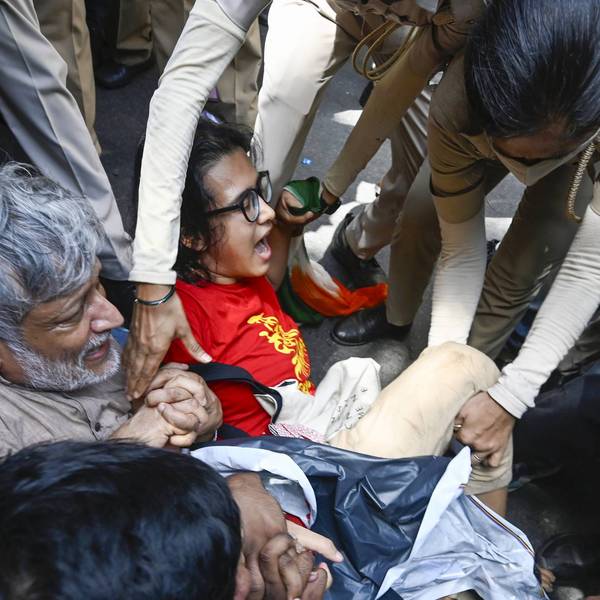

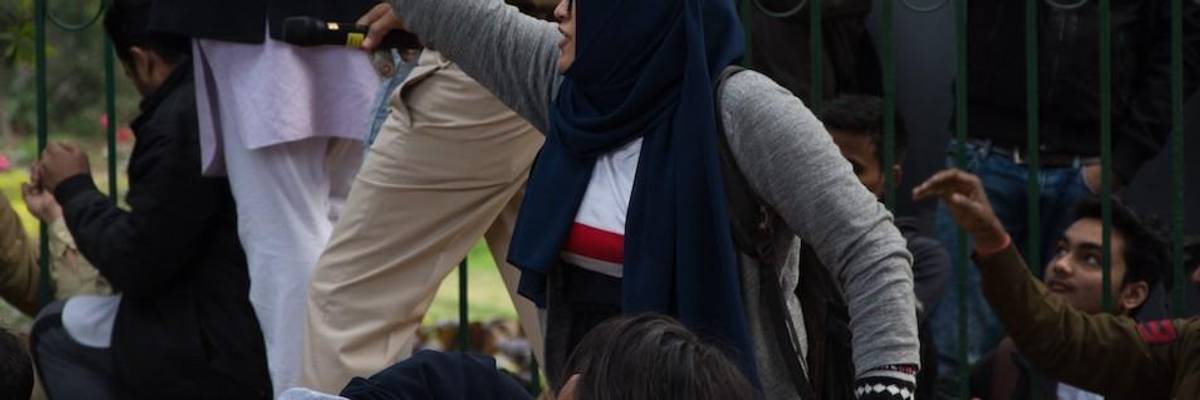
A protest against a controversial citizenship amendment bill turned violent when Delhi Police shot tear gas and beat students of Jamia Millia Islamia University in Delhi, India on December 13, 2019. (Photo: Javed Sultan/Anadolu Agency/Getty Images)
Indian Crackdown on Dissent Over Bill Stripping Naturalized Citizenship From Muslims 'An Affront to Democratic Values'
"Is this democracy? Where are we living?"
A brutal police crackdown on student protests in India over the latest legislation aimed at curtailing the rights of the country's 200 million-strong Muslim majority have observers concerned over a possible escalation in state repression in the world's largest democracy.
The police response to the protests reportedly claimed the lives of at least five demonstrators around the country in the past week.
"We are faced with the biggest challenge since independence," Indian writer and activist Arundhati Roy said. "Stand up. Please. Stand up."
As Common Dreams reported on December 10, the passage of the Citizenship Amendment Bill on December 9 is just the latest move by Indian Prime Minister Narendra Modi's extremist right-wing government to codify Hindu supremacy across the nominally secular nation of 1.3 billion people.
Modi, whose ruling government has already set up internment camps for religious minorities in the northeastern state of Assam, is being blamed for the violence against protesters.
"Modi's use of violence against minorities and dissenters in India is an affront to democratic values," tweeted journalist Ash Sarkar. "It is fascistic."
Police assaulted demonstrators New Delhi's Muslim-majority Jamia Millia Islamia University Sunday, The New York Times reported:
Videos widely circulated on social media show officers beating students with wooden sticks, smashing some on their heads even after they had been knocked down. In one video, a group of female students tries to rescue a young man from the grasp of the police. A squad of officers in riot gear tears him away and knocks him down with heavy blows. Even after the women form a protective circle around the downed student, officers can be seen trying to jab the young man with their wooden poles.
"Students were running around to save their lives," one woman at the protest told the press. "Is this democracy? Where are we living?"
Video from the demonstrations showed in stark relief the level of brutality of the police response to the student protest.
Sociology student Mohammad Faisal, in comment to The Guardian, described a violent scene.
"The policemen entered the library and mosque inside our campus and beat up the students mercilessly who were studying or offering prayer and in no way were connected to the protests yesterday," Faisal said. "Police fired teargas shells inside the library. There was a blind student in the library then. He started crying loudly. Police even beat up that student."
The student demonstrations, and state crackdown, were of concern to journalist Rana Ayyub, who on Sunday posted a picture from the demonstrations to show the bravery of the young protesters.
"These are the protestors who have rattled the Indian democracy," said Ayyub. "These are the students being brutalised for fighting communalism in India."
In a statement, Amnesty International India executive director Avinash Kumar called for security forces to show restraint.
"Amnesty India urges the government of India and state governments to respect the right to dissent by peaceful protesters and review their approach in policing the protests in order to de-escalate the situation and prevent more lives being put at risk," said Kumar. "Police should only use lethal force in response to an imminent threat of death or serious injury, and only as a last resort."
Al Jazeera journalist Sana Saeed on Twitter asked why the protests and state response were not receiving more coverage in western media.
"Thousands have been protesting but where is the media coverage?" wondered Saeed. "The shouts of solidarity from impressed media pundits?"
"Next time," she said, "people in countries which are close U.S. allies should protest in Hong Kong instead."
We are at a crossroads
This country and this world are at a monumental crossroads. In a few short weeks, US voters will have an opportunity to beat back the forces of fascism and confront the billionaires who are rigging the economy, our media system, and our democracy, making it increasingly impossible for ordinary people to get by. We’re not just talking about the election. We’re talking about what must be done once these fascist elements are vanquished from power. We need a bolder set of solutions than what either major party has so far been willing to offer and a working-class movement ready to fight like hell for it. Trump didn't emerge from nowhere. The conditions that fueled MAGA authoritarianism were created by decades of radical neoliberal economic policies and a corrupt political system dominated by corporate interests. They slashed taxes on the super-rich, promising that the benefits would trickle down. They said giveaways to the corporate titans would make life more affordable for the rest of us. It was all bullshit. And when a bitter, betrayed populace searches for someone to blame, right-wing demagogues have little trouble finding scapegoats. People know when they're being lied to, but you won't hear any of this from the corporate media. Only independent journalism—powered and funded by people who believe in building a better world—can deliver truly trustworthy daily news. Our Fall Campaign is underway, and we need your help. To power our newsroom through the rest of the year, we need to raise $125,000 by midnight on October 31. So if you share our vision, please contribute whatever you can to sustain our work. |
A brutal police crackdown on student protests in India over the latest legislation aimed at curtailing the rights of the country's 200 million-strong Muslim majority have observers concerned over a possible escalation in state repression in the world's largest democracy.
The police response to the protests reportedly claimed the lives of at least five demonstrators around the country in the past week.
"We are faced with the biggest challenge since independence," Indian writer and activist Arundhati Roy said. "Stand up. Please. Stand up."
As Common Dreams reported on December 10, the passage of the Citizenship Amendment Bill on December 9 is just the latest move by Indian Prime Minister Narendra Modi's extremist right-wing government to codify Hindu supremacy across the nominally secular nation of 1.3 billion people.
Modi, whose ruling government has already set up internment camps for religious minorities in the northeastern state of Assam, is being blamed for the violence against protesters.
"Modi's use of violence against minorities and dissenters in India is an affront to democratic values," tweeted journalist Ash Sarkar. "It is fascistic."
Police assaulted demonstrators New Delhi's Muslim-majority Jamia Millia Islamia University Sunday, The New York Times reported:
Videos widely circulated on social media show officers beating students with wooden sticks, smashing some on their heads even after they had been knocked down. In one video, a group of female students tries to rescue a young man from the grasp of the police. A squad of officers in riot gear tears him away and knocks him down with heavy blows. Even after the women form a protective circle around the downed student, officers can be seen trying to jab the young man with their wooden poles.
"Students were running around to save their lives," one woman at the protest told the press. "Is this democracy? Where are we living?"
Video from the demonstrations showed in stark relief the level of brutality of the police response to the student protest.
Sociology student Mohammad Faisal, in comment to The Guardian, described a violent scene.
"The policemen entered the library and mosque inside our campus and beat up the students mercilessly who were studying or offering prayer and in no way were connected to the protests yesterday," Faisal said. "Police fired teargas shells inside the library. There was a blind student in the library then. He started crying loudly. Police even beat up that student."
The student demonstrations, and state crackdown, were of concern to journalist Rana Ayyub, who on Sunday posted a picture from the demonstrations to show the bravery of the young protesters.
"These are the protestors who have rattled the Indian democracy," said Ayyub. "These are the students being brutalised for fighting communalism in India."
In a statement, Amnesty International India executive director Avinash Kumar called for security forces to show restraint.
"Amnesty India urges the government of India and state governments to respect the right to dissent by peaceful protesters and review their approach in policing the protests in order to de-escalate the situation and prevent more lives being put at risk," said Kumar. "Police should only use lethal force in response to an imminent threat of death or serious injury, and only as a last resort."
Al Jazeera journalist Sana Saeed on Twitter asked why the protests and state response were not receiving more coverage in western media.
"Thousands have been protesting but where is the media coverage?" wondered Saeed. "The shouts of solidarity from impressed media pundits?"
"Next time," she said, "people in countries which are close U.S. allies should protest in Hong Kong instead."
A brutal police crackdown on student protests in India over the latest legislation aimed at curtailing the rights of the country's 200 million-strong Muslim majority have observers concerned over a possible escalation in state repression in the world's largest democracy.
The police response to the protests reportedly claimed the lives of at least five demonstrators around the country in the past week.
"We are faced with the biggest challenge since independence," Indian writer and activist Arundhati Roy said. "Stand up. Please. Stand up."
As Common Dreams reported on December 10, the passage of the Citizenship Amendment Bill on December 9 is just the latest move by Indian Prime Minister Narendra Modi's extremist right-wing government to codify Hindu supremacy across the nominally secular nation of 1.3 billion people.
Modi, whose ruling government has already set up internment camps for religious minorities in the northeastern state of Assam, is being blamed for the violence against protesters.
"Modi's use of violence against minorities and dissenters in India is an affront to democratic values," tweeted journalist Ash Sarkar. "It is fascistic."
Police assaulted demonstrators New Delhi's Muslim-majority Jamia Millia Islamia University Sunday, The New York Times reported:
Videos widely circulated on social media show officers beating students with wooden sticks, smashing some on their heads even after they had been knocked down. In one video, a group of female students tries to rescue a young man from the grasp of the police. A squad of officers in riot gear tears him away and knocks him down with heavy blows. Even after the women form a protective circle around the downed student, officers can be seen trying to jab the young man with their wooden poles.
"Students were running around to save their lives," one woman at the protest told the press. "Is this democracy? Where are we living?"
Video from the demonstrations showed in stark relief the level of brutality of the police response to the student protest.
Sociology student Mohammad Faisal, in comment to The Guardian, described a violent scene.
"The policemen entered the library and mosque inside our campus and beat up the students mercilessly who were studying or offering prayer and in no way were connected to the protests yesterday," Faisal said. "Police fired teargas shells inside the library. There was a blind student in the library then. He started crying loudly. Police even beat up that student."
The student demonstrations, and state crackdown, were of concern to journalist Rana Ayyub, who on Sunday posted a picture from the demonstrations to show the bravery of the young protesters.
"These are the protestors who have rattled the Indian democracy," said Ayyub. "These are the students being brutalised for fighting communalism in India."
In a statement, Amnesty International India executive director Avinash Kumar called for security forces to show restraint.
"Amnesty India urges the government of India and state governments to respect the right to dissent by peaceful protesters and review their approach in policing the protests in order to de-escalate the situation and prevent more lives being put at risk," said Kumar. "Police should only use lethal force in response to an imminent threat of death or serious injury, and only as a last resort."
Al Jazeera journalist Sana Saeed on Twitter asked why the protests and state response were not receiving more coverage in western media.
"Thousands have been protesting but where is the media coverage?" wondered Saeed. "The shouts of solidarity from impressed media pundits?"
"Next time," she said, "people in countries which are close U.S. allies should protest in Hong Kong instead."