SUBSCRIBE TO OUR FREE NEWSLETTER
Daily news & progressive opinion—funded by the people, not the corporations—delivered straight to your inbox.
5
#000000
#FFFFFF
To donate by check, phone, or other method, see our More Ways to Give page.
Daily news & progressive opinion—funded by the people, not the corporations—delivered straight to your inbox.
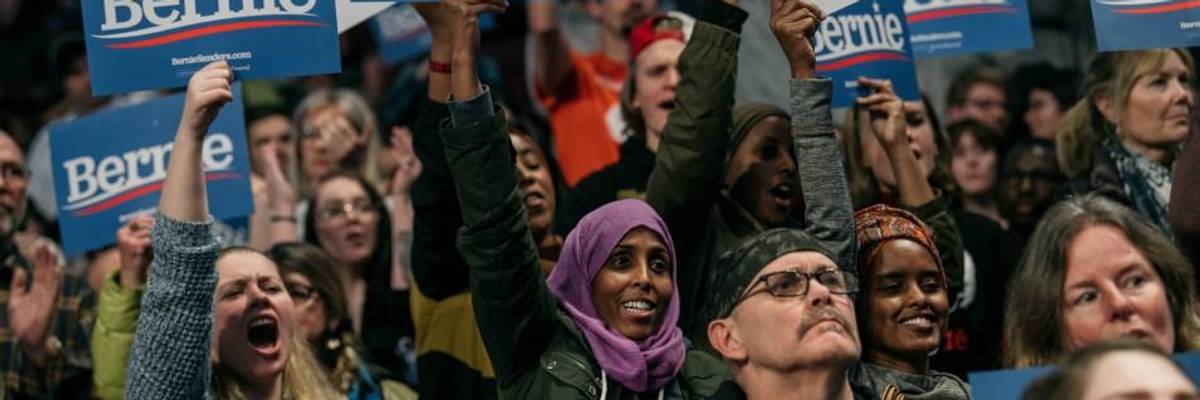
Supporters of Sen. Bernie Sanders (I-Vt.) cheer at the University of Minnesotas Williams Arena on November 3, 2019 in Minneapolis, Minnesota. (Photo: Scott Heins/Getty Images)
Scholar and activist Keeanga-Yamahtta Taylor on Tuesday argued that Sen. Bernie Sanders' strong standing in the 2020 Democratic presidential race is attributable to his success in mobilizing a multiracial coalition of working class people who are often rendered invisible by the corporate media and political establishment.
"Neither the Democratic Party establishment nor the mainstream media really understand his campaign," Taylor, assistant professor of African-American Studies at Princeton University, wrote in the New York Times Tuesday. "That's because it disregards conventional wisdom in politics today--tax cuts for the elite and corporations and public-private partnerships to finance healthcare, education, housing, and other public services."
"His demands for a redistribution of wealth from the top to the rest of society and universal, government-backed programs have resonated with the forgotten residents of the country."
--Keeanga-Yamahtta Taylor, Princeton University
Building on his long-shot 2016 presidential bid that garnered 13 million votes, "the Sanders campaign has transformed into a tribune of the oppressed and marginalized," Taylor wrote.
The diverse grassroots composition of Sanders' base, Taylor wrote, is evident in the campaign's fundraising numbers. Sanders leads the 2020 Democratic field in donations from teachers, retail workers, farmers, nurses, construction workers, and drivers.
"Sanders is also the leading recipient of donations from Latinos," Taylor wrote. "According to Essence magazine, Mr. Sanders is the favorite candidate among black women aged 18 to 34. Only 49 percent of his supporters are white, compared with 71 percent of Warren supporters."
Taylor also highlighted Sanders' major endorsements, including the Center for Popular Democracy (CPD) Action, a coalition of more than 40 progressive community groups with over 600,000 members nationwide. CPD Action announced Tuesday that its members voted to endorse the senator from Vermont in the 2020 Democratic primary.
"Bernie Sanders is the powerful movement candidate we need to defeat Donald Trump," Jennifer Epps-Addison, co-executive director of the Center for Popular Democracy Action, said in a statement. "From ending mass incarceration and deportations to the $15 minimum wage and Medicare for All, Sanders is working hand-in-hand with our communities to champion the policies that we need to thrive."
Though Sanders has gained ground in the polls and garnered endorsements from prominent progressive organizations, corporate media outlets have often downplayed or ignored the Vermont senator's campaign--a phenomenon Sanders supporters have termed the "Bernie blackout."
Taylor alluded to the media's sparse coverage of Sanders compared to the rest of the Democratic field, noting that, "under normal circumstances, the multiracial working class is invisible."
"This has meant its support for Mr. Sanders's candidacy has been hard to register in the mainstream coverage of the Democratic race," Taylor wrote. "Mr. Sanders has reached the typically invisible, downwardly mobile working class with his language of 'class warfare.' He has tapped into the anger and bitterness coursing through the lives of regular people."
"Without cynicism or the typical racist explanations that blame African-Americans and Latino immigrants for their own financial hardship, Mr. Sanders blames capitalism," Taylor added. "His demands for a redistribution of wealth from the top to the rest of society and universal, government-backed programs have resonated with the forgotten residents of the country."
Dear Common Dreams reader, It’s been nearly 30 years since I co-founded Common Dreams with my late wife, Lina Newhouser. We had the radical notion that journalism should serve the public good, not corporate profits. It was clear to us from the outset what it would take to build such a project. No paid advertisements. No corporate sponsors. No millionaire publisher telling us what to think or do. Many people said we wouldn't last a year, but we proved those doubters wrong. Together with a tremendous team of journalists and dedicated staff, we built an independent media outlet free from the constraints of profits and corporate control. Our mission has always been simple: To inform. To inspire. To ignite change for the common good. Building Common Dreams was not easy. Our survival was never guaranteed. When you take on the most powerful forces—Wall Street greed, fossil fuel industry destruction, Big Tech lobbyists, and uber-rich oligarchs who have spent billions upon billions rigging the economy and democracy in their favor—the only bulwark you have is supporters who believe in your work. But here’s the urgent message from me today. It's never been this bad out there. And it's never been this hard to keep us going. At the very moment Common Dreams is most needed, the threats we face are intensifying. We need your support now more than ever. We don't accept corporate advertising and never will. We don't have a paywall because we don't think people should be blocked from critical news based on their ability to pay. Everything we do is funded by the donations of readers like you. When everyone does the little they can afford, we are strong. But if that support retreats or dries up, so do we. Will you donate now to make sure Common Dreams not only survives but thrives? —Craig Brown, Co-founder |
Scholar and activist Keeanga-Yamahtta Taylor on Tuesday argued that Sen. Bernie Sanders' strong standing in the 2020 Democratic presidential race is attributable to his success in mobilizing a multiracial coalition of working class people who are often rendered invisible by the corporate media and political establishment.
"Neither the Democratic Party establishment nor the mainstream media really understand his campaign," Taylor, assistant professor of African-American Studies at Princeton University, wrote in the New York Times Tuesday. "That's because it disregards conventional wisdom in politics today--tax cuts for the elite and corporations and public-private partnerships to finance healthcare, education, housing, and other public services."
"His demands for a redistribution of wealth from the top to the rest of society and universal, government-backed programs have resonated with the forgotten residents of the country."
--Keeanga-Yamahtta Taylor, Princeton University
Building on his long-shot 2016 presidential bid that garnered 13 million votes, "the Sanders campaign has transformed into a tribune of the oppressed and marginalized," Taylor wrote.
The diverse grassroots composition of Sanders' base, Taylor wrote, is evident in the campaign's fundraising numbers. Sanders leads the 2020 Democratic field in donations from teachers, retail workers, farmers, nurses, construction workers, and drivers.
"Sanders is also the leading recipient of donations from Latinos," Taylor wrote. "According to Essence magazine, Mr. Sanders is the favorite candidate among black women aged 18 to 34. Only 49 percent of his supporters are white, compared with 71 percent of Warren supporters."
Taylor also highlighted Sanders' major endorsements, including the Center for Popular Democracy (CPD) Action, a coalition of more than 40 progressive community groups with over 600,000 members nationwide. CPD Action announced Tuesday that its members voted to endorse the senator from Vermont in the 2020 Democratic primary.
"Bernie Sanders is the powerful movement candidate we need to defeat Donald Trump," Jennifer Epps-Addison, co-executive director of the Center for Popular Democracy Action, said in a statement. "From ending mass incarceration and deportations to the $15 minimum wage and Medicare for All, Sanders is working hand-in-hand with our communities to champion the policies that we need to thrive."
Though Sanders has gained ground in the polls and garnered endorsements from prominent progressive organizations, corporate media outlets have often downplayed or ignored the Vermont senator's campaign--a phenomenon Sanders supporters have termed the "Bernie blackout."
Taylor alluded to the media's sparse coverage of Sanders compared to the rest of the Democratic field, noting that, "under normal circumstances, the multiracial working class is invisible."
"This has meant its support for Mr. Sanders's candidacy has been hard to register in the mainstream coverage of the Democratic race," Taylor wrote. "Mr. Sanders has reached the typically invisible, downwardly mobile working class with his language of 'class warfare.' He has tapped into the anger and bitterness coursing through the lives of regular people."
"Without cynicism or the typical racist explanations that blame African-Americans and Latino immigrants for their own financial hardship, Mr. Sanders blames capitalism," Taylor added. "His demands for a redistribution of wealth from the top to the rest of society and universal, government-backed programs have resonated with the forgotten residents of the country."
Scholar and activist Keeanga-Yamahtta Taylor on Tuesday argued that Sen. Bernie Sanders' strong standing in the 2020 Democratic presidential race is attributable to his success in mobilizing a multiracial coalition of working class people who are often rendered invisible by the corporate media and political establishment.
"Neither the Democratic Party establishment nor the mainstream media really understand his campaign," Taylor, assistant professor of African-American Studies at Princeton University, wrote in the New York Times Tuesday. "That's because it disregards conventional wisdom in politics today--tax cuts for the elite and corporations and public-private partnerships to finance healthcare, education, housing, and other public services."
"His demands for a redistribution of wealth from the top to the rest of society and universal, government-backed programs have resonated with the forgotten residents of the country."
--Keeanga-Yamahtta Taylor, Princeton University
Building on his long-shot 2016 presidential bid that garnered 13 million votes, "the Sanders campaign has transformed into a tribune of the oppressed and marginalized," Taylor wrote.
The diverse grassroots composition of Sanders' base, Taylor wrote, is evident in the campaign's fundraising numbers. Sanders leads the 2020 Democratic field in donations from teachers, retail workers, farmers, nurses, construction workers, and drivers.
"Sanders is also the leading recipient of donations from Latinos," Taylor wrote. "According to Essence magazine, Mr. Sanders is the favorite candidate among black women aged 18 to 34. Only 49 percent of his supporters are white, compared with 71 percent of Warren supporters."
Taylor also highlighted Sanders' major endorsements, including the Center for Popular Democracy (CPD) Action, a coalition of more than 40 progressive community groups with over 600,000 members nationwide. CPD Action announced Tuesday that its members voted to endorse the senator from Vermont in the 2020 Democratic primary.
"Bernie Sanders is the powerful movement candidate we need to defeat Donald Trump," Jennifer Epps-Addison, co-executive director of the Center for Popular Democracy Action, said in a statement. "From ending mass incarceration and deportations to the $15 minimum wage and Medicare for All, Sanders is working hand-in-hand with our communities to champion the policies that we need to thrive."
Though Sanders has gained ground in the polls and garnered endorsements from prominent progressive organizations, corporate media outlets have often downplayed or ignored the Vermont senator's campaign--a phenomenon Sanders supporters have termed the "Bernie blackout."
Taylor alluded to the media's sparse coverage of Sanders compared to the rest of the Democratic field, noting that, "under normal circumstances, the multiracial working class is invisible."
"This has meant its support for Mr. Sanders's candidacy has been hard to register in the mainstream coverage of the Democratic race," Taylor wrote. "Mr. Sanders has reached the typically invisible, downwardly mobile working class with his language of 'class warfare.' He has tapped into the anger and bitterness coursing through the lives of regular people."
"Without cynicism or the typical racist explanations that blame African-Americans and Latino immigrants for their own financial hardship, Mr. Sanders blames capitalism," Taylor added. "His demands for a redistribution of wealth from the top to the rest of society and universal, government-backed programs have resonated with the forgotten residents of the country."