SUBSCRIBE TO OUR FREE NEWSLETTER
Daily news & progressive opinion—funded by the people, not the corporations—delivered straight to your inbox.
5
#000000
#FFFFFF
To donate by check, phone, or other method, see our More Ways to Give page.
Daily news & progressive opinion—funded by the people, not the corporations—delivered straight to your inbox.
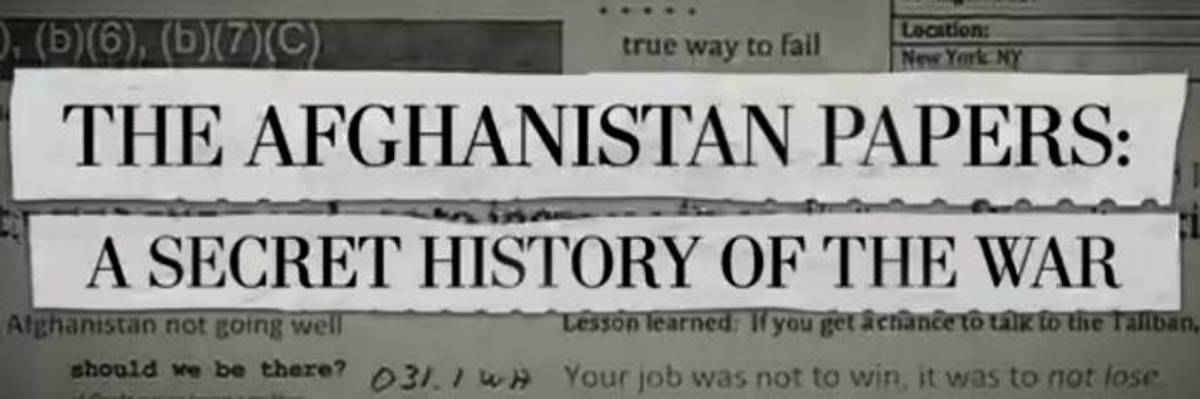
"The metrics were always manipulated for the duration of the war," one unnamed National Security Council official said in an interview obtained by the Post. (Image: WaPo)
A major Washington Post investigation released Monday is a confirmation of the peace movement's message that "there's no military solution in Afghanistan."
That's according to Paul Kawika Martin, senior director of policy and political affairs at Peace Action, replying to "The Afghanistan Papers." The report exposes how top officials spanning the George W. Bush, Obama, and Trump administrations waged a deliberate misinformation campaign to conceal the total failures of the 18-year war in Afghanistan.
The bombshell from investigative reporter Craig Whitlock "broadly resembles the Pentagon Papers," and it is based on over 2,000 pages of notes from interviews with a federal agency that "bring into sharp relief the core failings of the war that persist to this day" and belie comments by officials "who assured Americans year after year" of progress made in the war.
The Post also published this accompanying video:
The paper obtained the cache of documents following a legal battle that lasted three years and included two lawsuits.
The documents came out of a project from the Office of the Special Inspector General for Afghanistan Reconstruction (SIGAR), an agency now headed by Obama-appointee John Sopko. That project, entitled Lessons Learned, was meant to assess "the U.S. reconstruction experience in Afghanistan." While it has released a number of reports beginning in 2016, those public documents had major omissions, namely "the harshest and most frank criticisms from the interviews" SIGAR conducted.
As the Post reported, the interviewees, who were directly involved in the war effort, were forthright, believing their remarks would not be made public. They revealed that officials continually misled the public about the war's success, there was no strategy, their efforts fueled corruption, and the U.S. was clearly losing ground as well as tens of thousands of lives and at least $1 trillion.
The trove includes transcripts and notes from over 400 interviewers between 2014 and 2018. SIGAR blacked out names of roughly 85 percent of interviewees.
"It was impossible to create good metrics" about the troop surge, one unnamed senior National Security Council official said in a 2016 interview. "We tried using troop numbers trained, violence levels, control of territory and none of it painted an accurate picture." They added, "The metrics were always manipulated for the duration of the war."
That theme was similar to Army colonel Bob Crowley's remarks in a 2016 interview. "Surveys, for instance, were totally unreliable but reinforced that everything we were doing was right and we became a self-licking ice cream cone," Crowley said.
Ryan Crocker, who was the top U.S. diplomat in Kabul from 2011 to 2012, said in a 2016 interview, "Our biggest single project, sadly and inadvertently, of course, may have been the development of mass corruption."
The Post's reporting also used previously classified memos known as "snowflakes" from former Pentagon chief Donald H. Rumsfeld between 2001 and 2006.
"I have no visibility into who the bad guys are," Rumsfeld said in a 2003 memo. "We are woefully deficient in human intelligence."
"Take the time to read every word of this," progressive commentator Krystal Ball said on Twitter of Whitlock's new investigation. "Three administrations have lied to us about Afghanistan. How many lives have been lost and fortunes spent for nothing??"
Rep. Ro Khanna (D-Calif.) said the takeaway from the reporting was clear: "18 years later it's time to get out. Now."
Read the full Washington Post investigation.
This country and this world are at a monumental crossroads. US voters have an opportunity to beat back the forces of fascism and confront the billionaires who are rigging the economy, our media system, and our democracy, making it increasingly impossible for ordinary people to get by. We’re not just talking about the election. We’re talking about what must be done once these fascist elements are vanquished from power. We need a bolder set of solutions than what either major party has so far been willing to offer and a working-class movement ready to fight like hell for it. Trump didn't emerge from nowhere. The conditions that fueled MAGA authoritarianism were created by decades of radical neoliberal economic policies and a corrupt political system dominated by corporate interests. They slashed taxes on the super-rich, promising that the benefits would trickle down. They said giveaways to the corporate titans would make life more affordable for the rest of us. It was all bullshit. And when a bitter, betrayed populace searches for someone to blame, right-wing demagogues have little trouble finding scapegoats. People know when they're being lied to, but you won't hear any of this from the corporate media. Only independent journalism—powered and funded by people who believe in building a better world—can deliver truly trustworthy daily news. If you share our vision, please contribute whatever you can to sustain our work. |
A major Washington Post investigation released Monday is a confirmation of the peace movement's message that "there's no military solution in Afghanistan."
That's according to Paul Kawika Martin, senior director of policy and political affairs at Peace Action, replying to "The Afghanistan Papers." The report exposes how top officials spanning the George W. Bush, Obama, and Trump administrations waged a deliberate misinformation campaign to conceal the total failures of the 18-year war in Afghanistan.
The bombshell from investigative reporter Craig Whitlock "broadly resembles the Pentagon Papers," and it is based on over 2,000 pages of notes from interviews with a federal agency that "bring into sharp relief the core failings of the war that persist to this day" and belie comments by officials "who assured Americans year after year" of progress made in the war.
The Post also published this accompanying video:
The paper obtained the cache of documents following a legal battle that lasted three years and included two lawsuits.
The documents came out of a project from the Office of the Special Inspector General for Afghanistan Reconstruction (SIGAR), an agency now headed by Obama-appointee John Sopko. That project, entitled Lessons Learned, was meant to assess "the U.S. reconstruction experience in Afghanistan." While it has released a number of reports beginning in 2016, those public documents had major omissions, namely "the harshest and most frank criticisms from the interviews" SIGAR conducted.
As the Post reported, the interviewees, who were directly involved in the war effort, were forthright, believing their remarks would not be made public. They revealed that officials continually misled the public about the war's success, there was no strategy, their efforts fueled corruption, and the U.S. was clearly losing ground as well as tens of thousands of lives and at least $1 trillion.
The trove includes transcripts and notes from over 400 interviewers between 2014 and 2018. SIGAR blacked out names of roughly 85 percent of interviewees.
"It was impossible to create good metrics" about the troop surge, one unnamed senior National Security Council official said in a 2016 interview. "We tried using troop numbers trained, violence levels, control of territory and none of it painted an accurate picture." They added, "The metrics were always manipulated for the duration of the war."
That theme was similar to Army colonel Bob Crowley's remarks in a 2016 interview. "Surveys, for instance, were totally unreliable but reinforced that everything we were doing was right and we became a self-licking ice cream cone," Crowley said.
Ryan Crocker, who was the top U.S. diplomat in Kabul from 2011 to 2012, said in a 2016 interview, "Our biggest single project, sadly and inadvertently, of course, may have been the development of mass corruption."
The Post's reporting also used previously classified memos known as "snowflakes" from former Pentagon chief Donald H. Rumsfeld between 2001 and 2006.
"I have no visibility into who the bad guys are," Rumsfeld said in a 2003 memo. "We are woefully deficient in human intelligence."
"Take the time to read every word of this," progressive commentator Krystal Ball said on Twitter of Whitlock's new investigation. "Three administrations have lied to us about Afghanistan. How many lives have been lost and fortunes spent for nothing??"
Rep. Ro Khanna (D-Calif.) said the takeaway from the reporting was clear: "18 years later it's time to get out. Now."
Read the full Washington Post investigation.