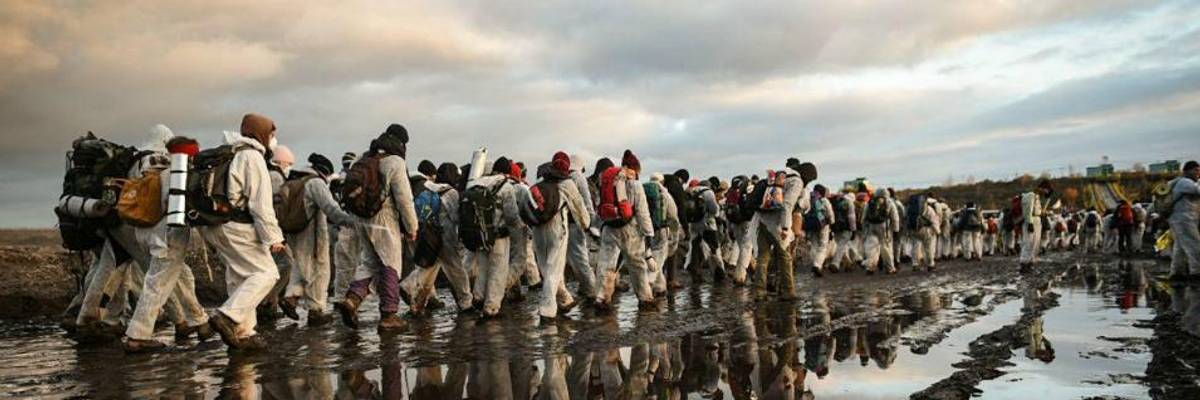
Climate activists protests at three coal mines in Germany Saturday. (Photo: Ende Gelande/Twitter)
Thousands of Activists Stage Protests at Three German Coal Mines to Demand Bolder Climate Policies
"We're at a critical moment—the window of opportunity to stop the climate crisis is closing rapidly."
On the heels of Friday's global youth-led climate strike, thousands of activists staged demonstrations at three coal mines in Germany Saturday to protest the government's plan to phase out coal by 2038, which activists say isn't soon enough.
The German news agency dpa reported that "protesters ran into the Janschwalde and Welzow-Sud open-cast mining sites in the eastern state of Brandenburg, as well as the United Schleenhain lignite mining area in neighboring Saxony."
Ende Gelande (End of the Road), which helped organize the protests, said there were about 4,000 demonstrators total, while some reporting put the number closer to 2,000.
"We're at a critical moment--the window of opportunity to stop the climate crisis is closing rapidly," Ende Gelande spokesman Johnny Parks told German broadcaster DW.
The power plant at Janschwalde has been deemed one of the top polluting facilities in Europe in terms of planet-warming emissions. Parks said that "we want to show with our protest today that this mine needs to be shut down permanently."
According to DW:
By early evening, about 500 protesters had left Janschwalde, either on foot or transported in mining company vehicles.
However, another 500 activists remained on-site at Welzow-Sud, with police preventing them from occupying large equipment. Activists said they did not plan to spend the night there, however, with temperatures in the single digits.
In Saxony, police were escorting the approximately 1,200 protesters in stages, first taking their details before allowing them to leave.
The demonstrations drew a strong police presence at each of the mines and there were reports of some clashes between authorities and protesters. LEAG, the energy company that operates the mine in Welzow-Sud, said it "will use legal means against anyone who disregards the boundaries of our premises."
Meanwhile, Fridays for Future Germany--a regional branch of the youth climate movement launched last year by Swedish teenager Greta Thunberg--expressed solidarity with the protesters at the coal mines, a move that was welcomed by Ende Gelande.
Saturday's actions came after tens of thousands of people poured into the streets across Germany on Friday for a global climate strike that aimed to pressure all governments attending the U.N.'s COP 25 summit in Madrid on Monday to pursue bolder policies to battle the climate emergency.
German youth climate leader Luisa Neubauer--along with Thunberg and Angela Valenzuela of Chile--wrote Friday for Project Syndicate that "the science is crying out for urgent action, and still our leaders dare to ignore it. So we continue to fight."
Neubauer told The Local Germany that there has been massive "political failure" in terms of tackling the climate crisis.
The Local Germany reported that climate strike events were held in more than 500 cities across the country Friday "as Germany's upper house of parliament, the Bundesrat, voted to block part of the German government's new climate package."
"Members voted for the majority of measures to pass," the report continued, "but urged a renegotiation of some parts related to taxes and subsidies."
The vote and protests followed the publication Tuesday of the German government's Climate Monitoring Report--which, as Environment Minister Svenja Schulze summarized, found that "the consequences of climate change are becoming increasingly apparent" in the country.
The United Nations Environment Program also released a major climate report on Tuesday. Warning that global temperatures are on track to rise as much as 3.2degC by the end of the century, the U.N.'s new Emissions Gap report called for "rapid and transformational" action to curb emissions and avert climate catastrophe.
We are at a crossroads
This country and this world are at a monumental crossroads. In a few short weeks, US voters will have an opportunity to beat back the forces of fascism and confront the billionaires who are rigging the economy, our media system, and our democracy, making it increasingly impossible for ordinary people to get by. We’re not just talking about the election. We’re talking about what must be done once these fascist elements are vanquished from power. We need a bolder set of solutions than what either major party has so far been willing to offer and a working-class movement ready to fight like hell for it. Trump didn't emerge from nowhere. The conditions that fueled MAGA authoritarianism were created by decades of radical neoliberal economic policies and a corrupt political system dominated by corporate interests. They slashed taxes on the super-rich, promising that the benefits would trickle down. They said giveaways to the corporate titans would make life more affordable for the rest of us. It was all bullshit. And when a bitter, betrayed populace searches for someone to blame, right-wing demagogues have little trouble finding scapegoats. People know when they're being lied to, but you won't hear any of this from the corporate media. Only independent journalism—powered and funded by people who believe in building a better world—can deliver truly trustworthy daily news. Our Fall Campaign is underway, and we need your help. To power our newsroom through the rest of the year, we need to raise $125,000 by midnight on October 31. So if you share our vision, please contribute whatever you can to sustain our work. |
On the heels of Friday's global youth-led climate strike, thousands of activists staged demonstrations at three coal mines in Germany Saturday to protest the government's plan to phase out coal by 2038, which activists say isn't soon enough.
The German news agency dpa reported that "protesters ran into the Janschwalde and Welzow-Sud open-cast mining sites in the eastern state of Brandenburg, as well as the United Schleenhain lignite mining area in neighboring Saxony."
Ende Gelande (End of the Road), which helped organize the protests, said there were about 4,000 demonstrators total, while some reporting put the number closer to 2,000.
"We're at a critical moment--the window of opportunity to stop the climate crisis is closing rapidly," Ende Gelande spokesman Johnny Parks told German broadcaster DW.
The power plant at Janschwalde has been deemed one of the top polluting facilities in Europe in terms of planet-warming emissions. Parks said that "we want to show with our protest today that this mine needs to be shut down permanently."
According to DW:
By early evening, about 500 protesters had left Janschwalde, either on foot or transported in mining company vehicles.
However, another 500 activists remained on-site at Welzow-Sud, with police preventing them from occupying large equipment. Activists said they did not plan to spend the night there, however, with temperatures in the single digits.
In Saxony, police were escorting the approximately 1,200 protesters in stages, first taking their details before allowing them to leave.
The demonstrations drew a strong police presence at each of the mines and there were reports of some clashes between authorities and protesters. LEAG, the energy company that operates the mine in Welzow-Sud, said it "will use legal means against anyone who disregards the boundaries of our premises."
Meanwhile, Fridays for Future Germany--a regional branch of the youth climate movement launched last year by Swedish teenager Greta Thunberg--expressed solidarity with the protesters at the coal mines, a move that was welcomed by Ende Gelande.
Saturday's actions came after tens of thousands of people poured into the streets across Germany on Friday for a global climate strike that aimed to pressure all governments attending the U.N.'s COP 25 summit in Madrid on Monday to pursue bolder policies to battle the climate emergency.
German youth climate leader Luisa Neubauer--along with Thunberg and Angela Valenzuela of Chile--wrote Friday for Project Syndicate that "the science is crying out for urgent action, and still our leaders dare to ignore it. So we continue to fight."
Neubauer told The Local Germany that there has been massive "political failure" in terms of tackling the climate crisis.
The Local Germany reported that climate strike events were held in more than 500 cities across the country Friday "as Germany's upper house of parliament, the Bundesrat, voted to block part of the German government's new climate package."
"Members voted for the majority of measures to pass," the report continued, "but urged a renegotiation of some parts related to taxes and subsidies."
The vote and protests followed the publication Tuesday of the German government's Climate Monitoring Report--which, as Environment Minister Svenja Schulze summarized, found that "the consequences of climate change are becoming increasingly apparent" in the country.
The United Nations Environment Program also released a major climate report on Tuesday. Warning that global temperatures are on track to rise as much as 3.2degC by the end of the century, the U.N.'s new Emissions Gap report called for "rapid and transformational" action to curb emissions and avert climate catastrophe.
On the heels of Friday's global youth-led climate strike, thousands of activists staged demonstrations at three coal mines in Germany Saturday to protest the government's plan to phase out coal by 2038, which activists say isn't soon enough.
The German news agency dpa reported that "protesters ran into the Janschwalde and Welzow-Sud open-cast mining sites in the eastern state of Brandenburg, as well as the United Schleenhain lignite mining area in neighboring Saxony."
Ende Gelande (End of the Road), which helped organize the protests, said there were about 4,000 demonstrators total, while some reporting put the number closer to 2,000.
"We're at a critical moment--the window of opportunity to stop the climate crisis is closing rapidly," Ende Gelande spokesman Johnny Parks told German broadcaster DW.
The power plant at Janschwalde has been deemed one of the top polluting facilities in Europe in terms of planet-warming emissions. Parks said that "we want to show with our protest today that this mine needs to be shut down permanently."
According to DW:
By early evening, about 500 protesters had left Janschwalde, either on foot or transported in mining company vehicles.
However, another 500 activists remained on-site at Welzow-Sud, with police preventing them from occupying large equipment. Activists said they did not plan to spend the night there, however, with temperatures in the single digits.
In Saxony, police were escorting the approximately 1,200 protesters in stages, first taking their details before allowing them to leave.
The demonstrations drew a strong police presence at each of the mines and there were reports of some clashes between authorities and protesters. LEAG, the energy company that operates the mine in Welzow-Sud, said it "will use legal means against anyone who disregards the boundaries of our premises."
Meanwhile, Fridays for Future Germany--a regional branch of the youth climate movement launched last year by Swedish teenager Greta Thunberg--expressed solidarity with the protesters at the coal mines, a move that was welcomed by Ende Gelande.
Saturday's actions came after tens of thousands of people poured into the streets across Germany on Friday for a global climate strike that aimed to pressure all governments attending the U.N.'s COP 25 summit in Madrid on Monday to pursue bolder policies to battle the climate emergency.
German youth climate leader Luisa Neubauer--along with Thunberg and Angela Valenzuela of Chile--wrote Friday for Project Syndicate that "the science is crying out for urgent action, and still our leaders dare to ignore it. So we continue to fight."
Neubauer told The Local Germany that there has been massive "political failure" in terms of tackling the climate crisis.
The Local Germany reported that climate strike events were held in more than 500 cities across the country Friday "as Germany's upper house of parliament, the Bundesrat, voted to block part of the German government's new climate package."
"Members voted for the majority of measures to pass," the report continued, "but urged a renegotiation of some parts related to taxes and subsidies."
The vote and protests followed the publication Tuesday of the German government's Climate Monitoring Report--which, as Environment Minister Svenja Schulze summarized, found that "the consequences of climate change are becoming increasingly apparent" in the country.
The United Nations Environment Program also released a major climate report on Tuesday. Warning that global temperatures are on track to rise as much as 3.2degC by the end of the century, the U.N.'s new Emissions Gap report called for "rapid and transformational" action to curb emissions and avert climate catastrophe.