SUBSCRIBE TO OUR FREE NEWSLETTER
Daily news & progressive opinion—funded by the people, not the corporations—delivered straight to your inbox.
5
#000000
#FFFFFF
To donate by check, phone, or other method, see our More Ways to Give page.
Daily news & progressive opinion—funded by the people, not the corporations—delivered straight to your inbox.
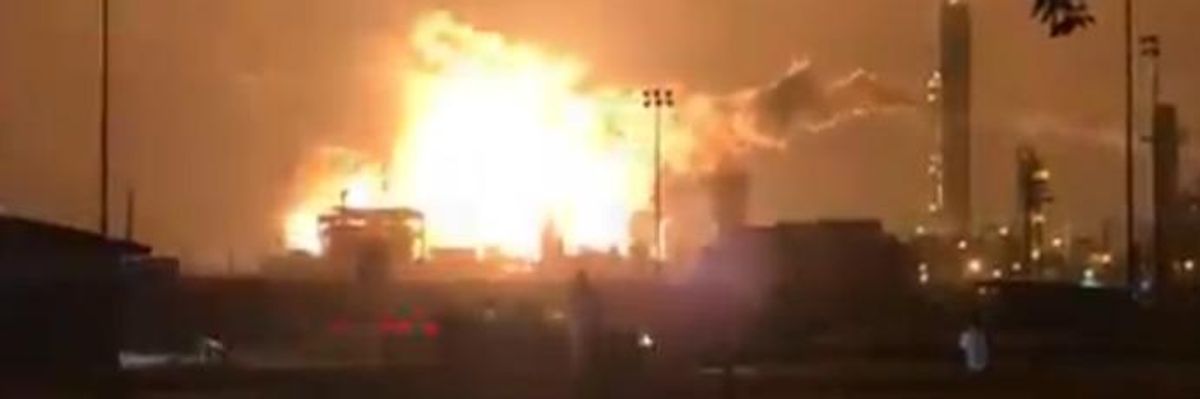
An explosion occurred at roughly 1:00 am Wednesday at a chemical plant in Port Neches, Texas. (Screengrab from video courtesy Derek Ross Hall via Twitter)
Concerns about air quality lingered Wednesday following a major early morning explosion at a chemical plant in Port Neches, Texas that shot a fireball into the sky.
The disaster at the TPC Group-owned facility roughly 94 miles east of Houston took place a week after the Trump administration rolled back safety rules meant to protect workers and people who live near chemical plants. In light of the timing, Catherine Fraser, Environment Texas's clean air associate, called Wednesday's explosion "a timely warning that state and federal officials need to do more to keep communities safe."
"It shook our house twice," Shawn Dunlap, who lives in neighboring Nederland, told NBC News. "It was just like a bomb going off." Twitter user @souljaslim52 put it another way: "shit blew tf up."
According to a statement from TPC Group, the incident occurred at 1:00am local time. The company said it "cannot speak to the cause of the incident or the extent of damage." The Port Neches Police Department, in a statement posted to Facebook, said, "There's extensive damage throughout the city."
Area residents reported damaged homes, with some suffering shattered glass and blown-off doors. Three workers at the plant also suffered minor injuries, the company said.
"Throughout the morning more booms could be heard in the area as firefighters attempted to control the blaze," reported Beaumont's KBMT.
Local ABC affiliate KTRK reported that the chemical burning is butadiene, which the EPA classifies as carcinogenic.
Area residents captured images and sounds of the explosion:
Environment Texas's Fraser, in her statement, pointed to the plant's history as cause for particular concern. "This facility has a track record of violating the Clean Air Act," she said, "with five other illegal emissions events just in 2019, emitting carcinogenic 1,3 butadiene and other chemicals, and a history of community complaints."
"According to the EPA, the TPC Plant has been in non-compliance 12 separate quarters over the last 3 years, and has received 7 formal enforcement actions over the last 5 years. According to the TCEQ, the chemical of most concern is butadiene," Fraser continued. "The TPC plant emitted 61,379 pounds of butadiene in 2018. Butadiene is a known human carcinogen."
Environmental justice expert Mustafa Santiago Ali weighed in on the explosion with a brief statement on Twitter. He noted that the Trump administration's move last week to finalize the weakening of the Chemical Disaster Rule and chided the president for "putting more people's lives in danger."
This post has been updated to correct that Port Neches is east of Houston, not west, as it was originally written.
Dear Common Dreams reader, It’s been nearly 30 years since I co-founded Common Dreams with my late wife, Lina Newhouser. We had the radical notion that journalism should serve the public good, not corporate profits. It was clear to us from the outset what it would take to build such a project. No paid advertisements. No corporate sponsors. No millionaire publisher telling us what to think or do. Many people said we wouldn't last a year, but we proved those doubters wrong. Together with a tremendous team of journalists and dedicated staff, we built an independent media outlet free from the constraints of profits and corporate control. Our mission has always been simple: To inform. To inspire. To ignite change for the common good. Building Common Dreams was not easy. Our survival was never guaranteed. When you take on the most powerful forces—Wall Street greed, fossil fuel industry destruction, Big Tech lobbyists, and uber-rich oligarchs who have spent billions upon billions rigging the economy and democracy in their favor—the only bulwark you have is supporters who believe in your work. But here’s the urgent message from me today. It's never been this bad out there. And it's never been this hard to keep us going. At the very moment Common Dreams is most needed, the threats we face are intensifying. We need your support now more than ever. We don't accept corporate advertising and never will. We don't have a paywall because we don't think people should be blocked from critical news based on their ability to pay. Everything we do is funded by the donations of readers like you. When everyone does the little they can afford, we are strong. But if that support retreats or dries up, so do we. Will you donate now to make sure Common Dreams not only survives but thrives? —Craig Brown, Co-founder |
Concerns about air quality lingered Wednesday following a major early morning explosion at a chemical plant in Port Neches, Texas that shot a fireball into the sky.
The disaster at the TPC Group-owned facility roughly 94 miles east of Houston took place a week after the Trump administration rolled back safety rules meant to protect workers and people who live near chemical plants. In light of the timing, Catherine Fraser, Environment Texas's clean air associate, called Wednesday's explosion "a timely warning that state and federal officials need to do more to keep communities safe."
"It shook our house twice," Shawn Dunlap, who lives in neighboring Nederland, told NBC News. "It was just like a bomb going off." Twitter user @souljaslim52 put it another way: "shit blew tf up."
According to a statement from TPC Group, the incident occurred at 1:00am local time. The company said it "cannot speak to the cause of the incident or the extent of damage." The Port Neches Police Department, in a statement posted to Facebook, said, "There's extensive damage throughout the city."
Area residents reported damaged homes, with some suffering shattered glass and blown-off doors. Three workers at the plant also suffered minor injuries, the company said.
"Throughout the morning more booms could be heard in the area as firefighters attempted to control the blaze," reported Beaumont's KBMT.
Local ABC affiliate KTRK reported that the chemical burning is butadiene, which the EPA classifies as carcinogenic.
Area residents captured images and sounds of the explosion:
Environment Texas's Fraser, in her statement, pointed to the plant's history as cause for particular concern. "This facility has a track record of violating the Clean Air Act," she said, "with five other illegal emissions events just in 2019, emitting carcinogenic 1,3 butadiene and other chemicals, and a history of community complaints."
"According to the EPA, the TPC Plant has been in non-compliance 12 separate quarters over the last 3 years, and has received 7 formal enforcement actions over the last 5 years. According to the TCEQ, the chemical of most concern is butadiene," Fraser continued. "The TPC plant emitted 61,379 pounds of butadiene in 2018. Butadiene is a known human carcinogen."
Environmental justice expert Mustafa Santiago Ali weighed in on the explosion with a brief statement on Twitter. He noted that the Trump administration's move last week to finalize the weakening of the Chemical Disaster Rule and chided the president for "putting more people's lives in danger."
This post has been updated to correct that Port Neches is east of Houston, not west, as it was originally written.
Concerns about air quality lingered Wednesday following a major early morning explosion at a chemical plant in Port Neches, Texas that shot a fireball into the sky.
The disaster at the TPC Group-owned facility roughly 94 miles east of Houston took place a week after the Trump administration rolled back safety rules meant to protect workers and people who live near chemical plants. In light of the timing, Catherine Fraser, Environment Texas's clean air associate, called Wednesday's explosion "a timely warning that state and federal officials need to do more to keep communities safe."
"It shook our house twice," Shawn Dunlap, who lives in neighboring Nederland, told NBC News. "It was just like a bomb going off." Twitter user @souljaslim52 put it another way: "shit blew tf up."
According to a statement from TPC Group, the incident occurred at 1:00am local time. The company said it "cannot speak to the cause of the incident or the extent of damage." The Port Neches Police Department, in a statement posted to Facebook, said, "There's extensive damage throughout the city."
Area residents reported damaged homes, with some suffering shattered glass and blown-off doors. Three workers at the plant also suffered minor injuries, the company said.
"Throughout the morning more booms could be heard in the area as firefighters attempted to control the blaze," reported Beaumont's KBMT.
Local ABC affiliate KTRK reported that the chemical burning is butadiene, which the EPA classifies as carcinogenic.
Area residents captured images and sounds of the explosion:
Environment Texas's Fraser, in her statement, pointed to the plant's history as cause for particular concern. "This facility has a track record of violating the Clean Air Act," she said, "with five other illegal emissions events just in 2019, emitting carcinogenic 1,3 butadiene and other chemicals, and a history of community complaints."
"According to the EPA, the TPC Plant has been in non-compliance 12 separate quarters over the last 3 years, and has received 7 formal enforcement actions over the last 5 years. According to the TCEQ, the chemical of most concern is butadiene," Fraser continued. "The TPC plant emitted 61,379 pounds of butadiene in 2018. Butadiene is a known human carcinogen."
Environmental justice expert Mustafa Santiago Ali weighed in on the explosion with a brief statement on Twitter. He noted that the Trump administration's move last week to finalize the weakening of the Chemical Disaster Rule and chided the president for "putting more people's lives in danger."
This post has been updated to correct that Port Neches is east of Houston, not west, as it was originally written.