SUBSCRIBE TO OUR FREE NEWSLETTER
Daily news & progressive opinion—funded by the people, not the corporations—delivered straight to your inbox.
5
#000000
#FFFFFF
To donate by check, phone, or other method, see our More Ways to Give page.
Daily news & progressive opinion—funded by the people, not the corporations—delivered straight to your inbox.
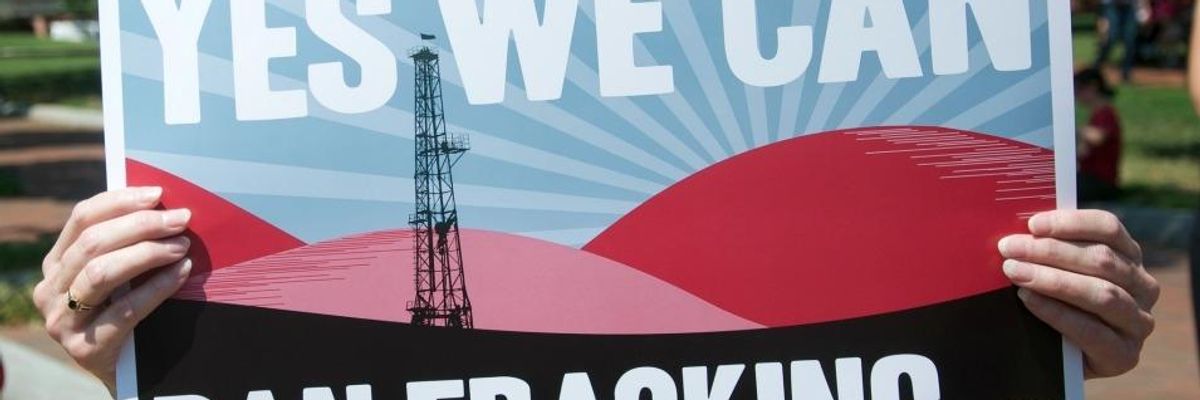
A protester holds a sign at an anti-fracking protest in Washington, D.C. in 2013. (Photo: Food & Water Watch/Flickr/cc)
"The actions we take now by extracting, transporting, and liquefying fracked gas will determine the health of generations to come."
That's according to Dr. Laalitha Surapaneni, an assistant professor at the University of Minnesota in the general internal medicine department and lead author of a report (pdf) published Tuesday by the nonprofit advocacy group Physicians for Social Responsibility (PSR).
Surapaneni and co-author Zachary Morse's new report, which details how liquefied natural gas (LNG) threatens both human health and the planet, comes as the Trump administration and bipartisan federal legislation continue to support its production.
LNG is primarily composed of methane, a greenhouse gas that is 84-87 times more potent than carbon dioxide over a 20-year period. The United States has seen a boom in LNG production over the past 15 years, driven primarily by the extraction process known as horizontal hydraulic fracturing or fracking--which involves injecting water and a secret mix of chemicals into rock formations.
The International Energy Agency (IEA) projected in June that the United States is on track to become the world's leading exporter of liquefied natural gas within five years. A Food & Water Watch report that shortly preceded the IEA's projection highlighted the more than 700 recently built or proposed U.S. facilities that aim "to capitalize off of a glut of cheap fracked gas."
"With LNG projects, we are locking ourselves into fossil fuel infrastructure that will heat up our planet and impose a human health cost."
--Dr. Laalitha Surapaneni, PSR
Surapaneni warned Tuesday that "with LNG projects, we are locking ourselves into fossil fuel infrastructure that will heat up our planet and impose a human health cost."
"Our current climate crisis is a health emergency," she said. "It is unconscionable that we continue to subject our communities to these risks when we have the technology to make a just transition to renewable energy."
The new 10-page report followed the sixth edition of the Compendium of Scientific, Medical, and Media Findings Demonstrating Risks and Harms of Fracking that PSR and Concerned Health Professionals of New York published in June--which led experts at PSR and elsewhere to reiterate that "we need to ban fracking."
In PSR's latest report, a section on "The Warming Planet" emphasizes the heat-trapping abilities of methane and notes that the Intergovernmental Panel on Climate Change (IPCC), the U.S. Global Change Research Program, and The Lancet "have all called for a rapid, unprecedented shift away from all fossil fuels in order to prevent potentially catastrophic climate change effects."
The report acknowledges research that has shown planetary heating caused by human activity leads to more intense extreme weather events, from fires to hurricanes, that can impact public health by increasing threats of heat stroke and exposure to waterborne illnesses.
The report's "polluting supply chain" section warns about health risks related to the "slurry of chemicals" used in the fracking process as well as air quality concerns near LNG terminals.
PSR references a U.S. Environmental Protection Agency webpage detailing the effects of particulate matter pollution, which range from premature death in people with heart or lung disease and nonfatal hearth attacks to aggravated asthma and decreased lung function.
In terms of safety and security, PSR notes that "LNG is a volatile and potentially explosive material," pointing to an 2014 incident in Plymouth, Washington that injured five people.
"LNG also poses grounds for concern in regard to national security," the report says. "A full LNG tanker carries the energy equivalent of 55 atomic bombs, making it a potential target for terrorist attacks, especially when at port near population centers."
Another section of the report points out how LNG production contributes to environmental injustice. As PSR explains:
These facilities are often placed in areas that are predominantly home to African American, Native American, and Hispanic families, and families of lower socioeconomic status, and may be sited close to schools and nursing homes. Such proximity, often reflecting these communities' lack of political power, intensifies the impact on vulnerable populations and people with pre-existing health conditions.
After outlining how the United States "is now rapidly building out its export capacity" for LNG, it concludes with a call to action--urging readers to share information about the health risks, demand greater transparency and more scientific research, and advocate for an urgent transition to clean energy.
"We have a unique opportunity," said Surapaneni, "to shape a world that is healthy and equitable by moving away from fossil fuels."
Dear Common Dreams reader, It’s been nearly 30 years since I co-founded Common Dreams with my late wife, Lina Newhouser. We had the radical notion that journalism should serve the public good, not corporate profits. It was clear to us from the outset what it would take to build such a project. No paid advertisements. No corporate sponsors. No millionaire publisher telling us what to think or do. Many people said we wouldn't last a year, but we proved those doubters wrong. Together with a tremendous team of journalists and dedicated staff, we built an independent media outlet free from the constraints of profits and corporate control. Our mission has always been simple: To inform. To inspire. To ignite change for the common good. Building Common Dreams was not easy. Our survival was never guaranteed. When you take on the most powerful forces—Wall Street greed, fossil fuel industry destruction, Big Tech lobbyists, and uber-rich oligarchs who have spent billions upon billions rigging the economy and democracy in their favor—the only bulwark you have is supporters who believe in your work. But here’s the urgent message from me today. It's never been this bad out there. And it's never been this hard to keep us going. At the very moment Common Dreams is most needed, the threats we face are intensifying. We need your support now more than ever. We don't accept corporate advertising and never will. We don't have a paywall because we don't think people should be blocked from critical news based on their ability to pay. Everything we do is funded by the donations of readers like you. When everyone does the little they can afford, we are strong. But if that support retreats or dries up, so do we. Will you donate now to make sure Common Dreams not only survives but thrives? —Craig Brown, Co-founder |
"The actions we take now by extracting, transporting, and liquefying fracked gas will determine the health of generations to come."
That's according to Dr. Laalitha Surapaneni, an assistant professor at the University of Minnesota in the general internal medicine department and lead author of a report (pdf) published Tuesday by the nonprofit advocacy group Physicians for Social Responsibility (PSR).
Surapaneni and co-author Zachary Morse's new report, which details how liquefied natural gas (LNG) threatens both human health and the planet, comes as the Trump administration and bipartisan federal legislation continue to support its production.
LNG is primarily composed of methane, a greenhouse gas that is 84-87 times more potent than carbon dioxide over a 20-year period. The United States has seen a boom in LNG production over the past 15 years, driven primarily by the extraction process known as horizontal hydraulic fracturing or fracking--which involves injecting water and a secret mix of chemicals into rock formations.
The International Energy Agency (IEA) projected in June that the United States is on track to become the world's leading exporter of liquefied natural gas within five years. A Food & Water Watch report that shortly preceded the IEA's projection highlighted the more than 700 recently built or proposed U.S. facilities that aim "to capitalize off of a glut of cheap fracked gas."
"With LNG projects, we are locking ourselves into fossil fuel infrastructure that will heat up our planet and impose a human health cost."
--Dr. Laalitha Surapaneni, PSR
Surapaneni warned Tuesday that "with LNG projects, we are locking ourselves into fossil fuel infrastructure that will heat up our planet and impose a human health cost."
"Our current climate crisis is a health emergency," she said. "It is unconscionable that we continue to subject our communities to these risks when we have the technology to make a just transition to renewable energy."
The new 10-page report followed the sixth edition of the Compendium of Scientific, Medical, and Media Findings Demonstrating Risks and Harms of Fracking that PSR and Concerned Health Professionals of New York published in June--which led experts at PSR and elsewhere to reiterate that "we need to ban fracking."
In PSR's latest report, a section on "The Warming Planet" emphasizes the heat-trapping abilities of methane and notes that the Intergovernmental Panel on Climate Change (IPCC), the U.S. Global Change Research Program, and The Lancet "have all called for a rapid, unprecedented shift away from all fossil fuels in order to prevent potentially catastrophic climate change effects."
The report acknowledges research that has shown planetary heating caused by human activity leads to more intense extreme weather events, from fires to hurricanes, that can impact public health by increasing threats of heat stroke and exposure to waterborne illnesses.
The report's "polluting supply chain" section warns about health risks related to the "slurry of chemicals" used in the fracking process as well as air quality concerns near LNG terminals.
PSR references a U.S. Environmental Protection Agency webpage detailing the effects of particulate matter pollution, which range from premature death in people with heart or lung disease and nonfatal hearth attacks to aggravated asthma and decreased lung function.
In terms of safety and security, PSR notes that "LNG is a volatile and potentially explosive material," pointing to an 2014 incident in Plymouth, Washington that injured five people.
"LNG also poses grounds for concern in regard to national security," the report says. "A full LNG tanker carries the energy equivalent of 55 atomic bombs, making it a potential target for terrorist attacks, especially when at port near population centers."
Another section of the report points out how LNG production contributes to environmental injustice. As PSR explains:
These facilities are often placed in areas that are predominantly home to African American, Native American, and Hispanic families, and families of lower socioeconomic status, and may be sited close to schools and nursing homes. Such proximity, often reflecting these communities' lack of political power, intensifies the impact on vulnerable populations and people with pre-existing health conditions.
After outlining how the United States "is now rapidly building out its export capacity" for LNG, it concludes with a call to action--urging readers to share information about the health risks, demand greater transparency and more scientific research, and advocate for an urgent transition to clean energy.
"We have a unique opportunity," said Surapaneni, "to shape a world that is healthy and equitable by moving away from fossil fuels."
"The actions we take now by extracting, transporting, and liquefying fracked gas will determine the health of generations to come."
That's according to Dr. Laalitha Surapaneni, an assistant professor at the University of Minnesota in the general internal medicine department and lead author of a report (pdf) published Tuesday by the nonprofit advocacy group Physicians for Social Responsibility (PSR).
Surapaneni and co-author Zachary Morse's new report, which details how liquefied natural gas (LNG) threatens both human health and the planet, comes as the Trump administration and bipartisan federal legislation continue to support its production.
LNG is primarily composed of methane, a greenhouse gas that is 84-87 times more potent than carbon dioxide over a 20-year period. The United States has seen a boom in LNG production over the past 15 years, driven primarily by the extraction process known as horizontal hydraulic fracturing or fracking--which involves injecting water and a secret mix of chemicals into rock formations.
The International Energy Agency (IEA) projected in June that the United States is on track to become the world's leading exporter of liquefied natural gas within five years. A Food & Water Watch report that shortly preceded the IEA's projection highlighted the more than 700 recently built or proposed U.S. facilities that aim "to capitalize off of a glut of cheap fracked gas."
"With LNG projects, we are locking ourselves into fossil fuel infrastructure that will heat up our planet and impose a human health cost."
--Dr. Laalitha Surapaneni, PSR
Surapaneni warned Tuesday that "with LNG projects, we are locking ourselves into fossil fuel infrastructure that will heat up our planet and impose a human health cost."
"Our current climate crisis is a health emergency," she said. "It is unconscionable that we continue to subject our communities to these risks when we have the technology to make a just transition to renewable energy."
The new 10-page report followed the sixth edition of the Compendium of Scientific, Medical, and Media Findings Demonstrating Risks and Harms of Fracking that PSR and Concerned Health Professionals of New York published in June--which led experts at PSR and elsewhere to reiterate that "we need to ban fracking."
In PSR's latest report, a section on "The Warming Planet" emphasizes the heat-trapping abilities of methane and notes that the Intergovernmental Panel on Climate Change (IPCC), the U.S. Global Change Research Program, and The Lancet "have all called for a rapid, unprecedented shift away from all fossil fuels in order to prevent potentially catastrophic climate change effects."
The report acknowledges research that has shown planetary heating caused by human activity leads to more intense extreme weather events, from fires to hurricanes, that can impact public health by increasing threats of heat stroke and exposure to waterborne illnesses.
The report's "polluting supply chain" section warns about health risks related to the "slurry of chemicals" used in the fracking process as well as air quality concerns near LNG terminals.
PSR references a U.S. Environmental Protection Agency webpage detailing the effects of particulate matter pollution, which range from premature death in people with heart or lung disease and nonfatal hearth attacks to aggravated asthma and decreased lung function.
In terms of safety and security, PSR notes that "LNG is a volatile and potentially explosive material," pointing to an 2014 incident in Plymouth, Washington that injured five people.
"LNG also poses grounds for concern in regard to national security," the report says. "A full LNG tanker carries the energy equivalent of 55 atomic bombs, making it a potential target for terrorist attacks, especially when at port near population centers."
Another section of the report points out how LNG production contributes to environmental injustice. As PSR explains:
These facilities are often placed in areas that are predominantly home to African American, Native American, and Hispanic families, and families of lower socioeconomic status, and may be sited close to schools and nursing homes. Such proximity, often reflecting these communities' lack of political power, intensifies the impact on vulnerable populations and people with pre-existing health conditions.
After outlining how the United States "is now rapidly building out its export capacity" for LNG, it concludes with a call to action--urging readers to share information about the health risks, demand greater transparency and more scientific research, and advocate for an urgent transition to clean energy.
"We have a unique opportunity," said Surapaneni, "to shape a world that is healthy and equitable by moving away from fossil fuels."