SUBSCRIBE TO OUR FREE NEWSLETTER
Daily news & progressive opinion—funded by the people, not the corporations—delivered straight to your inbox.
5
#000000
#FFFFFF
To donate by check, phone, or other method, see our More Ways to Give page.

New research "shows that gaining Medicaid coverage is literally a matter of life and death, particularly for people with serious health needs," and bolsters arguments in favor of states expanding their Medicaid programs, according to a report published this week by a leading progressive policy institute.
A report released Wednesday by the Center on Budget and Policy Priorities (CBPP) details how the Affordable Care Act's (ACA) expansion of Medicaid from 2014 to 2017 saved the lives of at least 19,200 people aged 55 to 64. Meanwhile, state decisions to not expand during that time led to the premature deaths of 15,600 adults in that age group.
Highlighting those figures in a tweet Friday, Andy Slavitt, who served as head of the Centers for Medicare and Medicaid Services in the Obama administration, called the CBPP's report "major" and "important."
Medicaid is a joint federal and state health insurance program that provides coverage to low-income people, families and children, pregnant women, the elderly, and people with disabilities. The ACA, signed in 2010, aimed to force states to expand Medicaid eligibility to adults with incomes up to 138 percent of the federal poverty level--but a 2012 U.S. Supreme Court ruling made the expansion voluntary.
The CBPP report is based on a study conducted by Sarah Miller of the University of Michigan, Sean Altekruse of the National Institutes of Health, Norman Johnson of the Census Bureau, and Laura Wherry of the University of California, Los Angeles. The researchers looked at mortality trends for lower-income older adults in recent years, as several states expanded Medicaid eligibility.
Based on the study, Matt Broaddus and Aviva Aron-Dine explain in their CBPP report (pdf), "the lifesaving impacts of Medicaid expansion are large: an estimated 39 to 64 percent reduction in annual mortality rates for older adults gaining coverage."
Broaddus and Aron-Dine write that "the new research fills a void, using a novel dataset to document sizable declines in mortality that smaller surveys could not detect. But its findings are consistent with a large body of research that has already documented that Medicaid expansion improves access to care and health outcomes."
"For example, research shows that Medicaid expansion increased the share of low-income adults using medications to control chronic conditions like heart disease and diabetes," the CBPP authors note. "The new study finds particularly clear evidence of a drop in mortality from conditions like these, which are amenable to medication and other treatment."
In a related blog post, Aron-Dine points out that "the study likely underestimates the lives saved by expansion because it doesn't capture the policy's long-term benefits or include certain expansion states. Nonetheless, expansion's lifesaving potential ranks with other major public health interventions: if all states had expanded Medicaid, the lives saved just among older adults in 2017 would roughly equal the lives saved by seatbelts among the full population."
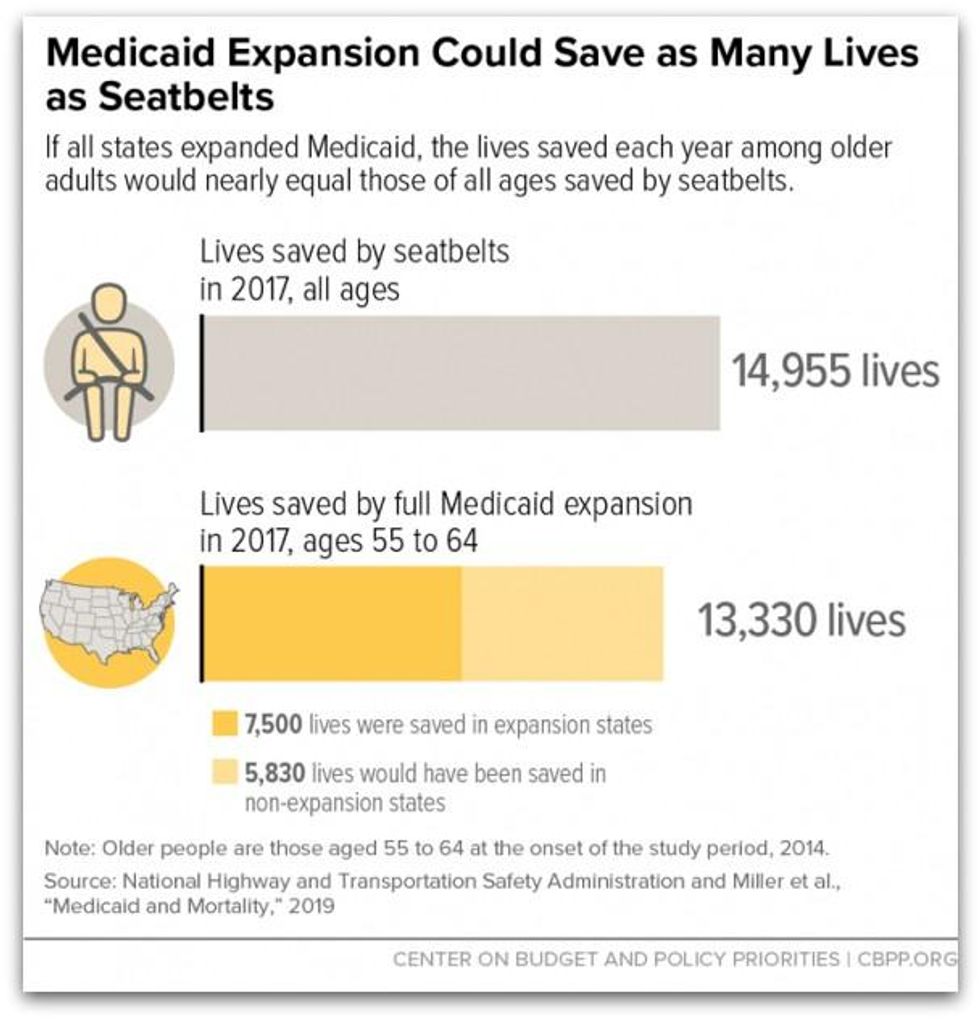
CBPP's report comes after 33 states and Washington, D.C. have expanded their Medicaid programs in recent years and three more plan to do so in 2020.
Aron-Dine's blog post also summarizes previous research showing that Medicaid expansion boosts health and well-being by preventing evictions, improving quality of care, and increasing access to treatment for opioid use disorder. She concludes that "these findings should give the 14 states that haven't yet decided to expand Medicaid more reason to do so."
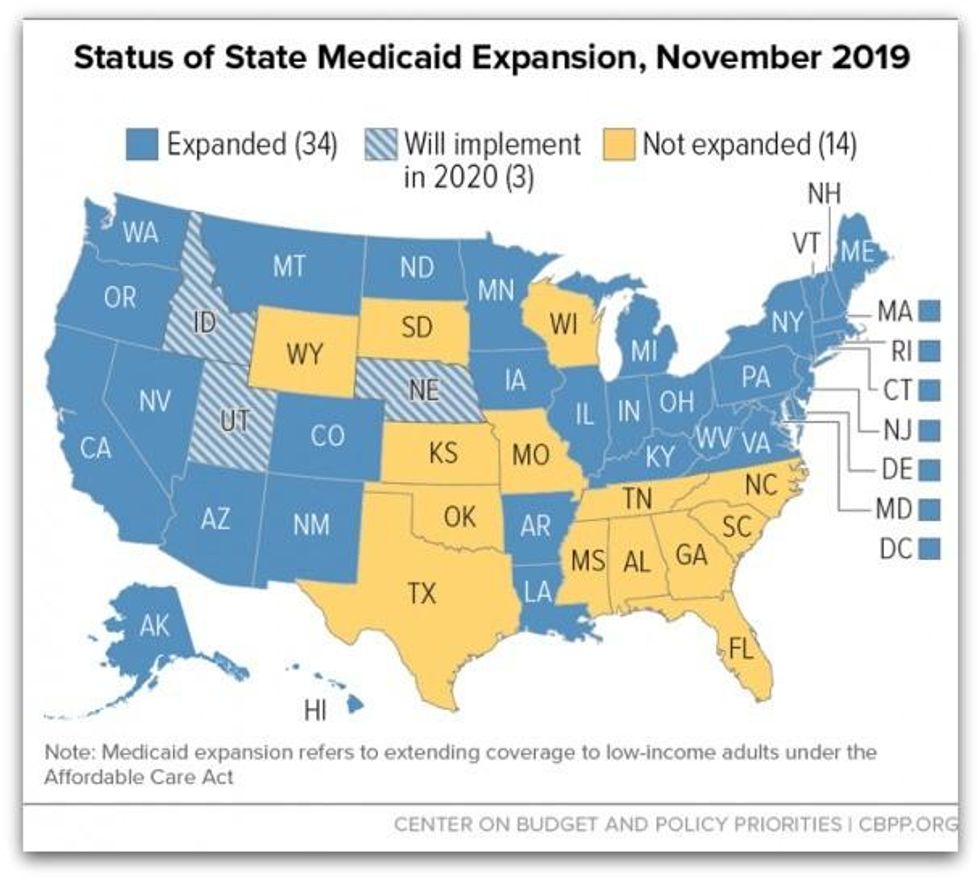
One of the charts created by CBPP as part of a collection explaining the "far-reaching benefits" of the ACA's Medicaid expansion shows that many states which have not expanded eligibility are located in the South, where state legislatures and governor posts often have been dominated by Republicans in recent years:
Judy Solomon, a CBPP senior fellow who focuses on health policy, shared the institute's new report on Twitter Wednesday and connected the ongoing fight for nationwide Medicaid expansion to some state-level results from Tuesday's election.
In Virginia, the Democratic Party took full control of the state government for the first time in nearly three decades by flipping seats in the state House of Delegates and Senate. In Kentucky, Democrat Andy Beshear declared victory in the race for governor--though the widely unpopular Republican incumbent, Matt Bevin, has refused to concede.
Last year, in a move decried as "vindictive and cruel," Bevin cancelled dental and vision Medicaid coverage for 460,000 in Kentucky just after a federal judge struck down the governor's attempt to impose work requirements on the state's 1.4 million Medicaid recipients.
Solomon said Wednesday that voters in both Kentucky and Virginia "showed they understand #Medicaid saves lives, increases financial stability, and improves overall well-being."
New research "shows that gaining Medicaid coverage is literally a matter of life and death, particularly for people with serious health needs," and bolsters arguments in favor of states expanding their Medicaid programs, according to a report published this week by a leading progressive policy institute.
A report released Wednesday by the Center on Budget and Policy Priorities (CBPP) details how the Affordable Care Act's (ACA) expansion of Medicaid from 2014 to 2017 saved the lives of at least 19,200 people aged 55 to 64. Meanwhile, state decisions to not expand during that time led to the premature deaths of 15,600 adults in that age group.
Highlighting those figures in a tweet Friday, Andy Slavitt, who served as head of the Centers for Medicare and Medicaid Services in the Obama administration, called the CBPP's report "major" and "important."
Medicaid is a joint federal and state health insurance program that provides coverage to low-income people, families and children, pregnant women, the elderly, and people with disabilities. The ACA, signed in 2010, aimed to force states to expand Medicaid eligibility to adults with incomes up to 138 percent of the federal poverty level--but a 2012 U.S. Supreme Court ruling made the expansion voluntary.
The CBPP report is based on a study conducted by Sarah Miller of the University of Michigan, Sean Altekruse of the National Institutes of Health, Norman Johnson of the Census Bureau, and Laura Wherry of the University of California, Los Angeles. The researchers looked at mortality trends for lower-income older adults in recent years, as several states expanded Medicaid eligibility.
Based on the study, Matt Broaddus and Aviva Aron-Dine explain in their CBPP report (pdf), "the lifesaving impacts of Medicaid expansion are large: an estimated 39 to 64 percent reduction in annual mortality rates for older adults gaining coverage."
Broaddus and Aron-Dine write that "the new research fills a void, using a novel dataset to document sizable declines in mortality that smaller surveys could not detect. But its findings are consistent with a large body of research that has already documented that Medicaid expansion improves access to care and health outcomes."
"For example, research shows that Medicaid expansion increased the share of low-income adults using medications to control chronic conditions like heart disease and diabetes," the CBPP authors note. "The new study finds particularly clear evidence of a drop in mortality from conditions like these, which are amenable to medication and other treatment."
In a related blog post, Aron-Dine points out that "the study likely underestimates the lives saved by expansion because it doesn't capture the policy's long-term benefits or include certain expansion states. Nonetheless, expansion's lifesaving potential ranks with other major public health interventions: if all states had expanded Medicaid, the lives saved just among older adults in 2017 would roughly equal the lives saved by seatbelts among the full population."
CBPP's report comes after 33 states and Washington, D.C. have expanded their Medicaid programs in recent years and three more plan to do so in 2020.
Aron-Dine's blog post also summarizes previous research showing that Medicaid expansion boosts health and well-being by preventing evictions, improving quality of care, and increasing access to treatment for opioid use disorder. She concludes that "these findings should give the 14 states that haven't yet decided to expand Medicaid more reason to do so."
One of the charts created by CBPP as part of a collection explaining the "far-reaching benefits" of the ACA's Medicaid expansion shows that many states which have not expanded eligibility are located in the South, where state legislatures and governor posts often have been dominated by Republicans in recent years:
Judy Solomon, a CBPP senior fellow who focuses on health policy, shared the institute's new report on Twitter Wednesday and connected the ongoing fight for nationwide Medicaid expansion to some state-level results from Tuesday's election.
In Virginia, the Democratic Party took full control of the state government for the first time in nearly three decades by flipping seats in the state House of Delegates and Senate. In Kentucky, Democrat Andy Beshear declared victory in the race for governor--though the widely unpopular Republican incumbent, Matt Bevin, has refused to concede.
Last year, in a move decried as "vindictive and cruel," Bevin cancelled dental and vision Medicaid coverage for 460,000 in Kentucky just after a federal judge struck down the governor's attempt to impose work requirements on the state's 1.4 million Medicaid recipients.
Solomon said Wednesday that voters in both Kentucky and Virginia "showed they understand #Medicaid saves lives, increases financial stability, and improves overall well-being."
New research "shows that gaining Medicaid coverage is literally a matter of life and death, particularly for people with serious health needs," and bolsters arguments in favor of states expanding their Medicaid programs, according to a report published this week by a leading progressive policy institute.
A report released Wednesday by the Center on Budget and Policy Priorities (CBPP) details how the Affordable Care Act's (ACA) expansion of Medicaid from 2014 to 2017 saved the lives of at least 19,200 people aged 55 to 64. Meanwhile, state decisions to not expand during that time led to the premature deaths of 15,600 adults in that age group.
Highlighting those figures in a tweet Friday, Andy Slavitt, who served as head of the Centers for Medicare and Medicaid Services in the Obama administration, called the CBPP's report "major" and "important."
Medicaid is a joint federal and state health insurance program that provides coverage to low-income people, families and children, pregnant women, the elderly, and people with disabilities. The ACA, signed in 2010, aimed to force states to expand Medicaid eligibility to adults with incomes up to 138 percent of the federal poverty level--but a 2012 U.S. Supreme Court ruling made the expansion voluntary.
The CBPP report is based on a study conducted by Sarah Miller of the University of Michigan, Sean Altekruse of the National Institutes of Health, Norman Johnson of the Census Bureau, and Laura Wherry of the University of California, Los Angeles. The researchers looked at mortality trends for lower-income older adults in recent years, as several states expanded Medicaid eligibility.
Based on the study, Matt Broaddus and Aviva Aron-Dine explain in their CBPP report (pdf), "the lifesaving impacts of Medicaid expansion are large: an estimated 39 to 64 percent reduction in annual mortality rates for older adults gaining coverage."
Broaddus and Aron-Dine write that "the new research fills a void, using a novel dataset to document sizable declines in mortality that smaller surveys could not detect. But its findings are consistent with a large body of research that has already documented that Medicaid expansion improves access to care and health outcomes."
"For example, research shows that Medicaid expansion increased the share of low-income adults using medications to control chronic conditions like heart disease and diabetes," the CBPP authors note. "The new study finds particularly clear evidence of a drop in mortality from conditions like these, which are amenable to medication and other treatment."
In a related blog post, Aron-Dine points out that "the study likely underestimates the lives saved by expansion because it doesn't capture the policy's long-term benefits or include certain expansion states. Nonetheless, expansion's lifesaving potential ranks with other major public health interventions: if all states had expanded Medicaid, the lives saved just among older adults in 2017 would roughly equal the lives saved by seatbelts among the full population."
CBPP's report comes after 33 states and Washington, D.C. have expanded their Medicaid programs in recent years and three more plan to do so in 2020.
Aron-Dine's blog post also summarizes previous research showing that Medicaid expansion boosts health and well-being by preventing evictions, improving quality of care, and increasing access to treatment for opioid use disorder. She concludes that "these findings should give the 14 states that haven't yet decided to expand Medicaid more reason to do so."
One of the charts created by CBPP as part of a collection explaining the "far-reaching benefits" of the ACA's Medicaid expansion shows that many states which have not expanded eligibility are located in the South, where state legislatures and governor posts often have been dominated by Republicans in recent years:
Judy Solomon, a CBPP senior fellow who focuses on health policy, shared the institute's new report on Twitter Wednesday and connected the ongoing fight for nationwide Medicaid expansion to some state-level results from Tuesday's election.
In Virginia, the Democratic Party took full control of the state government for the first time in nearly three decades by flipping seats in the state House of Delegates and Senate. In Kentucky, Democrat Andy Beshear declared victory in the race for governor--though the widely unpopular Republican incumbent, Matt Bevin, has refused to concede.
Last year, in a move decried as "vindictive and cruel," Bevin cancelled dental and vision Medicaid coverage for 460,000 in Kentucky just after a federal judge struck down the governor's attempt to impose work requirements on the state's 1.4 million Medicaid recipients.
Solomon said Wednesday that voters in both Kentucky and Virginia "showed they understand #Medicaid saves lives, increases financial stability, and improves overall well-being."