

SUBSCRIBE TO OUR FREE NEWSLETTER
Daily news & progressive opinion—funded by the people, not the corporations—delivered straight to your inbox.
5
#000000
#FFFFFF
To donate by check, phone, or other method, see our More Ways to Give page.
Daily news & progressive opinion—funded by the people, not the corporations—delivered straight to your inbox.
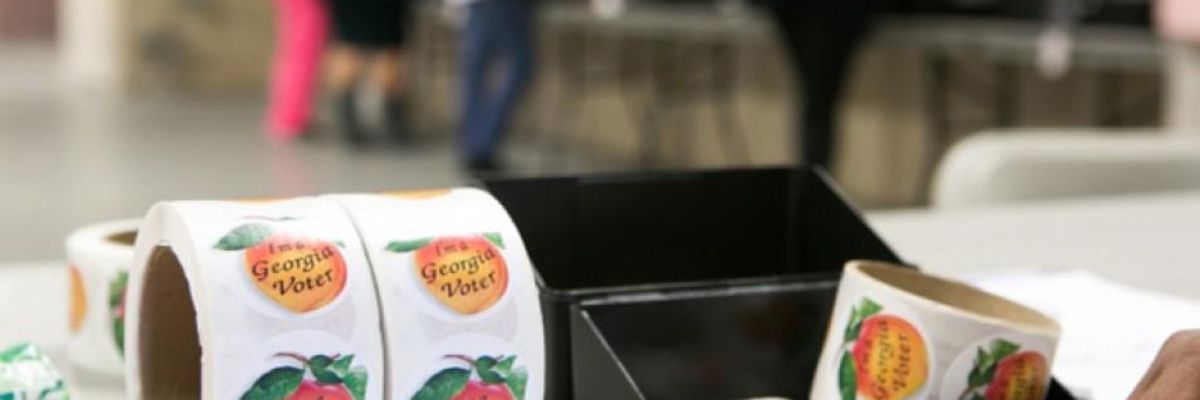
More than 300,000 voter registrations in Georgia are at risk of being purged from the rolls under the state's new voter registration rules. (Photo: Jessica McGowan/Getty Images)
Voting rights advocates in Georgia vowed to fight for the rights of more than 300,000 people in the state whose registrations may be purged from the rolls in the coming weeks by Republican Gov. Brian Kemp's administration.
Secretary of State Brad Raffensperger announced Monday that about 330,000 voter registrations may be canceled in early December if the voters do not confirm that they still live in the state. The purge is targeting people who have not voted in the last five years and could affect about four percent of the state's eligible voters.
"Having a long history of voter suppression, the Georgia secretary of state's office has a responsibility to guarantee that not a single voter is wrongly included on the purge list."
--Lauren Groh-Wargo, Fair Fight Action
"Voters should not lose their right to vote simply because they have decided not to express that right in recent elections," Fair Fight Action's Lauren Groh-Wargo told the Atlanta Journal-Constitution. The group was founded by Stacey Abrams, the 2018 Democratic gubernatorial candidate in the state.
While Kemp was serving as secretary of state in 2017, his office oversaw the largest purge of voter registrations in U.S. history, kicking more than 534,000 people off the rolls. Voting rights groups condemned Georgia's Republican leaders for what they saw as massive voter suppression effort--especially after Kemp went on to win the 2018 election by 1.4 percentage points.
"Having a long history of voter suppression, the Georgia secretary of state's office has a responsibility to guarantee that not a single voter is wrongly included on the purge list," Groh-Wargo told the Journal-Constitution.
This year, election officials will have to notify voters before their registrations are purged--a requirement that wasn't in effect in 2018. Notifications warning of the purge will be sent out to voters' last known addresses in early November and recipients will have 30 days to respond before their names are removed from state records.
The nonpartisan group Georgia Voter Guide posted an image of the form on social media and warned voters to respond if they receive the notification.
Fair Fight also tweeted that it plans to organize volunteer phone banks and other efforts to contact voters who will be receiving the forms.
The group filed a lawsuit against the state earlier this year alleging that during the 2018 election Kemp's former office kept voters from the polls by canceling registrations and well as closing hundreds of precincts in rural areas that were largely populated by low-income and black residents.
On Monday, American Public Media (APM) reported that Georgia's voter registration deadline--one of the strictest in the country, requiring voters to register at least 29 days before an election--kept 87,000 people from voting in 2018.
"This is why every state should have Election Day registration," tweeted journalist Ari Berman.
Voting experts say deadlines and confirmation forms like those Georgia is requiring don't reflect the reality of how many Americans vote.
"A significant part of the electorate makes up its mind on the day of the election," political science professor Robert Alexander told APM. "What's important is that people who want to go to the polls should be able to."
Dear Common Dreams reader, It’s been nearly 30 years since I co-founded Common Dreams with my late wife, Lina Newhouser. We had the radical notion that journalism should serve the public good, not corporate profits. It was clear to us from the outset what it would take to build such a project. No paid advertisements. No corporate sponsors. No millionaire publisher telling us what to think or do. Many people said we wouldn't last a year, but we proved those doubters wrong. Together with a tremendous team of journalists and dedicated staff, we built an independent media outlet free from the constraints of profits and corporate control. Our mission has always been simple: To inform. To inspire. To ignite change for the common good. Building Common Dreams was not easy. Our survival was never guaranteed. When you take on the most powerful forces—Wall Street greed, fossil fuel industry destruction, Big Tech lobbyists, and uber-rich oligarchs who have spent billions upon billions rigging the economy and democracy in their favor—the only bulwark you have is supporters who believe in your work. But here’s the urgent message from me today. It's never been this bad out there. And it's never been this hard to keep us going. At the very moment Common Dreams is most needed, the threats we face are intensifying. We need your support now more than ever. We don't accept corporate advertising and never will. We don't have a paywall because we don't think people should be blocked from critical news based on their ability to pay. Everything we do is funded by the donations of readers like you. When everyone does the little they can afford, we are strong. But if that support retreats or dries up, so do we. Will you donate now to make sure Common Dreams not only survives but thrives? —Craig Brown, Co-founder |
Voting rights advocates in Georgia vowed to fight for the rights of more than 300,000 people in the state whose registrations may be purged from the rolls in the coming weeks by Republican Gov. Brian Kemp's administration.
Secretary of State Brad Raffensperger announced Monday that about 330,000 voter registrations may be canceled in early December if the voters do not confirm that they still live in the state. The purge is targeting people who have not voted in the last five years and could affect about four percent of the state's eligible voters.
"Having a long history of voter suppression, the Georgia secretary of state's office has a responsibility to guarantee that not a single voter is wrongly included on the purge list."
--Lauren Groh-Wargo, Fair Fight Action
"Voters should not lose their right to vote simply because they have decided not to express that right in recent elections," Fair Fight Action's Lauren Groh-Wargo told the Atlanta Journal-Constitution. The group was founded by Stacey Abrams, the 2018 Democratic gubernatorial candidate in the state.
While Kemp was serving as secretary of state in 2017, his office oversaw the largest purge of voter registrations in U.S. history, kicking more than 534,000 people off the rolls. Voting rights groups condemned Georgia's Republican leaders for what they saw as massive voter suppression effort--especially after Kemp went on to win the 2018 election by 1.4 percentage points.
"Having a long history of voter suppression, the Georgia secretary of state's office has a responsibility to guarantee that not a single voter is wrongly included on the purge list," Groh-Wargo told the Journal-Constitution.
This year, election officials will have to notify voters before their registrations are purged--a requirement that wasn't in effect in 2018. Notifications warning of the purge will be sent out to voters' last known addresses in early November and recipients will have 30 days to respond before their names are removed from state records.
The nonpartisan group Georgia Voter Guide posted an image of the form on social media and warned voters to respond if they receive the notification.
Fair Fight also tweeted that it plans to organize volunteer phone banks and other efforts to contact voters who will be receiving the forms.
The group filed a lawsuit against the state earlier this year alleging that during the 2018 election Kemp's former office kept voters from the polls by canceling registrations and well as closing hundreds of precincts in rural areas that were largely populated by low-income and black residents.
On Monday, American Public Media (APM) reported that Georgia's voter registration deadline--one of the strictest in the country, requiring voters to register at least 29 days before an election--kept 87,000 people from voting in 2018.
"This is why every state should have Election Day registration," tweeted journalist Ari Berman.
Voting experts say deadlines and confirmation forms like those Georgia is requiring don't reflect the reality of how many Americans vote.
"A significant part of the electorate makes up its mind on the day of the election," political science professor Robert Alexander told APM. "What's important is that people who want to go to the polls should be able to."
Voting rights advocates in Georgia vowed to fight for the rights of more than 300,000 people in the state whose registrations may be purged from the rolls in the coming weeks by Republican Gov. Brian Kemp's administration.
Secretary of State Brad Raffensperger announced Monday that about 330,000 voter registrations may be canceled in early December if the voters do not confirm that they still live in the state. The purge is targeting people who have not voted in the last five years and could affect about four percent of the state's eligible voters.
"Having a long history of voter suppression, the Georgia secretary of state's office has a responsibility to guarantee that not a single voter is wrongly included on the purge list."
--Lauren Groh-Wargo, Fair Fight Action
"Voters should not lose their right to vote simply because they have decided not to express that right in recent elections," Fair Fight Action's Lauren Groh-Wargo told the Atlanta Journal-Constitution. The group was founded by Stacey Abrams, the 2018 Democratic gubernatorial candidate in the state.
While Kemp was serving as secretary of state in 2017, his office oversaw the largest purge of voter registrations in U.S. history, kicking more than 534,000 people off the rolls. Voting rights groups condemned Georgia's Republican leaders for what they saw as massive voter suppression effort--especially after Kemp went on to win the 2018 election by 1.4 percentage points.
"Having a long history of voter suppression, the Georgia secretary of state's office has a responsibility to guarantee that not a single voter is wrongly included on the purge list," Groh-Wargo told the Journal-Constitution.
This year, election officials will have to notify voters before their registrations are purged--a requirement that wasn't in effect in 2018. Notifications warning of the purge will be sent out to voters' last known addresses in early November and recipients will have 30 days to respond before their names are removed from state records.
The nonpartisan group Georgia Voter Guide posted an image of the form on social media and warned voters to respond if they receive the notification.
Fair Fight also tweeted that it plans to organize volunteer phone banks and other efforts to contact voters who will be receiving the forms.
The group filed a lawsuit against the state earlier this year alleging that during the 2018 election Kemp's former office kept voters from the polls by canceling registrations and well as closing hundreds of precincts in rural areas that were largely populated by low-income and black residents.
On Monday, American Public Media (APM) reported that Georgia's voter registration deadline--one of the strictest in the country, requiring voters to register at least 29 days before an election--kept 87,000 people from voting in 2018.
"This is why every state should have Election Day registration," tweeted journalist Ari Berman.
Voting experts say deadlines and confirmation forms like those Georgia is requiring don't reflect the reality of how many Americans vote.
"A significant part of the electorate makes up its mind on the day of the election," political science professor Robert Alexander told APM. "What's important is that people who want to go to the polls should be able to."

