
Driven by projections of "spectacular" growth in the solar power market, global renewable energy capacity could increase by 50 percent in the next five years, according to a report released Monday by the International Energy Agency.
The IEA's report, Renewables 2019, uses market analysis on renewable energy and technologies, including solar photovoltaic (PV) systems, to project industry trends through 2024.
The intergovernmental organization summarized its projections for capacity, which refers to the maximum amount of power that installations can produce, in a statement:
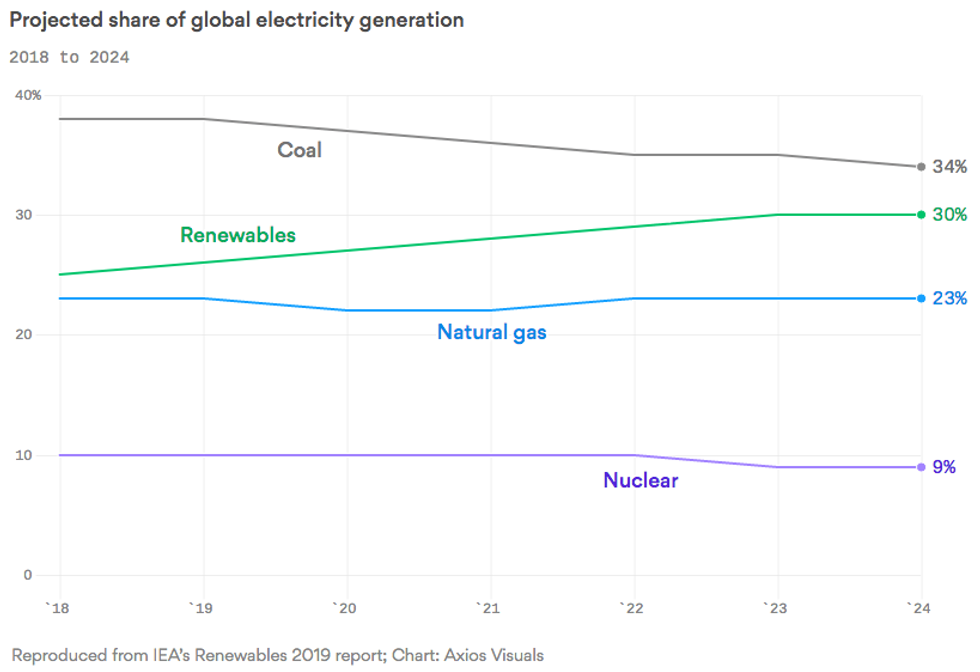
This increase of 1,200 gigawatts--equivalent to the current total power capacity of the United States--is driven by cost reductions and concerted government policy efforts. Solar PV accounts for 60 percent of the rise. The share of renewables in global power generation is set to rise from 26 percent today to 30 percent in 2024.
IEA executive director Fatih Birol said Monday that "renewables are already the world's second largest source of electricity, but their deployment still needs to accelerate if we are to achieve long-term climate, air quality, and energy access goals."
Three major challenges to boosting deployment are "policy and regulatory uncertainty, high investment risks, and system integration of wind and solar PV," according to the IEA's report. "Important policy and tariff reforms are needed to ensure distributed PV's growth is sustainable."
The report forecasts an increase in installations of solar PV systems on homes as well as commercial buildings and industrial facilities. By 2024, the number of solar rooftop systems on homes could double to about 100 million, with high demand in Austria, Australia, Belgium, the state of California, and the Netherlands.
IEA projects the cost of generating electricity from distributed solar PV systems could decline by up to 35 percent within five years. Birol said that "as costs continue to fall, we have a growing incentive to ramp up the deployment of solar PV."
"Distributed PV's potential is breathtaking, but its development needs to be well managed to balance the different interests of PV system owners, other consumers, and energy and distribution companies," he added. "The IEA is ready to advise governments on what is needed to take full advantage of this rapidly emerging technology without jeopardizing electricity security."
The IEA's projections and promise to assist with this deployment, however, come with some baggage. The Paris-based organization, founded in the wake of the 1973 oil crisis, has long been accused of "deliberately" undermining a global transition to renewable energy because of its ties to the fossil fuel and nuclear industries.
"The IEA has always been, and remains, dismally pessimistic about wind and solar energy," David Roberts wrote for Vox in 2015. "Why does the IEA continue to lowball renewables, even in the face of persistent critiques? There are several stories about this floating around, and none of them are entirely satisfying."
In response to that letter, climate activist Hannah McKinnon wrote for Oil Change International, "The suggested changes to the IEA's WEO would have an outsized impact on everything from the urgent need to 'shift the trillions' away from climate-incompatible fossil fuel financing to helping governments plan for success in energy decision-making to how we collectively conceive our energy future."
Birol, for his part, defended IEA's forecasts, writing in April that the SDS "is fully aligned with the Paris agreement's goal of 'holding the increase in the global average temperature to well below 2degC above pre-industrial levels and pursuing efforts to limit the temperature increase to 1.5degC.'"
Driven by projections of "spectacular" growth in the solar power market, global renewable energy capacity could increase by 50 percent in the next five years, according to a report released Monday by the International Energy Agency.
The IEA's report, Renewables 2019, uses market analysis on renewable energy and technologies, including solar photovoltaic (PV) systems, to project industry trends through 2024.
The intergovernmental organization summarized its projections for capacity, which refers to the maximum amount of power that installations can produce, in a statement:
This increase of 1,200 gigawatts--equivalent to the current total power capacity of the United States--is driven by cost reductions and concerted government policy efforts. Solar PV accounts for 60 percent of the rise. The share of renewables in global power generation is set to rise from 26 percent today to 30 percent in 2024.
IEA executive director Fatih Birol said Monday that "renewables are already the world's second largest source of electricity, but their deployment still needs to accelerate if we are to achieve long-term climate, air quality, and energy access goals."
Three major challenges to boosting deployment are "policy and regulatory uncertainty, high investment risks, and system integration of wind and solar PV," according to the IEA's report. "Important policy and tariff reforms are needed to ensure distributed PV's growth is sustainable."
The report forecasts an increase in installations of solar PV systems on homes as well as commercial buildings and industrial facilities. By 2024, the number of solar rooftop systems on homes could double to about 100 million, with high demand in Austria, Australia, Belgium, the state of California, and the Netherlands.
IEA projects the cost of generating electricity from distributed solar PV systems could decline by up to 35 percent within five years. Birol said that "as costs continue to fall, we have a growing incentive to ramp up the deployment of solar PV."
"Distributed PV's potential is breathtaking, but its development needs to be well managed to balance the different interests of PV system owners, other consumers, and energy and distribution companies," he added. "The IEA is ready to advise governments on what is needed to take full advantage of this rapidly emerging technology without jeopardizing electricity security."
The IEA's projections and promise to assist with this deployment, however, come with some baggage. The Paris-based organization, founded in the wake of the 1973 oil crisis, has long been accused of "deliberately" undermining a global transition to renewable energy because of its ties to the fossil fuel and nuclear industries.
"The IEA has always been, and remains, dismally pessimistic about wind and solar energy," David Roberts wrote for Vox in 2015. "Why does the IEA continue to lowball renewables, even in the face of persistent critiques? There are several stories about this floating around, and none of them are entirely satisfying."
In response to that letter, climate activist Hannah McKinnon wrote for Oil Change International, "The suggested changes to the IEA's WEO would have an outsized impact on everything from the urgent need to 'shift the trillions' away from climate-incompatible fossil fuel financing to helping governments plan for success in energy decision-making to how we collectively conceive our energy future."
Birol, for his part, defended IEA's forecasts, writing in April that the SDS "is fully aligned with the Paris agreement's goal of 'holding the increase in the global average temperature to well below 2degC above pre-industrial levels and pursuing efforts to limit the temperature increase to 1.5degC.'"
Driven by projections of "spectacular" growth in the solar power market, global renewable energy capacity could increase by 50 percent in the next five years, according to a report released Monday by the International Energy Agency.
The IEA's report, Renewables 2019, uses market analysis on renewable energy and technologies, including solar photovoltaic (PV) systems, to project industry trends through 2024.
The intergovernmental organization summarized its projections for capacity, which refers to the maximum amount of power that installations can produce, in a statement:
This increase of 1,200 gigawatts--equivalent to the current total power capacity of the United States--is driven by cost reductions and concerted government policy efforts. Solar PV accounts for 60 percent of the rise. The share of renewables in global power generation is set to rise from 26 percent today to 30 percent in 2024.
IEA executive director Fatih Birol said Monday that "renewables are already the world's second largest source of electricity, but their deployment still needs to accelerate if we are to achieve long-term climate, air quality, and energy access goals."
Three major challenges to boosting deployment are "policy and regulatory uncertainty, high investment risks, and system integration of wind and solar PV," according to the IEA's report. "Important policy and tariff reforms are needed to ensure distributed PV's growth is sustainable."
The report forecasts an increase in installations of solar PV systems on homes as well as commercial buildings and industrial facilities. By 2024, the number of solar rooftop systems on homes could double to about 100 million, with high demand in Austria, Australia, Belgium, the state of California, and the Netherlands.
IEA projects the cost of generating electricity from distributed solar PV systems could decline by up to 35 percent within five years. Birol said that "as costs continue to fall, we have a growing incentive to ramp up the deployment of solar PV."
"Distributed PV's potential is breathtaking, but its development needs to be well managed to balance the different interests of PV system owners, other consumers, and energy and distribution companies," he added. "The IEA is ready to advise governments on what is needed to take full advantage of this rapidly emerging technology without jeopardizing electricity security."
The IEA's projections and promise to assist with this deployment, however, come with some baggage. The Paris-based organization, founded in the wake of the 1973 oil crisis, has long been accused of "deliberately" undermining a global transition to renewable energy because of its ties to the fossil fuel and nuclear industries.
"The IEA has always been, and remains, dismally pessimistic about wind and solar energy," David Roberts wrote for Vox in 2015. "Why does the IEA continue to lowball renewables, even in the face of persistent critiques? There are several stories about this floating around, and none of them are entirely satisfying."
In response to that letter, climate activist Hannah McKinnon wrote for Oil Change International, "The suggested changes to the IEA's WEO would have an outsized impact on everything from the urgent need to 'shift the trillions' away from climate-incompatible fossil fuel financing to helping governments plan for success in energy decision-making to how we collectively conceive our energy future."
Birol, for his part, defended IEA's forecasts, writing in April that the SDS "is fully aligned with the Paris agreement's goal of 'holding the increase in the global average temperature to well below 2degC above pre-industrial levels and pursuing efforts to limit the temperature increase to 1.5degC.'"