SUBSCRIBE TO OUR FREE NEWSLETTER
Daily news & progressive opinion—funded by the people, not the corporations—delivered straight to your inbox.
5
#000000
#FFFFFF
To donate by check, phone, or other method, see our More Ways to Give page.
Daily news & progressive opinion—funded by the people, not the corporations—delivered straight to your inbox.
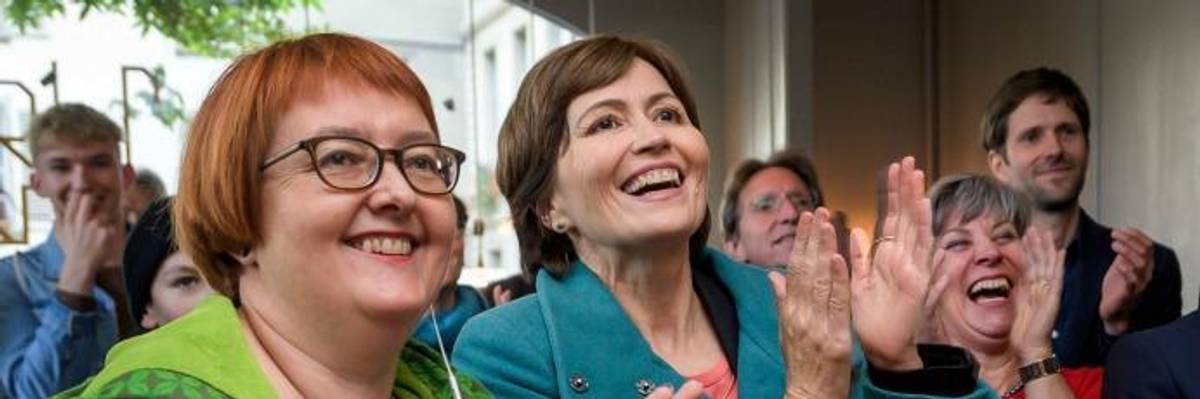
Swiss Green Party President Regula Rytz (C) reacts with party members upon the announcement of the first results during the general election on October 20, 2019 in Switzerland's capital Bern. (Photo: Fabrice Coffrini/AFP via Getty Images)
Greens in Switzerland saw historic gains--and the right wing lost ground--after Swiss voters went to the polls Sunday for national elections.
"It is not a green wave; it is a tsunami, a hurricane," deputy Greens leader Celina Vara told Swiss radio.
Agence France-Presse reported Sunday:
The Greens garnered 13.2 per cent support, exceeding their pre-election projection and marking a six-point bump on their 2015 performance. The Green Liberals (GLP)--an environmentalist party with libertarian socio-economic policies--also gained ground, taking 7.8 percent of the vote compared with less than five per cent in 2015.
Combined, the two parties have nearly 21 percent "should they overcome policy differences and decide to join forces," the Sydney Morning Herald noted. "Together," the outlet added, "they gained 26 seats in the 200-seat lower house, potentially putting them in line to take one of the seats in the seven-seat cabinet, the Federal Council" (Bundesrat/Conseil Federal).
The anti-immigration Swiss People's Party (SVP), however, still claimed the top spot with 25.6 percent of the vote, AFP reported, though the result marked a 3.8 percentage point drop since the 2015 election. According to Europe Elects, the party had "its worst national parliament election result since 1999."
With 11.4 percent of the vote, the center-right CVP (EPP), for its part, had "its worst national parliament election result since its creation in 1912," Europe Elects said.
"The three other parties in the cabinet, the SP, the FDP, and the Christian Democrats, also chalked up significant losses, with the latter party being beaten to fourth spot by the Greens for the first time," reported The Guardian.
"This is a historic result for the Swiss Greens," said Regula Rytz, president of the Swiss Greens (Grune Schweiz/ Les Verts Suisse), in a statement Sunday. "Never before has climate featured so dominantly among people's concerns and never before have the Swiss Greens performed so well."
"The Green wave continues to roll on in Switzerland this weekend in the latest in a string of victories for Green parties across Europe," European Green Party co-chair Reinhard Butikofer said Sunday. "We congratulate the Swiss Greens on this emphatic victory for Green values, which has stemmed the rise of a toxic far-right political narrative."
"The disappearance of the Pizol glacier in the Swiss Alps earlier this year made climate change more urgently closer to home than ever before," added Butikofer. "It made it clear that urgent climate action simply cannot wait any longer."
That urgency is at least in part thanks to young people rising up in cities worldwide demanding leaders take climate action.
The green parties' victory, according to Euro Intelligence, "will shake up the composition of the seven-seat Bundesrat, which hardly ever changed over the past decades. Clearly, the green movement and the Friday for future protests had been a vote changer."
This country and this world are at a monumental crossroads. US voters have an opportunity to beat back the forces of fascism and confront the billionaires who are rigging the economy, our media system, and our democracy, making it increasingly impossible for ordinary people to get by. We’re not just talking about the election. We’re talking about what must be done once these fascist elements are vanquished from power. We need a bolder set of solutions than what either major party has so far been willing to offer and a working-class movement ready to fight like hell for it. Trump didn't emerge from nowhere. The conditions that fueled MAGA authoritarianism were created by decades of radical neoliberal economic policies and a corrupt political system dominated by corporate interests. They slashed taxes on the super-rich, promising that the benefits would trickle down. They said giveaways to the corporate titans would make life more affordable for the rest of us. It was all bullshit. And when a bitter, betrayed populace searches for someone to blame, right-wing demagogues have little trouble finding scapegoats. People know when they're being lied to, but you won't hear any of this from the corporate media. Only independent journalism—powered and funded by people who believe in building a better world—can deliver truly trustworthy daily news. If you share our vision, please contribute whatever you can to sustain our work. |
Greens in Switzerland saw historic gains--and the right wing lost ground--after Swiss voters went to the polls Sunday for national elections.
"It is not a green wave; it is a tsunami, a hurricane," deputy Greens leader Celina Vara told Swiss radio.
Agence France-Presse reported Sunday:
The Greens garnered 13.2 per cent support, exceeding their pre-election projection and marking a six-point bump on their 2015 performance. The Green Liberals (GLP)--an environmentalist party with libertarian socio-economic policies--also gained ground, taking 7.8 percent of the vote compared with less than five per cent in 2015.
Combined, the two parties have nearly 21 percent "should they overcome policy differences and decide to join forces," the Sydney Morning Herald noted. "Together," the outlet added, "they gained 26 seats in the 200-seat lower house, potentially putting them in line to take one of the seats in the seven-seat cabinet, the Federal Council" (Bundesrat/Conseil Federal).
The anti-immigration Swiss People's Party (SVP), however, still claimed the top spot with 25.6 percent of the vote, AFP reported, though the result marked a 3.8 percentage point drop since the 2015 election. According to Europe Elects, the party had "its worst national parliament election result since 1999."
With 11.4 percent of the vote, the center-right CVP (EPP), for its part, had "its worst national parliament election result since its creation in 1912," Europe Elects said.
"The three other parties in the cabinet, the SP, the FDP, and the Christian Democrats, also chalked up significant losses, with the latter party being beaten to fourth spot by the Greens for the first time," reported The Guardian.
"This is a historic result for the Swiss Greens," said Regula Rytz, president of the Swiss Greens (Grune Schweiz/ Les Verts Suisse), in a statement Sunday. "Never before has climate featured so dominantly among people's concerns and never before have the Swiss Greens performed so well."
"The Green wave continues to roll on in Switzerland this weekend in the latest in a string of victories for Green parties across Europe," European Green Party co-chair Reinhard Butikofer said Sunday. "We congratulate the Swiss Greens on this emphatic victory for Green values, which has stemmed the rise of a toxic far-right political narrative."
"The disappearance of the Pizol glacier in the Swiss Alps earlier this year made climate change more urgently closer to home than ever before," added Butikofer. "It made it clear that urgent climate action simply cannot wait any longer."
That urgency is at least in part thanks to young people rising up in cities worldwide demanding leaders take climate action.
The green parties' victory, according to Euro Intelligence, "will shake up the composition of the seven-seat Bundesrat, which hardly ever changed over the past decades. Clearly, the green movement and the Friday for future protests had been a vote changer."