SUBSCRIBE TO OUR FREE NEWSLETTER
Daily news & progressive opinion—funded by the people, not the corporations—delivered straight to your inbox.
5
#000000
#FFFFFF
To donate by check, phone, or other method, see our More Ways to Give page.
Daily news & progressive opinion—funded by the people, not the corporations—delivered straight to your inbox.
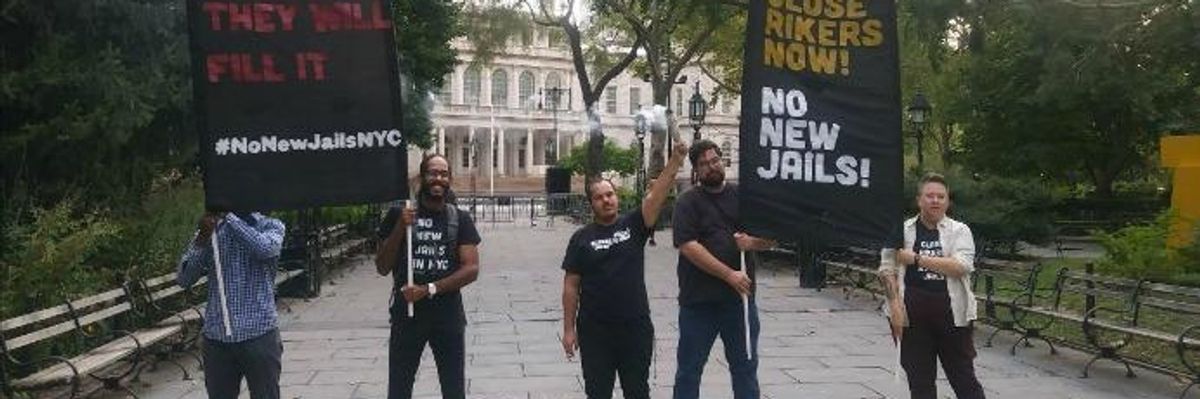
Protesters call for the closure of the Rikers prison complex and for no new prisons to be built. (Photo: No New Jails)
Social justice advocates said Thursday that their fight is not yet over after the city council of New York voted in favor of a plan to close the notorious Rikers Island jail complex by 2026 and open four borough-based jails.
"With an opportunity to take a stand against the centuries-old and universally-failed strategy of fixing jails by building jails," said No New Jails (NNJ) in a statement, "the council fell miserably short of the mark."
The $8.7 billion legislative package including the closure passed the council in a 36-13 vote and now heads to the desk of Mayor Bill De Blasio, who praised the plan and said at a press conference Thursday that the vote was "definitional and binding. Rikers is closing."
As the New York Daily News reported,
De Blasio first announced the plan to shutdown Rikers and construct new borough-based jails back in 2017. At the time, the proposal was projected to cost a staggering $10.6 billion. That figure has since dropped to $8.7 billion amid decarceration efforts like the implementation of state bail reforms and citywide investments in pretrial and sentencing diversion programs, officials said.
Projections over the average daily jail population have also fallen, down from an estimated 5,000 inmates in December 2018 to 3,300 people, according to a new city report released earlier this week.
A $391 million programming package that promises to fund mental health services, alternatives to incarceration and expand pretrial services like supervised release is attached to the ULURP.
The possibility of closing Rikers--a prison the Times' Mara Gay described as "a decrepit monument to an era of mass incarceration that robbed generations of black, Hispanic, and other Americans of their humanity"-- was welcomed by carceral system reform advocates. Other aspects of the plan, however, including the new jails which will be housed in Manhattan, Brooklyn, the Bronx, and Queens, came under fire.
Protesters with NNJ underscored that message Thursday when they disrupted the council meeting with shouts of "If they build it, they will fill it!"
One of the council members who voted against the plan, Democrat Carlos Menchaca, delivered a similar message during the vote. "We should be fighting mass incarceration and all cages," he said.
Another group, VOCAL-NY, said in a statement Thursday that its "members and leaders could not support the building of new jails, nor could they oppose investments to address the conditions within the borough facilities."
We cannot applaud the community investments that have been announced, despite there being meaningful and important commitments. Much of the investments are into criminal justice programs that serve people once they have become entangled in the criminal justice system, as opposed to true community investments that decrease the chance of that ever happening. Of the investments that are truly community-oriented, they are piecemeal and inadequate. We lay the blame for this at the feet of the mayor, not at the council.
According to New York City Public Advocate Jumaane D. Williams, the #CloseRikers movement will continue "even when the 400-acre monument to the cruelty of incarceration culture is finally empty." In an on-ed published Wednesday at the Daily News, he called for investments in public health, permanent housing, and pathways to reentry in order to better achieve decarceration.
Without a commitment to a large-scale investment in taking on the systemic inequities and injustices that have led to such mass incarceration at Rikers, this plan will only ensure that new beds in new locations will continue to be filled in a cycle of incarceration that has perpetuated and propped up jails to this point. With the goal of decarceration in mind, it must be paired with the goal of harm reduction--for as many people as possible, as quickly as possible, within the criminal justice system and outside of it.
Our criminal justice system isn't broken. It's operating how it was designed, and we cannot simply reform it; we need to uproot it. That means expanding mental health programs, income-targeted affordable housing programs, community investment, building up neighborhoods and people who have been left behind or discounted. In cases where crime does occur, it means expanding programs that provide alternatives to incarceration.
Williams and others say it's clear much more must be done to address the criminal justice system.
"We are more committed than ever to closing Rikers immediately with no new jails," said NNJ. "The fight is just beginning."
Dear Common Dreams reader, It’s been nearly 30 years since I co-founded Common Dreams with my late wife, Lina Newhouser. We had the radical notion that journalism should serve the public good, not corporate profits. It was clear to us from the outset what it would take to build such a project. No paid advertisements. No corporate sponsors. No millionaire publisher telling us what to think or do. Many people said we wouldn't last a year, but we proved those doubters wrong. Together with a tremendous team of journalists and dedicated staff, we built an independent media outlet free from the constraints of profits and corporate control. Our mission has always been simple: To inform. To inspire. To ignite change for the common good. Building Common Dreams was not easy. Our survival was never guaranteed. When you take on the most powerful forces—Wall Street greed, fossil fuel industry destruction, Big Tech lobbyists, and uber-rich oligarchs who have spent billions upon billions rigging the economy and democracy in their favor—the only bulwark you have is supporters who believe in your work. But here’s the urgent message from me today. It's never been this bad out there. And it's never been this hard to keep us going. At the very moment Common Dreams is most needed, the threats we face are intensifying. We need your support now more than ever. We don't accept corporate advertising and never will. We don't have a paywall because we don't think people should be blocked from critical news based on their ability to pay. Everything we do is funded by the donations of readers like you. When everyone does the little they can afford, we are strong. But if that support retreats or dries up, so do we. Will you donate now to make sure Common Dreams not only survives but thrives? —Craig Brown, Co-founder |
Social justice advocates said Thursday that their fight is not yet over after the city council of New York voted in favor of a plan to close the notorious Rikers Island jail complex by 2026 and open four borough-based jails.
"With an opportunity to take a stand against the centuries-old and universally-failed strategy of fixing jails by building jails," said No New Jails (NNJ) in a statement, "the council fell miserably short of the mark."
The $8.7 billion legislative package including the closure passed the council in a 36-13 vote and now heads to the desk of Mayor Bill De Blasio, who praised the plan and said at a press conference Thursday that the vote was "definitional and binding. Rikers is closing."
As the New York Daily News reported,
De Blasio first announced the plan to shutdown Rikers and construct new borough-based jails back in 2017. At the time, the proposal was projected to cost a staggering $10.6 billion. That figure has since dropped to $8.7 billion amid decarceration efforts like the implementation of state bail reforms and citywide investments in pretrial and sentencing diversion programs, officials said.
Projections over the average daily jail population have also fallen, down from an estimated 5,000 inmates in December 2018 to 3,300 people, according to a new city report released earlier this week.
A $391 million programming package that promises to fund mental health services, alternatives to incarceration and expand pretrial services like supervised release is attached to the ULURP.
The possibility of closing Rikers--a prison the Times' Mara Gay described as "a decrepit monument to an era of mass incarceration that robbed generations of black, Hispanic, and other Americans of their humanity"-- was welcomed by carceral system reform advocates. Other aspects of the plan, however, including the new jails which will be housed in Manhattan, Brooklyn, the Bronx, and Queens, came under fire.
Protesters with NNJ underscored that message Thursday when they disrupted the council meeting with shouts of "If they build it, they will fill it!"
One of the council members who voted against the plan, Democrat Carlos Menchaca, delivered a similar message during the vote. "We should be fighting mass incarceration and all cages," he said.
Another group, VOCAL-NY, said in a statement Thursday that its "members and leaders could not support the building of new jails, nor could they oppose investments to address the conditions within the borough facilities."
We cannot applaud the community investments that have been announced, despite there being meaningful and important commitments. Much of the investments are into criminal justice programs that serve people once they have become entangled in the criminal justice system, as opposed to true community investments that decrease the chance of that ever happening. Of the investments that are truly community-oriented, they are piecemeal and inadequate. We lay the blame for this at the feet of the mayor, not at the council.
According to New York City Public Advocate Jumaane D. Williams, the #CloseRikers movement will continue "even when the 400-acre monument to the cruelty of incarceration culture is finally empty." In an on-ed published Wednesday at the Daily News, he called for investments in public health, permanent housing, and pathways to reentry in order to better achieve decarceration.
Without a commitment to a large-scale investment in taking on the systemic inequities and injustices that have led to such mass incarceration at Rikers, this plan will only ensure that new beds in new locations will continue to be filled in a cycle of incarceration that has perpetuated and propped up jails to this point. With the goal of decarceration in mind, it must be paired with the goal of harm reduction--for as many people as possible, as quickly as possible, within the criminal justice system and outside of it.
Our criminal justice system isn't broken. It's operating how it was designed, and we cannot simply reform it; we need to uproot it. That means expanding mental health programs, income-targeted affordable housing programs, community investment, building up neighborhoods and people who have been left behind or discounted. In cases where crime does occur, it means expanding programs that provide alternatives to incarceration.
Williams and others say it's clear much more must be done to address the criminal justice system.
"We are more committed than ever to closing Rikers immediately with no new jails," said NNJ. "The fight is just beginning."
Social justice advocates said Thursday that their fight is not yet over after the city council of New York voted in favor of a plan to close the notorious Rikers Island jail complex by 2026 and open four borough-based jails.
"With an opportunity to take a stand against the centuries-old and universally-failed strategy of fixing jails by building jails," said No New Jails (NNJ) in a statement, "the council fell miserably short of the mark."
The $8.7 billion legislative package including the closure passed the council in a 36-13 vote and now heads to the desk of Mayor Bill De Blasio, who praised the plan and said at a press conference Thursday that the vote was "definitional and binding. Rikers is closing."
As the New York Daily News reported,
De Blasio first announced the plan to shutdown Rikers and construct new borough-based jails back in 2017. At the time, the proposal was projected to cost a staggering $10.6 billion. That figure has since dropped to $8.7 billion amid decarceration efforts like the implementation of state bail reforms and citywide investments in pretrial and sentencing diversion programs, officials said.
Projections over the average daily jail population have also fallen, down from an estimated 5,000 inmates in December 2018 to 3,300 people, according to a new city report released earlier this week.
A $391 million programming package that promises to fund mental health services, alternatives to incarceration and expand pretrial services like supervised release is attached to the ULURP.
The possibility of closing Rikers--a prison the Times' Mara Gay described as "a decrepit monument to an era of mass incarceration that robbed generations of black, Hispanic, and other Americans of their humanity"-- was welcomed by carceral system reform advocates. Other aspects of the plan, however, including the new jails which will be housed in Manhattan, Brooklyn, the Bronx, and Queens, came under fire.
Protesters with NNJ underscored that message Thursday when they disrupted the council meeting with shouts of "If they build it, they will fill it!"
One of the council members who voted against the plan, Democrat Carlos Menchaca, delivered a similar message during the vote. "We should be fighting mass incarceration and all cages," he said.
Another group, VOCAL-NY, said in a statement Thursday that its "members and leaders could not support the building of new jails, nor could they oppose investments to address the conditions within the borough facilities."
We cannot applaud the community investments that have been announced, despite there being meaningful and important commitments. Much of the investments are into criminal justice programs that serve people once they have become entangled in the criminal justice system, as opposed to true community investments that decrease the chance of that ever happening. Of the investments that are truly community-oriented, they are piecemeal and inadequate. We lay the blame for this at the feet of the mayor, not at the council.
According to New York City Public Advocate Jumaane D. Williams, the #CloseRikers movement will continue "even when the 400-acre monument to the cruelty of incarceration culture is finally empty." In an on-ed published Wednesday at the Daily News, he called for investments in public health, permanent housing, and pathways to reentry in order to better achieve decarceration.
Without a commitment to a large-scale investment in taking on the systemic inequities and injustices that have led to such mass incarceration at Rikers, this plan will only ensure that new beds in new locations will continue to be filled in a cycle of incarceration that has perpetuated and propped up jails to this point. With the goal of decarceration in mind, it must be paired with the goal of harm reduction--for as many people as possible, as quickly as possible, within the criminal justice system and outside of it.
Our criminal justice system isn't broken. It's operating how it was designed, and we cannot simply reform it; we need to uproot it. That means expanding mental health programs, income-targeted affordable housing programs, community investment, building up neighborhoods and people who have been left behind or discounted. In cases where crime does occur, it means expanding programs that provide alternatives to incarceration.
Williams and others say it's clear much more must be done to address the criminal justice system.
"We are more committed than ever to closing Rikers immediately with no new jails," said NNJ. "The fight is just beginning."