SUBSCRIBE TO OUR FREE NEWSLETTER
Daily news & progressive opinion—funded by the people, not the corporations—delivered straight to your inbox.
5
#000000
#FFFFFF
To donate by check, phone, or other method, see our More Ways to Give page.
Daily news & progressive opinion—funded by the people, not the corporations—delivered straight to your inbox.
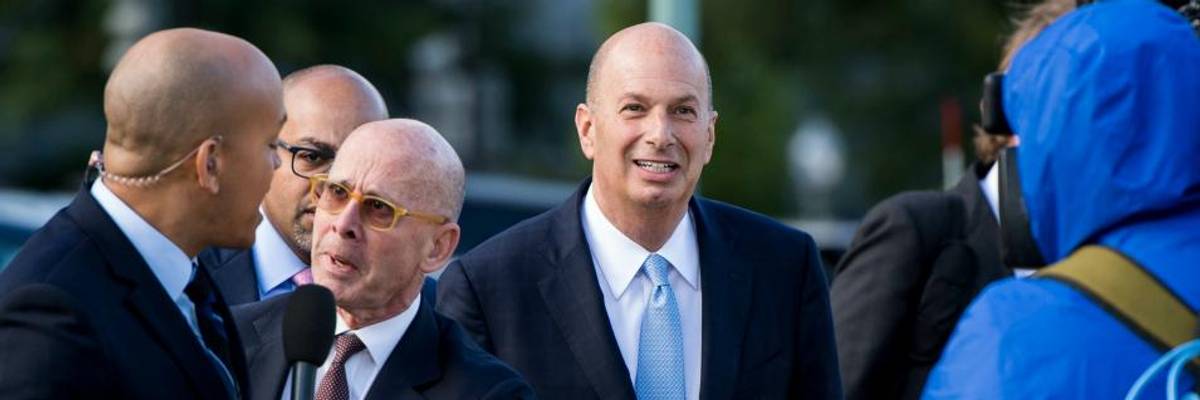
U.S. Ambassador to the European Union Gordon Sondland arrives at a closed session before the House Intelligence, Foreign Affairs and Oversight committees October 17, 2019 at the U.S. Capitol in Washington, D.C. (Photo by Alex Wong/Getty Images)
Gordon Sondland, U.S. Ambassador to the European Union, told House impeachment investigators on Thursday that President Donald Trump ordered him and other American diplomats to follow Rudy Giuliani's lead on Ukraine policy.
Sondland said in his opening statement (pdf) to the House committees leading the inquiry that he opposed the involvement of Giuliani, Trump's personal lawyer, in U.S.-Ukraine affairs--but ultimately obeyed the president's demands.
"Our view was that the men and women of the State Department, not the president's personal lawyer, should take responsibility for all aspects of U.S. foreign policy towards Ukraine," said Sondland, who was subpoenaed to testify after the Trump administration blocked him from appearing before the House last week.
"Based on the president's direction, we were faced with a choice," said Sondland. "We could abandon the goal of a White House meeting for [Ukranian] President [Volodymyr] Zelensky, which we all believed was crucial to strengthening U.S.-Ukrainian ties and furthering long-held U.S. foreign policy goals in the region; or we could do as President Trump directed and talk to Mr. Giuliani to address the president's concerns."
Rep. David Cicilline (D-R.I.), a member of the House Foreign Affairs Committee, told reporters Thursday that Sondland's opening remarks were "very damning" for the president and "further confirmation" that Giuliani was running a "shadow State Department effort" to investigate former Vice President Joe Biden.
Sondland said he didn't realize "until much later" that Giuliani was pressuring Ukraine to launch a probe into Biden.
Critics responded to Sondland's claim, which absolves him of complicity in potential wrongdoing, with skepticism. Washington Post reporter Aaron Blake noted on Twitter that "multiple stories" had been written about Giuliani's desire for an investigation into Biden.
"Mr. Giuliani has spearheaded the effort among conservatives to publicize and encourage the new investigation in Ukraine," the New York Times reported on May 1. Sondland said in his deposition that Trump instructed diplomats to work with Giuliani on Ukraine during a meeting on May 23.
As Sondland arrived at the Capitol to deliver his testimony, NBC reporter Geoff Bennett asked Sondland whether he is appearing before House investigators to "salvage" his reputation.
"I don't have a reputation to salvage," said Sondland.
Sondland refused to comment on whether there was a quid pro quo between Trump and Ukraine.
In his deposition, Sondland said he called Trump directly and asked him, "What do you want from Ukraine?"
"The president responded, 'Nothing. There is no quid pro quo.' The president repeated: 'no quid pro quo' multiple times," Sondland said. "This was a very short call. And I recall the president was in a bad mood."
As Common Dreams reported earlier this month, text exchanges released by House Democrats showed that Sondland attempted to assauge concerns about the president's actions raised by Bill Taylor, a top U.S. diplomat in Ukraine.
"Are we now saying that security assistance and WH meeting are conditioned on investigations?" Taylor asked in one September exchange.
Sondland replied simply, "Call me."
This country and this world are at a monumental crossroads. US voters have an opportunity to beat back the forces of fascism and confront the billionaires who are rigging the economy, our media system, and our democracy, making it increasingly impossible for ordinary people to get by. We’re not just talking about the election. We’re talking about what must be done once these fascist elements are vanquished from power. We need a bolder set of solutions than what either major party has so far been willing to offer and a working-class movement ready to fight like hell for it. Trump didn't emerge from nowhere. The conditions that fueled MAGA authoritarianism were created by decades of radical neoliberal economic policies and a corrupt political system dominated by corporate interests. They slashed taxes on the super-rich, promising that the benefits would trickle down. They said giveaways to the corporate titans would make life more affordable for the rest of us. It was all bullshit. And when a bitter, betrayed populace searches for someone to blame, right-wing demagogues have little trouble finding scapegoats. People know when they're being lied to, but you won't hear any of this from the corporate media. Only independent journalism—powered and funded by people who believe in building a better world—can deliver truly trustworthy daily news. If you share our vision, please contribute whatever you can to sustain our work. |
Gordon Sondland, U.S. Ambassador to the European Union, told House impeachment investigators on Thursday that President Donald Trump ordered him and other American diplomats to follow Rudy Giuliani's lead on Ukraine policy.
Sondland said in his opening statement (pdf) to the House committees leading the inquiry that he opposed the involvement of Giuliani, Trump's personal lawyer, in U.S.-Ukraine affairs--but ultimately obeyed the president's demands.
"Our view was that the men and women of the State Department, not the president's personal lawyer, should take responsibility for all aspects of U.S. foreign policy towards Ukraine," said Sondland, who was subpoenaed to testify after the Trump administration blocked him from appearing before the House last week.
"Based on the president's direction, we were faced with a choice," said Sondland. "We could abandon the goal of a White House meeting for [Ukranian] President [Volodymyr] Zelensky, which we all believed was crucial to strengthening U.S.-Ukrainian ties and furthering long-held U.S. foreign policy goals in the region; or we could do as President Trump directed and talk to Mr. Giuliani to address the president's concerns."
Rep. David Cicilline (D-R.I.), a member of the House Foreign Affairs Committee, told reporters Thursday that Sondland's opening remarks were "very damning" for the president and "further confirmation" that Giuliani was running a "shadow State Department effort" to investigate former Vice President Joe Biden.
Sondland said he didn't realize "until much later" that Giuliani was pressuring Ukraine to launch a probe into Biden.
Critics responded to Sondland's claim, which absolves him of complicity in potential wrongdoing, with skepticism. Washington Post reporter Aaron Blake noted on Twitter that "multiple stories" had been written about Giuliani's desire for an investigation into Biden.
"Mr. Giuliani has spearheaded the effort among conservatives to publicize and encourage the new investigation in Ukraine," the New York Times reported on May 1. Sondland said in his deposition that Trump instructed diplomats to work with Giuliani on Ukraine during a meeting on May 23.
As Sondland arrived at the Capitol to deliver his testimony, NBC reporter Geoff Bennett asked Sondland whether he is appearing before House investigators to "salvage" his reputation.
"I don't have a reputation to salvage," said Sondland.
Sondland refused to comment on whether there was a quid pro quo between Trump and Ukraine.
In his deposition, Sondland said he called Trump directly and asked him, "What do you want from Ukraine?"
"The president responded, 'Nothing. There is no quid pro quo.' The president repeated: 'no quid pro quo' multiple times," Sondland said. "This was a very short call. And I recall the president was in a bad mood."
As Common Dreams reported earlier this month, text exchanges released by House Democrats showed that Sondland attempted to assauge concerns about the president's actions raised by Bill Taylor, a top U.S. diplomat in Ukraine.
"Are we now saying that security assistance and WH meeting are conditioned on investigations?" Taylor asked in one September exchange.
Sondland replied simply, "Call me."