

SUBSCRIBE TO OUR FREE NEWSLETTER
Daily news & progressive opinion—funded by the people, not the corporations—delivered straight to your inbox.
5
#000000
#FFFFFF
To donate by check, phone, or other method, see our More Ways to Give page.
Daily news & progressive opinion—funded by the people, not the corporations—delivered straight to your inbox.
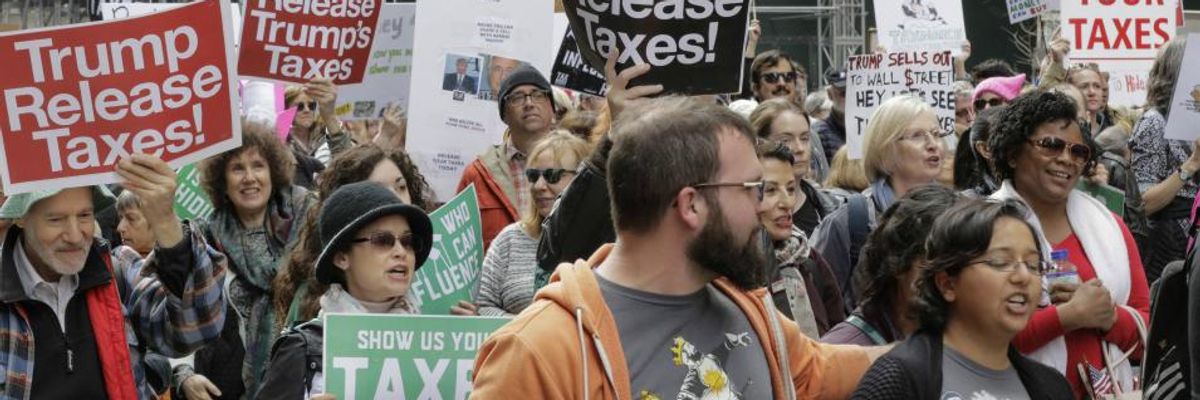
A crowd of people march to demand that President Donald Trump release his tax returns at Bryant Park in New York City on April 15, 2017. (Photo: EuropaNewswire/Gado/Getty Images)
A federal appeals court on Friday rejected President Donald Trump's attempt to block a House Oversight Committee subpoena demanding eight years of his financial records.
"We're one step closer to holding him accountable today," tweeted progressive advocacy group Tax March in response to the ruling by the U.S. Court of Appeals for the D.C. Circuit.
The decision in the case was 2-1, with Trump appointee Neomi Rao dissenting. The ruling affirms a lower court decision that ordered Mazars USA, Trump's longtime accounting firm, to turn over eight years of the president's tax and financial documents.
"Today's ruling is a fundamental and resounding victory for congressional oversight, our constitutional system of checks and balances, and the rule of law," Rep. Elijah Cummings (D-Md.), chairman of the House Oversight Committee, said in a statement. "For far too long, the president has placed his personal interests over the interests of the American people. After months of delay, it is time for the President to stop blocking Mazars from complying with the committee's lawful subpoena."
Eric Colombus, who served in the Justice Department under President Barack Obama, warned Rao's lonely dissent means "Dems shouldn't pop corks just yet."
"The Trump appointee dissented," Colombus tweeted, "giving Trump some hope that he might eke out a (ridiculous) win" if he appeals the ruling to the Supreme Court.
The court's 66-page majority opinion, authored by Judges David Tatel Patricia Millett, rejects Trump's argument that House Democrats' subpoena lacks legislative purpose and stresses that Congress has the constitutional authority to conduct oversight of the president.
"Contrary to the president's arguments, the committee possesses authority under both House rules and the constitution to issue the subpoena, and Mazars must comply," the opinion states.
Tatel and Millett cite former Supreme Court Justice Louis Brandeis's 1926 argument that the purpose of separation of powers is "not to avoid friction, but, by means of the inevitable friction incident to the distribution of the governmental powers among three departments, to save the people from autocracy."
This country and this world are at a monumental crossroads. US voters have an opportunity to beat back the forces of fascism and confront the billionaires who are rigging the economy, our media system, and our democracy, making it increasingly impossible for ordinary people to get by. We’re not just talking about the election. We’re talking about what must be done once these fascist elements are vanquished from power. We need a bolder set of solutions than what either major party has so far been willing to offer and a working-class movement ready to fight like hell for it. Trump didn't emerge from nowhere. The conditions that fueled MAGA authoritarianism were created by decades of radical neoliberal economic policies and a corrupt political system dominated by corporate interests. They slashed taxes on the super-rich, promising that the benefits would trickle down. They said giveaways to the corporate titans would make life more affordable for the rest of us. It was all bullshit. And when a bitter, betrayed populace searches for someone to blame, right-wing demagogues have little trouble finding scapegoats. People know when they're being lied to, but you won't hear any of this from the corporate media. Only independent journalism—powered and funded by people who believe in building a better world—can deliver truly trustworthy daily news. If you share our vision, please contribute whatever you can to sustain our work. |
A federal appeals court on Friday rejected President Donald Trump's attempt to block a House Oversight Committee subpoena demanding eight years of his financial records.
"We're one step closer to holding him accountable today," tweeted progressive advocacy group Tax March in response to the ruling by the U.S. Court of Appeals for the D.C. Circuit.
The decision in the case was 2-1, with Trump appointee Neomi Rao dissenting. The ruling affirms a lower court decision that ordered Mazars USA, Trump's longtime accounting firm, to turn over eight years of the president's tax and financial documents.
"Today's ruling is a fundamental and resounding victory for congressional oversight, our constitutional system of checks and balances, and the rule of law," Rep. Elijah Cummings (D-Md.), chairman of the House Oversight Committee, said in a statement. "For far too long, the president has placed his personal interests over the interests of the American people. After months of delay, it is time for the President to stop blocking Mazars from complying with the committee's lawful subpoena."
Eric Colombus, who served in the Justice Department under President Barack Obama, warned Rao's lonely dissent means "Dems shouldn't pop corks just yet."
"The Trump appointee dissented," Colombus tweeted, "giving Trump some hope that he might eke out a (ridiculous) win" if he appeals the ruling to the Supreme Court.
The court's 66-page majority opinion, authored by Judges David Tatel Patricia Millett, rejects Trump's argument that House Democrats' subpoena lacks legislative purpose and stresses that Congress has the constitutional authority to conduct oversight of the president.
"Contrary to the president's arguments, the committee possesses authority under both House rules and the constitution to issue the subpoena, and Mazars must comply," the opinion states.
Tatel and Millett cite former Supreme Court Justice Louis Brandeis's 1926 argument that the purpose of separation of powers is "not to avoid friction, but, by means of the inevitable friction incident to the distribution of the governmental powers among three departments, to save the people from autocracy."

