SUBSCRIBE TO OUR FREE NEWSLETTER
Daily news & progressive opinion—funded by the people, not the corporations—delivered straight to your inbox.
5
#000000
#FFFFFF
To donate by check, phone, or other method, see our More Ways to Give page.
Daily news & progressive opinion—funded by the people, not the corporations—delivered straight to your inbox.
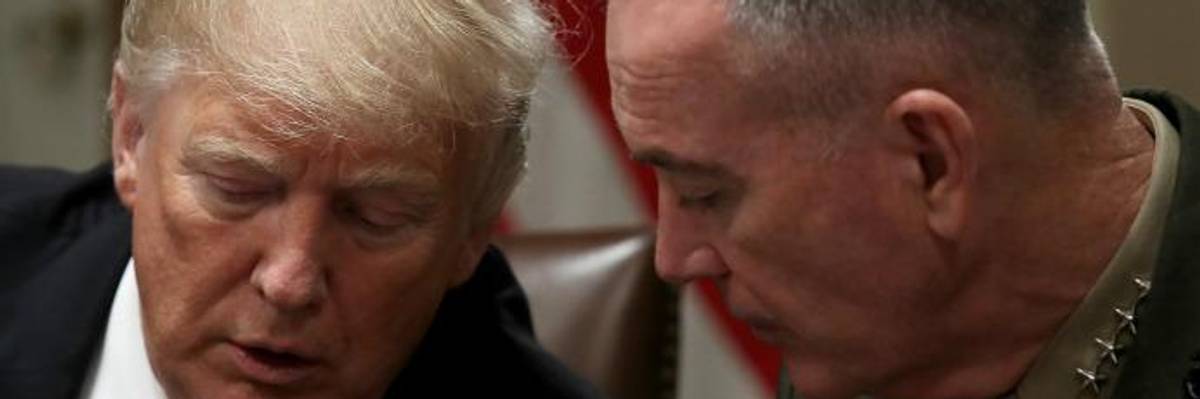
President Donald Trump confers with Chairman of the Joint Chiefs of Staff Joseph Dunford (R) during a meeting with military leaders in the Cabinet Room on October 23, 2018 in Washington, D.C. (Photo: Win McNamee/Getty Images)
Pentagon officials will reportedly present President Donald Trump on Friday with a number of options to attack Iran following a recent attack on a Saudi oil facility which the Trump administration blamed on Iran.
According to The Associated Press Trump, "will be presented with a list of potential airstrike targets inside Iran, among other possible responses, and he will be warned that military action against the Islamic Republic could escalate into war."
"The U.S. response could involve military, political, and economic actions," AP reported, "and the military options could range from no action at all to airstrikes or less visible moves such as cyberattacks."
The New York Times said Thursday that Defense Secretary Mark T. Esper and chairman of the Joint Chiefs of Staff Gen. Joseph F. Dunford Jr. will present the potential military options and potential targets to Trump. "The Pentagon is advocating military strikes that one senior official described as at the lower end of options," the Times reported, but he'll also see "other options that are stronger, options that would require dispatching more forces to the Persian Gulf region."
The president further increased tensions on Friday by announcing new sanctions targeting Iran. The president announced them during an Oval Office meeting with Australian Prime Minister Scott Morrison. Trump called the penalties, which hit Iran's national bank, the "highest sanctions ever imposed on a country."
Iran's foreign minister, Javad Zarif, has warned against the U.S. pursuing military conflict.
In interview that aired Thursday with CNN, Zarif said: "We don't want war. We don't want to engage in a military confrontation. But we won't blink to defend our territory."
"We believe that we do not need war in this region," Zarif added. "We believe that we need dialogue, we need cooperation, we need confidence-building in this region."
In tweets this week, Zarif suggested the attack on the Saudi oil facility was carried out by Houthi rebels as retaliation for the brutal war the U.S -backed Saudi coalition has waged in Yemen. Zarif also took aim at Secretary of State Mike Pompeo's assertion that the White House is striving for a "peaceful resolution."
"Having failed at 'max pressure', @SecPompeo's turning to 'max deceit,'" Zarif wrote.
Regarding the conflict in Yemen, he wrote, "Ending the war=only solution for all."
Trump for his part, has publicly given conflicting messages regarding his preferred route of engagement with Iran following this latest series of events.
In a tweet on Sunday, Trump suggested Iran was responsible for the oil attack that it the U.S. was "locked and loaded" to respond. On Wednesay, Trump announced the forthcoming sanctions and said: "There are many options. There's the ultimate option."
Following the president's "locked and loaded" comments, National Iranian American Council president Jamal Abdi warned that if "Trump fails to heed his anti-interventionist instincts and listens to the warmongers surrounding him, the U.S. risks triggering a regional war more catastrophic than the 2003 invasion of Iraq. Cooler heads must prevail and invest seriously in de-escalatory measures to stabilize the whole region."
Should Trump pick the path of war, he needs to go to Congress first, as Rep. Barbara Lee (D-Calif.) stressed Sunday.
Dear Common Dreams reader, It’s been nearly 30 years since I co-founded Common Dreams with my late wife, Lina Newhouser. We had the radical notion that journalism should serve the public good, not corporate profits. It was clear to us from the outset what it would take to build such a project. No paid advertisements. No corporate sponsors. No millionaire publisher telling us what to think or do. Many people said we wouldn't last a year, but we proved those doubters wrong. Together with a tremendous team of journalists and dedicated staff, we built an independent media outlet free from the constraints of profits and corporate control. Our mission has always been simple: To inform. To inspire. To ignite change for the common good. Building Common Dreams was not easy. Our survival was never guaranteed. When you take on the most powerful forces—Wall Street greed, fossil fuel industry destruction, Big Tech lobbyists, and uber-rich oligarchs who have spent billions upon billions rigging the economy and democracy in their favor—the only bulwark you have is supporters who believe in your work. But here’s the urgent message from me today. It's never been this bad out there. And it's never been this hard to keep us going. At the very moment Common Dreams is most needed, the threats we face are intensifying. We need your support now more than ever. We don't accept corporate advertising and never will. We don't have a paywall because we don't think people should be blocked from critical news based on their ability to pay. Everything we do is funded by the donations of readers like you. When everyone does the little they can afford, we are strong. But if that support retreats or dries up, so do we. Will you donate now to make sure Common Dreams not only survives but thrives? —Craig Brown, Co-founder |
Pentagon officials will reportedly present President Donald Trump on Friday with a number of options to attack Iran following a recent attack on a Saudi oil facility which the Trump administration blamed on Iran.
According to The Associated Press Trump, "will be presented with a list of potential airstrike targets inside Iran, among other possible responses, and he will be warned that military action against the Islamic Republic could escalate into war."
"The U.S. response could involve military, political, and economic actions," AP reported, "and the military options could range from no action at all to airstrikes or less visible moves such as cyberattacks."
The New York Times said Thursday that Defense Secretary Mark T. Esper and chairman of the Joint Chiefs of Staff Gen. Joseph F. Dunford Jr. will present the potential military options and potential targets to Trump. "The Pentagon is advocating military strikes that one senior official described as at the lower end of options," the Times reported, but he'll also see "other options that are stronger, options that would require dispatching more forces to the Persian Gulf region."
The president further increased tensions on Friday by announcing new sanctions targeting Iran. The president announced them during an Oval Office meeting with Australian Prime Minister Scott Morrison. Trump called the penalties, which hit Iran's national bank, the "highest sanctions ever imposed on a country."
Iran's foreign minister, Javad Zarif, has warned against the U.S. pursuing military conflict.
In interview that aired Thursday with CNN, Zarif said: "We don't want war. We don't want to engage in a military confrontation. But we won't blink to defend our territory."
"We believe that we do not need war in this region," Zarif added. "We believe that we need dialogue, we need cooperation, we need confidence-building in this region."
In tweets this week, Zarif suggested the attack on the Saudi oil facility was carried out by Houthi rebels as retaliation for the brutal war the U.S -backed Saudi coalition has waged in Yemen. Zarif also took aim at Secretary of State Mike Pompeo's assertion that the White House is striving for a "peaceful resolution."
"Having failed at 'max pressure', @SecPompeo's turning to 'max deceit,'" Zarif wrote.
Regarding the conflict in Yemen, he wrote, "Ending the war=only solution for all."
Trump for his part, has publicly given conflicting messages regarding his preferred route of engagement with Iran following this latest series of events.
In a tweet on Sunday, Trump suggested Iran was responsible for the oil attack that it the U.S. was "locked and loaded" to respond. On Wednesay, Trump announced the forthcoming sanctions and said: "There are many options. There's the ultimate option."
Following the president's "locked and loaded" comments, National Iranian American Council president Jamal Abdi warned that if "Trump fails to heed his anti-interventionist instincts and listens to the warmongers surrounding him, the U.S. risks triggering a regional war more catastrophic than the 2003 invasion of Iraq. Cooler heads must prevail and invest seriously in de-escalatory measures to stabilize the whole region."
Should Trump pick the path of war, he needs to go to Congress first, as Rep. Barbara Lee (D-Calif.) stressed Sunday.
Pentagon officials will reportedly present President Donald Trump on Friday with a number of options to attack Iran following a recent attack on a Saudi oil facility which the Trump administration blamed on Iran.
According to The Associated Press Trump, "will be presented with a list of potential airstrike targets inside Iran, among other possible responses, and he will be warned that military action against the Islamic Republic could escalate into war."
"The U.S. response could involve military, political, and economic actions," AP reported, "and the military options could range from no action at all to airstrikes or less visible moves such as cyberattacks."
The New York Times said Thursday that Defense Secretary Mark T. Esper and chairman of the Joint Chiefs of Staff Gen. Joseph F. Dunford Jr. will present the potential military options and potential targets to Trump. "The Pentagon is advocating military strikes that one senior official described as at the lower end of options," the Times reported, but he'll also see "other options that are stronger, options that would require dispatching more forces to the Persian Gulf region."
The president further increased tensions on Friday by announcing new sanctions targeting Iran. The president announced them during an Oval Office meeting with Australian Prime Minister Scott Morrison. Trump called the penalties, which hit Iran's national bank, the "highest sanctions ever imposed on a country."
Iran's foreign minister, Javad Zarif, has warned against the U.S. pursuing military conflict.
In interview that aired Thursday with CNN, Zarif said: "We don't want war. We don't want to engage in a military confrontation. But we won't blink to defend our territory."
"We believe that we do not need war in this region," Zarif added. "We believe that we need dialogue, we need cooperation, we need confidence-building in this region."
In tweets this week, Zarif suggested the attack on the Saudi oil facility was carried out by Houthi rebels as retaliation for the brutal war the U.S -backed Saudi coalition has waged in Yemen. Zarif also took aim at Secretary of State Mike Pompeo's assertion that the White House is striving for a "peaceful resolution."
"Having failed at 'max pressure', @SecPompeo's turning to 'max deceit,'" Zarif wrote.
Regarding the conflict in Yemen, he wrote, "Ending the war=only solution for all."
Trump for his part, has publicly given conflicting messages regarding his preferred route of engagement with Iran following this latest series of events.
In a tweet on Sunday, Trump suggested Iran was responsible for the oil attack that it the U.S. was "locked and loaded" to respond. On Wednesay, Trump announced the forthcoming sanctions and said: "There are many options. There's the ultimate option."
Following the president's "locked and loaded" comments, National Iranian American Council president Jamal Abdi warned that if "Trump fails to heed his anti-interventionist instincts and listens to the warmongers surrounding him, the U.S. risks triggering a regional war more catastrophic than the 2003 invasion of Iraq. Cooler heads must prevail and invest seriously in de-escalatory measures to stabilize the whole region."
Should Trump pick the path of war, he needs to go to Congress first, as Rep. Barbara Lee (D-Calif.) stressed Sunday.