

SUBSCRIBE TO OUR FREE NEWSLETTER
Daily news & progressive opinion—funded by the people, not the corporations—delivered straight to your inbox.
5
#000000
#FFFFFF
To donate by check, phone, or other method, see our More Ways to Give page.
Daily news & progressive opinion—funded by the people, not the corporations—delivered straight to your inbox.
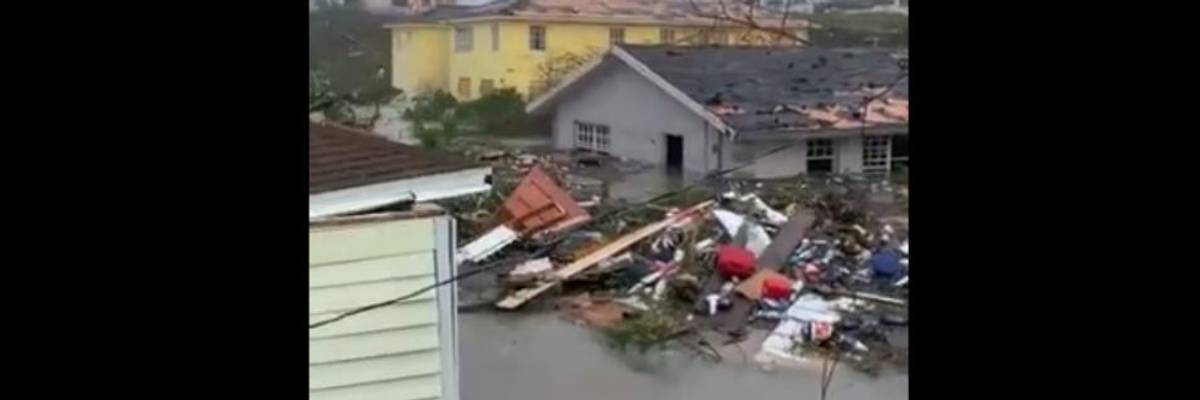
"I have seen utter devastation here in Marsh Harbour. We are surrounded by water with no way out," said ABC News correspondent Marcus Moore. (Photo: Twitter/Screengrab)
Videos posted online late Sunday and early Monday provided the first glimpse of the scale of destruction Hurricane Dorian--a historic Category 5 storm--left in its wake in the Bahamas as it slowly moves toward the southeastern coast of the United States, forcing nearly a million residents of Florida, Georgia, and the Carolinas to evacuate.
"I have seen utter devastation here... We are surrounded by water with no way out," said ABC News correspondent Marcus Moore, who was on the ground in Marsh Harbour.
"Absolute devastation, there really are no words," said Moore, surveying destroyed homes and buildings. "It is pure hell here on Marsh Harbour on Aboca Island in the northern part of the Bahamas."
The Guardian characterized Dorian as "the biggest storm to hit the Caribbean island chain in modern times," with wind gusts reaching as high as 220 mph.
During a press conference Sunday, Bahamian prime minister Hubert Minnis said Dorian "will put us to a test that we've never confronted before."
"This is probably the most sad and worst day of my life to address the Bahamian people," said Minnis. "I just want to say as a physician I've been trained to withstand many things, but never anything like this."
According to the National Hurricane Center, the storm remained at Category 5 strength Monday as it drifted over Grand Bahama Island, unleashing heavy rainfall and severe wind.
"This is a life-threatening situation. Residents on Grand Bahama Island should not leave their shelter when the eye passes over, as winds will rapidly increase on the other side of the eye," the center said. "These hazards will continue over Grand Bahama Island during most of the day, causing extreme destruction on the island."
Forecasters on Monday said the storm could get "dangerously close to the Florida east coast" as early as Monday night.
Florida, Georgia, North Carolina, and South Carolina have declared a state of emergency as the hurricane crawls toward the U.S. coast.
South Carolina Gov. Henry McMaster on Sunday issued a mandatory evacuation order for 830,000 people along the state's coastline. The order is set to take effect Monday at noon.
Dear Common Dreams reader, It’s been nearly 30 years since I co-founded Common Dreams with my late wife, Lina Newhouser. We had the radical notion that journalism should serve the public good, not corporate profits. It was clear to us from the outset what it would take to build such a project. No paid advertisements. No corporate sponsors. No millionaire publisher telling us what to think or do. Many people said we wouldn't last a year, but we proved those doubters wrong. Together with a tremendous team of journalists and dedicated staff, we built an independent media outlet free from the constraints of profits and corporate control. Our mission has always been simple: To inform. To inspire. To ignite change for the common good. Building Common Dreams was not easy. Our survival was never guaranteed. When you take on the most powerful forces—Wall Street greed, fossil fuel industry destruction, Big Tech lobbyists, and uber-rich oligarchs who have spent billions upon billions rigging the economy and democracy in their favor—the only bulwark you have is supporters who believe in your work. But here’s the urgent message from me today. It's never been this bad out there. And it's never been this hard to keep us going. At the very moment Common Dreams is most needed, the threats we face are intensifying. We need your support now more than ever. We don't accept corporate advertising and never will. We don't have a paywall because we don't think people should be blocked from critical news based on their ability to pay. Everything we do is funded by the donations of readers like you. When everyone does the little they can afford, we are strong. But if that support retreats or dries up, so do we. Will you donate now to make sure Common Dreams not only survives but thrives? —Craig Brown, Co-founder |
Videos posted online late Sunday and early Monday provided the first glimpse of the scale of destruction Hurricane Dorian--a historic Category 5 storm--left in its wake in the Bahamas as it slowly moves toward the southeastern coast of the United States, forcing nearly a million residents of Florida, Georgia, and the Carolinas to evacuate.
"I have seen utter devastation here... We are surrounded by water with no way out," said ABC News correspondent Marcus Moore, who was on the ground in Marsh Harbour.
"Absolute devastation, there really are no words," said Moore, surveying destroyed homes and buildings. "It is pure hell here on Marsh Harbour on Aboca Island in the northern part of the Bahamas."
The Guardian characterized Dorian as "the biggest storm to hit the Caribbean island chain in modern times," with wind gusts reaching as high as 220 mph.
During a press conference Sunday, Bahamian prime minister Hubert Minnis said Dorian "will put us to a test that we've never confronted before."
"This is probably the most sad and worst day of my life to address the Bahamian people," said Minnis. "I just want to say as a physician I've been trained to withstand many things, but never anything like this."
According to the National Hurricane Center, the storm remained at Category 5 strength Monday as it drifted over Grand Bahama Island, unleashing heavy rainfall and severe wind.
"This is a life-threatening situation. Residents on Grand Bahama Island should not leave their shelter when the eye passes over, as winds will rapidly increase on the other side of the eye," the center said. "These hazards will continue over Grand Bahama Island during most of the day, causing extreme destruction on the island."
Forecasters on Monday said the storm could get "dangerously close to the Florida east coast" as early as Monday night.
Florida, Georgia, North Carolina, and South Carolina have declared a state of emergency as the hurricane crawls toward the U.S. coast.
South Carolina Gov. Henry McMaster on Sunday issued a mandatory evacuation order for 830,000 people along the state's coastline. The order is set to take effect Monday at noon.
Videos posted online late Sunday and early Monday provided the first glimpse of the scale of destruction Hurricane Dorian--a historic Category 5 storm--left in its wake in the Bahamas as it slowly moves toward the southeastern coast of the United States, forcing nearly a million residents of Florida, Georgia, and the Carolinas to evacuate.
"I have seen utter devastation here... We are surrounded by water with no way out," said ABC News correspondent Marcus Moore, who was on the ground in Marsh Harbour.
"Absolute devastation, there really are no words," said Moore, surveying destroyed homes and buildings. "It is pure hell here on Marsh Harbour on Aboca Island in the northern part of the Bahamas."
The Guardian characterized Dorian as "the biggest storm to hit the Caribbean island chain in modern times," with wind gusts reaching as high as 220 mph.
During a press conference Sunday, Bahamian prime minister Hubert Minnis said Dorian "will put us to a test that we've never confronted before."
"This is probably the most sad and worst day of my life to address the Bahamian people," said Minnis. "I just want to say as a physician I've been trained to withstand many things, but never anything like this."
According to the National Hurricane Center, the storm remained at Category 5 strength Monday as it drifted over Grand Bahama Island, unleashing heavy rainfall and severe wind.
"This is a life-threatening situation. Residents on Grand Bahama Island should not leave their shelter when the eye passes over, as winds will rapidly increase on the other side of the eye," the center said. "These hazards will continue over Grand Bahama Island during most of the day, causing extreme destruction on the island."
Forecasters on Monday said the storm could get "dangerously close to the Florida east coast" as early as Monday night.
Florida, Georgia, North Carolina, and South Carolina have declared a state of emergency as the hurricane crawls toward the U.S. coast.
South Carolina Gov. Henry McMaster on Sunday issued a mandatory evacuation order for 830,000 people along the state's coastline. The order is set to take effect Monday at noon.

