SUBSCRIBE TO OUR FREE NEWSLETTER
Daily news & progressive opinion—funded by the people, not the corporations—delivered straight to your inbox.
5
#000000
#FFFFFF
To donate by check, phone, or other method, see our More Ways to Give page.
Daily news & progressive opinion—funded by the people, not the corporations—delivered straight to your inbox.
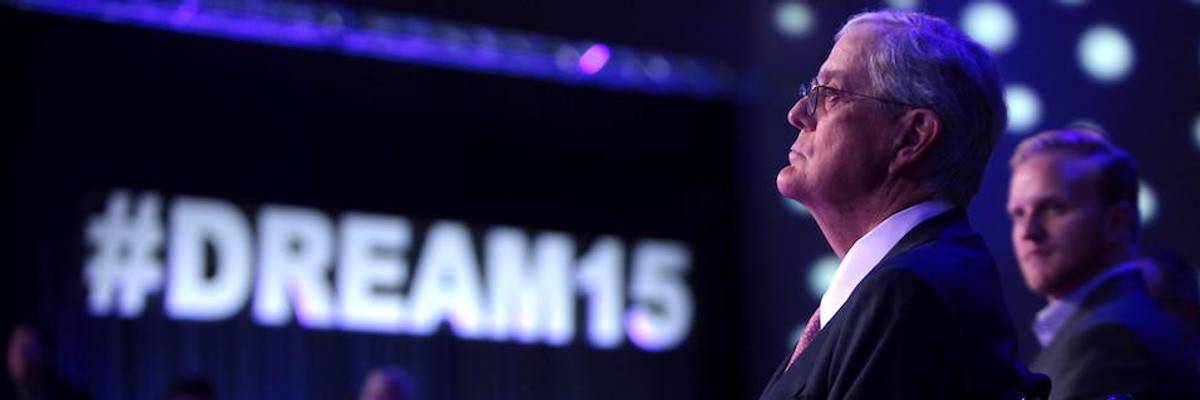
David Koch at the 2015 Defending the American Dream Summit at the Greater Columbus Convention Center in Columbus, Ohio. (Photo: Gage Skidmore/Flickr/cc)
Billionaire industrialist David Koch, who spent vast sums of his billions in personal fortune promoting climate denialism and other right wing causes over the last four decades, died Friday at 79.
His legacy in modern American politics was summed up by The New York Times:
Three decades after David Koch's public steps into politics, analysts say, the Koch brothers' money-fueled brand of libertarianism helped give rise to the Tea Party movement and strengthened the far-right wing of a resurgent Republican Party.
Koch was a controversial figure. His vast fortune--made in large part through fossil fuel extraction and manufacturing, though the company has interests in nearly everything--led him and his brother Charles to be two of the richest people in the world. The brothers spent at least $100 million since the 1970s promoting right-wing causes, and David ran for vice president as a member of the Libertarian Party in 1980.
One of the causes Koch dumped his fortune into promoting was climate crisis denialism.
By making vast sums of money from destroying the planet and then fighting against efforts to stem the flow of the crisis, tweeted Native American activist Tara Houska, Koch was a double damage denialist.
"Let's not forget the massive network of oil pipelines, refineries, and fossil fuel expansion projects that David Koch was directly responsible for," said Houska. "He funded climate deniers while he contributed to climate change, in the range of a 300 million ton carbon footprint annually."
On Twitter, HuffPost environmental reporter Alexander Kaufman noted the irony of Koch dying as the effects of the climate crisis the billionaire activist had a large hand in perpetuating are being increasingly felt around the globe.
"He deployed his stupendous fortune funding climate denial in the years when the science was clear and there was still time to avert catastrophic warming," said Kaufman. "He died as fires raged from the Amazon to the Arctic."
In a piece for Earther, Brian Kahn wrote that Koch and his brother's funding of the movement to obfuscate the costs of the climate crisis made them even more than the "arch-villains" they were from funding other right-wing causes. And, said Kahn, David Koch now gets to avoid the consequences of his actions.
"Climate change is a form of violence that will largely affect people with little power to address it or relatively little role in creating it," wrote Kahn. "Death is an escape hatch for David Koch while the rest of us are left scrambling for the emergency brake before we go over the cliff."
Koch's libertarianism led him to take some positions--such as his support of gay marriage and opposition to the war on drugs--that might make his legacy seem mixed. But, as media critic Adam Johnson pointed out, that's "trivial" in the context of Koch's full record.
"People will try to be nice and note David Koch opposed the war on drugs/militarism," Johnson tweeted, "but the money he gave opposing these twin evils was trivial compared to the funds he gave supporting candidates that backed the war on drugs/militarism and the related ideology of starving poor people."
The Koch brothers' reported antipathy to President Donald Trump, Jack Mirkinson wrote at Splinter, was hardly enough to offset the damage they did by promoting the Republican Party.
"The Kochs were not happy with everything Donald Trump did, but that is a low standard for anyone walking the planet--and anyway, they loved his tax plan," wrote Mirkinson.
The Intercept's Mehdi Hasan said on Twitter that Koch will be remembered in the short term for his wealth, philanthropy, and work to advance right-wing causes. But, Hasan said, that pales in comparison to his role as a "climate denier."
"That'll be his long-term legacy," said Hasan, "funding the effort to downplay an existential threat to all of us."
Dear Common Dreams reader, It’s been nearly 30 years since I co-founded Common Dreams with my late wife, Lina Newhouser. We had the radical notion that journalism should serve the public good, not corporate profits. It was clear to us from the outset what it would take to build such a project. No paid advertisements. No corporate sponsors. No millionaire publisher telling us what to think or do. Many people said we wouldn't last a year, but we proved those doubters wrong. Together with a tremendous team of journalists and dedicated staff, we built an independent media outlet free from the constraints of profits and corporate control. Our mission has always been simple: To inform. To inspire. To ignite change for the common good. Building Common Dreams was not easy. Our survival was never guaranteed. When you take on the most powerful forces—Wall Street greed, fossil fuel industry destruction, Big Tech lobbyists, and uber-rich oligarchs who have spent billions upon billions rigging the economy and democracy in their favor—the only bulwark you have is supporters who believe in your work. But here’s the urgent message from me today. It's never been this bad out there. And it's never been this hard to keep us going. At the very moment Common Dreams is most needed, the threats we face are intensifying. We need your support now more than ever. We don't accept corporate advertising and never will. We don't have a paywall because we don't think people should be blocked from critical news based on their ability to pay. Everything we do is funded by the donations of readers like you. When everyone does the little they can afford, we are strong. But if that support retreats or dries up, so do we. Will you donate now to make sure Common Dreams not only survives but thrives? —Craig Brown, Co-founder |
Billionaire industrialist David Koch, who spent vast sums of his billions in personal fortune promoting climate denialism and other right wing causes over the last four decades, died Friday at 79.
His legacy in modern American politics was summed up by The New York Times:
Three decades after David Koch's public steps into politics, analysts say, the Koch brothers' money-fueled brand of libertarianism helped give rise to the Tea Party movement and strengthened the far-right wing of a resurgent Republican Party.
Koch was a controversial figure. His vast fortune--made in large part through fossil fuel extraction and manufacturing, though the company has interests in nearly everything--led him and his brother Charles to be two of the richest people in the world. The brothers spent at least $100 million since the 1970s promoting right-wing causes, and David ran for vice president as a member of the Libertarian Party in 1980.
One of the causes Koch dumped his fortune into promoting was climate crisis denialism.
By making vast sums of money from destroying the planet and then fighting against efforts to stem the flow of the crisis, tweeted Native American activist Tara Houska, Koch was a double damage denialist.
"Let's not forget the massive network of oil pipelines, refineries, and fossil fuel expansion projects that David Koch was directly responsible for," said Houska. "He funded climate deniers while he contributed to climate change, in the range of a 300 million ton carbon footprint annually."
On Twitter, HuffPost environmental reporter Alexander Kaufman noted the irony of Koch dying as the effects of the climate crisis the billionaire activist had a large hand in perpetuating are being increasingly felt around the globe.
"He deployed his stupendous fortune funding climate denial in the years when the science was clear and there was still time to avert catastrophic warming," said Kaufman. "He died as fires raged from the Amazon to the Arctic."
In a piece for Earther, Brian Kahn wrote that Koch and his brother's funding of the movement to obfuscate the costs of the climate crisis made them even more than the "arch-villains" they were from funding other right-wing causes. And, said Kahn, David Koch now gets to avoid the consequences of his actions.
"Climate change is a form of violence that will largely affect people with little power to address it or relatively little role in creating it," wrote Kahn. "Death is an escape hatch for David Koch while the rest of us are left scrambling for the emergency brake before we go over the cliff."
Koch's libertarianism led him to take some positions--such as his support of gay marriage and opposition to the war on drugs--that might make his legacy seem mixed. But, as media critic Adam Johnson pointed out, that's "trivial" in the context of Koch's full record.
"People will try to be nice and note David Koch opposed the war on drugs/militarism," Johnson tweeted, "but the money he gave opposing these twin evils was trivial compared to the funds he gave supporting candidates that backed the war on drugs/militarism and the related ideology of starving poor people."
The Koch brothers' reported antipathy to President Donald Trump, Jack Mirkinson wrote at Splinter, was hardly enough to offset the damage they did by promoting the Republican Party.
"The Kochs were not happy with everything Donald Trump did, but that is a low standard for anyone walking the planet--and anyway, they loved his tax plan," wrote Mirkinson.
The Intercept's Mehdi Hasan said on Twitter that Koch will be remembered in the short term for his wealth, philanthropy, and work to advance right-wing causes. But, Hasan said, that pales in comparison to his role as a "climate denier."
"That'll be his long-term legacy," said Hasan, "funding the effort to downplay an existential threat to all of us."
Billionaire industrialist David Koch, who spent vast sums of his billions in personal fortune promoting climate denialism and other right wing causes over the last four decades, died Friday at 79.
His legacy in modern American politics was summed up by The New York Times:
Three decades after David Koch's public steps into politics, analysts say, the Koch brothers' money-fueled brand of libertarianism helped give rise to the Tea Party movement and strengthened the far-right wing of a resurgent Republican Party.
Koch was a controversial figure. His vast fortune--made in large part through fossil fuel extraction and manufacturing, though the company has interests in nearly everything--led him and his brother Charles to be two of the richest people in the world. The brothers spent at least $100 million since the 1970s promoting right-wing causes, and David ran for vice president as a member of the Libertarian Party in 1980.
One of the causes Koch dumped his fortune into promoting was climate crisis denialism.
By making vast sums of money from destroying the planet and then fighting against efforts to stem the flow of the crisis, tweeted Native American activist Tara Houska, Koch was a double damage denialist.
"Let's not forget the massive network of oil pipelines, refineries, and fossil fuel expansion projects that David Koch was directly responsible for," said Houska. "He funded climate deniers while he contributed to climate change, in the range of a 300 million ton carbon footprint annually."
On Twitter, HuffPost environmental reporter Alexander Kaufman noted the irony of Koch dying as the effects of the climate crisis the billionaire activist had a large hand in perpetuating are being increasingly felt around the globe.
"He deployed his stupendous fortune funding climate denial in the years when the science was clear and there was still time to avert catastrophic warming," said Kaufman. "He died as fires raged from the Amazon to the Arctic."
In a piece for Earther, Brian Kahn wrote that Koch and his brother's funding of the movement to obfuscate the costs of the climate crisis made them even more than the "arch-villains" they were from funding other right-wing causes. And, said Kahn, David Koch now gets to avoid the consequences of his actions.
"Climate change is a form of violence that will largely affect people with little power to address it or relatively little role in creating it," wrote Kahn. "Death is an escape hatch for David Koch while the rest of us are left scrambling for the emergency brake before we go over the cliff."
Koch's libertarianism led him to take some positions--such as his support of gay marriage and opposition to the war on drugs--that might make his legacy seem mixed. But, as media critic Adam Johnson pointed out, that's "trivial" in the context of Koch's full record.
"People will try to be nice and note David Koch opposed the war on drugs/militarism," Johnson tweeted, "but the money he gave opposing these twin evils was trivial compared to the funds he gave supporting candidates that backed the war on drugs/militarism and the related ideology of starving poor people."
The Koch brothers' reported antipathy to President Donald Trump, Jack Mirkinson wrote at Splinter, was hardly enough to offset the damage they did by promoting the Republican Party.
"The Kochs were not happy with everything Donald Trump did, but that is a low standard for anyone walking the planet--and anyway, they loved his tax plan," wrote Mirkinson.
The Intercept's Mehdi Hasan said on Twitter that Koch will be remembered in the short term for his wealth, philanthropy, and work to advance right-wing causes. But, Hasan said, that pales in comparison to his role as a "climate denier."
"That'll be his long-term legacy," said Hasan, "funding the effort to downplay an existential threat to all of us."