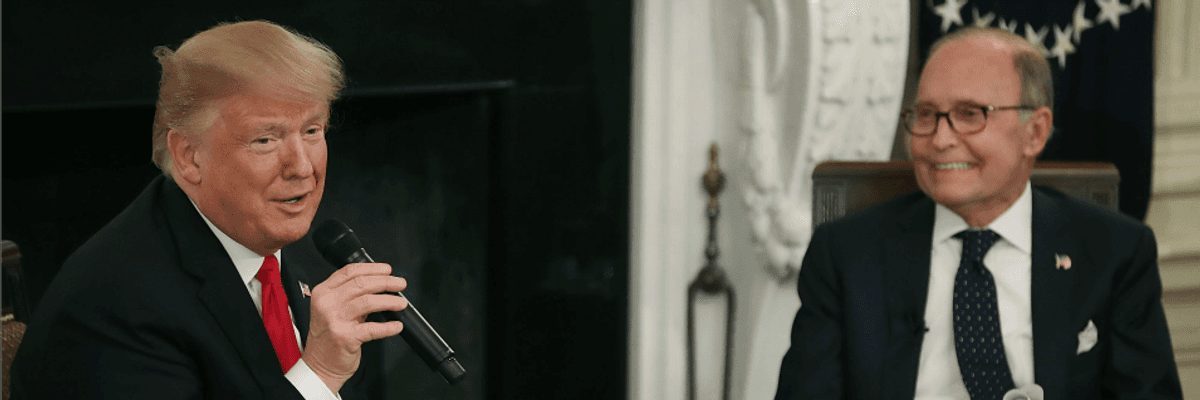
President Donald Trump speaks while flanked by Director of the National Economic Council Larry Kudlow during an event in the State Dining Room of the White House on October 31, 2018 in Washington, D.C. (Photo: Mark Wilson/Getty Images)
Amid Recession Warnings, Trump Reportedly Considering More Tax Cuts for Rich and Corporations
"Two of Trump's ideas for stimulating the economy are 1) cutting the corporate tax rate a little more (after cutting it a lot didn't do much), and 2) indexing capital gains to inflation. It's tax cuts for the rich all the way down."
While continuing to publicly downplay warning signs that the U.S. economy is barreling toward a recession, the Trump White House is reportedly weighing a number of supposed stimulus measures, including more tax cuts for the rich and large corporations.
Politico reported late Tuesday that Trump officials are considering "a cut of an additional percentage point or two to the corporate tax rate," which the GOP tax law slashed from 35 percent to 21 percent in 2018.
"The American people are waking up to the damage he has done to our economy by waging senseless trade wars and handing out trillions in tax cuts to the wealthy and corporations."
--Robert Reich, former Labor Secretary
"That's on top of a potential payroll tax cut," the news outlet noted, "which the Obama administration had used to shore up the economy, and a move to index the capital gains rate to inflation, which potentially could be done through an executive order."
A payroll tax cut, which Trump on Tuesday confirmed he is considering, would temporarily boost workers' paychecks.
But, as the Washington Post reported Monday, depending on how it is designed, a payroll tax cut could "pull billions of dollars away from Social Security."
The other option Trump is considering, indexing capital gains to inflation via executive order, would primarily benefit wealthy investors. According to Chye-Ching Huang of the Center on Budget and Policy Priorities, 86 percent of the benefits would go to the top one percent.
The Trump administration has been mulling indexing capital gains to inflation through executive action since last year, despite warnings the move may be illegal. As Common Dreams reported last month, a group of more than 20 Republican senators, led by Sen. Ted Cruz (R-Texas), is urging the president to push ahead with the executive order.
"We have been talking about indexing for a long time," Trump told reporters Tuesday. "I can do it directly."
Journalist Matt O'Brien derided the White House's reported ideas to ward off a recession as handouts to the rich that would do little to stimulate the economy.
"Hilariously, two of Trump's ideas for stimulating the economy are 1) cutting the corporate tax rate a little more (after cutting it a lot didn't do much), and 2) indexing capital gains to inflation," O'Brien tweeted on Tuesday. "It's tax cuts for the rich all the way down."
Trump's reported plans to put more money in the pockets of the wealthiest Americans and large corporations come just a week after the Treasury bond yield curve inverted for the first time since the Wall Street crash of 2008. The inverted yield curve has preceeded every major economic downturn over the past 50 years.
Economists and other observers were quick to point to Trump's reckless trade war with China, the world's second-largest economy behind the U.S., as a key reason for recession fears. As Common Dreams reported last week, the Twitter hashtag #TrumpRecession went viral shortly following the inverted yield curve.
Former Labor Secretary Robert Reich tweeted Tuesday that "we already know about Trump's racism, xenophobia, and fear-mongering."
"Now," said Reich, "the American people are waking up to the damage he has done to our economy by waging senseless trade wars and handing out trillions in tax cuts to the wealthy and corporations."
We are at a crossroads
This country and this world are at a monumental crossroads. In a few short weeks, US voters will have an opportunity to beat back the forces of fascism and confront the billionaires who are rigging the economy, our media system, and our democracy, making it increasingly impossible for ordinary people to get by. We’re not just talking about the election. We’re talking about what must be done once these fascist elements are vanquished from power. We need a bolder set of solutions than what either major party has so far been willing to offer and a working-class movement ready to fight like hell for it. Trump didn't emerge from nowhere. The conditions that fueled MAGA authoritarianism were created by decades of radical neoliberal economic policies and a corrupt political system dominated by corporate interests. They slashed taxes on the super-rich, promising that the benefits would trickle down. They said giveaways to the corporate titans would make life more affordable for the rest of us. It was all bullshit. And when a bitter, betrayed populace searches for someone to blame, right-wing demagogues have little trouble finding scapegoats. People know when they're being lied to, but you won't hear any of this from the corporate media. Only independent journalism—powered and funded by people who believe in building a better world—can deliver truly trustworthy daily news. Our Fall Campaign is underway, and we need your help. To power our newsroom through the rest of the year, we need to raise $125,000 by midnight on October 31. So if you share our vision, please contribute whatever you can to sustain our work. |
While continuing to publicly downplay warning signs that the U.S. economy is barreling toward a recession, the Trump White House is reportedly weighing a number of supposed stimulus measures, including more tax cuts for the rich and large corporations.
Politico reported late Tuesday that Trump officials are considering "a cut of an additional percentage point or two to the corporate tax rate," which the GOP tax law slashed from 35 percent to 21 percent in 2018.
"The American people are waking up to the damage he has done to our economy by waging senseless trade wars and handing out trillions in tax cuts to the wealthy and corporations."
--Robert Reich, former Labor Secretary
"That's on top of a potential payroll tax cut," the news outlet noted, "which the Obama administration had used to shore up the economy, and a move to index the capital gains rate to inflation, which potentially could be done through an executive order."
A payroll tax cut, which Trump on Tuesday confirmed he is considering, would temporarily boost workers' paychecks.
But, as the Washington Post reported Monday, depending on how it is designed, a payroll tax cut could "pull billions of dollars away from Social Security."
The other option Trump is considering, indexing capital gains to inflation via executive order, would primarily benefit wealthy investors. According to Chye-Ching Huang of the Center on Budget and Policy Priorities, 86 percent of the benefits would go to the top one percent.
The Trump administration has been mulling indexing capital gains to inflation through executive action since last year, despite warnings the move may be illegal. As Common Dreams reported last month, a group of more than 20 Republican senators, led by Sen. Ted Cruz (R-Texas), is urging the president to push ahead with the executive order.
"We have been talking about indexing for a long time," Trump told reporters Tuesday. "I can do it directly."
Journalist Matt O'Brien derided the White House's reported ideas to ward off a recession as handouts to the rich that would do little to stimulate the economy.
"Hilariously, two of Trump's ideas for stimulating the economy are 1) cutting the corporate tax rate a little more (after cutting it a lot didn't do much), and 2) indexing capital gains to inflation," O'Brien tweeted on Tuesday. "It's tax cuts for the rich all the way down."
Trump's reported plans to put more money in the pockets of the wealthiest Americans and large corporations come just a week after the Treasury bond yield curve inverted for the first time since the Wall Street crash of 2008. The inverted yield curve has preceeded every major economic downturn over the past 50 years.
Economists and other observers were quick to point to Trump's reckless trade war with China, the world's second-largest economy behind the U.S., as a key reason for recession fears. As Common Dreams reported last week, the Twitter hashtag #TrumpRecession went viral shortly following the inverted yield curve.
Former Labor Secretary Robert Reich tweeted Tuesday that "we already know about Trump's racism, xenophobia, and fear-mongering."
"Now," said Reich, "the American people are waking up to the damage he has done to our economy by waging senseless trade wars and handing out trillions in tax cuts to the wealthy and corporations."
While continuing to publicly downplay warning signs that the U.S. economy is barreling toward a recession, the Trump White House is reportedly weighing a number of supposed stimulus measures, including more tax cuts for the rich and large corporations.
Politico reported late Tuesday that Trump officials are considering "a cut of an additional percentage point or two to the corporate tax rate," which the GOP tax law slashed from 35 percent to 21 percent in 2018.
"The American people are waking up to the damage he has done to our economy by waging senseless trade wars and handing out trillions in tax cuts to the wealthy and corporations."
--Robert Reich, former Labor Secretary
"That's on top of a potential payroll tax cut," the news outlet noted, "which the Obama administration had used to shore up the economy, and a move to index the capital gains rate to inflation, which potentially could be done through an executive order."
A payroll tax cut, which Trump on Tuesday confirmed he is considering, would temporarily boost workers' paychecks.
But, as the Washington Post reported Monday, depending on how it is designed, a payroll tax cut could "pull billions of dollars away from Social Security."
The other option Trump is considering, indexing capital gains to inflation via executive order, would primarily benefit wealthy investors. According to Chye-Ching Huang of the Center on Budget and Policy Priorities, 86 percent of the benefits would go to the top one percent.
The Trump administration has been mulling indexing capital gains to inflation through executive action since last year, despite warnings the move may be illegal. As Common Dreams reported last month, a group of more than 20 Republican senators, led by Sen. Ted Cruz (R-Texas), is urging the president to push ahead with the executive order.
"We have been talking about indexing for a long time," Trump told reporters Tuesday. "I can do it directly."
Journalist Matt O'Brien derided the White House's reported ideas to ward off a recession as handouts to the rich that would do little to stimulate the economy.
"Hilariously, two of Trump's ideas for stimulating the economy are 1) cutting the corporate tax rate a little more (after cutting it a lot didn't do much), and 2) indexing capital gains to inflation," O'Brien tweeted on Tuesday. "It's tax cuts for the rich all the way down."
Trump's reported plans to put more money in the pockets of the wealthiest Americans and large corporations come just a week after the Treasury bond yield curve inverted for the first time since the Wall Street crash of 2008. The inverted yield curve has preceeded every major economic downturn over the past 50 years.
Economists and other observers were quick to point to Trump's reckless trade war with China, the world's second-largest economy behind the U.S., as a key reason for recession fears. As Common Dreams reported last week, the Twitter hashtag #TrumpRecession went viral shortly following the inverted yield curve.
Former Labor Secretary Robert Reich tweeted Tuesday that "we already know about Trump's racism, xenophobia, and fear-mongering."
"Now," said Reich, "the American people are waking up to the damage he has done to our economy by waging senseless trade wars and handing out trillions in tax cuts to the wealthy and corporations."