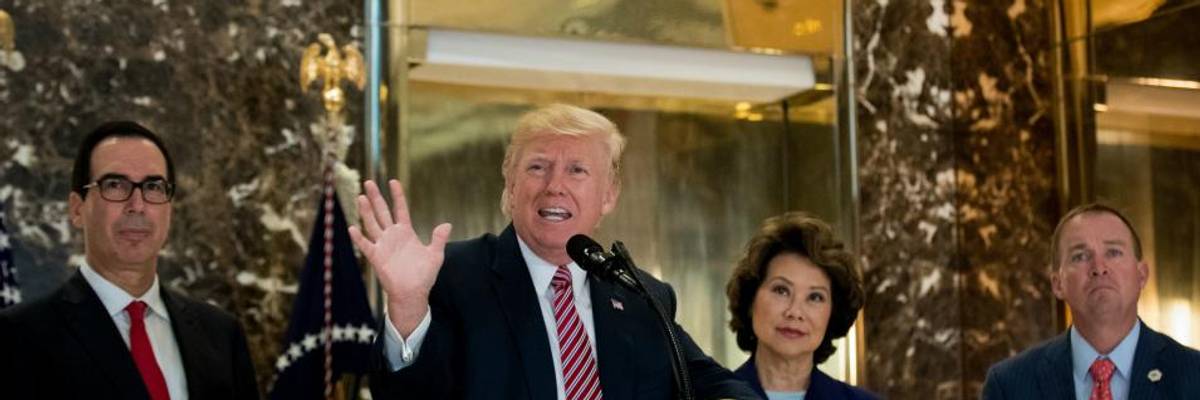
President Donald Trump delivers remarks following a meeting on infrastructure at Trump Tower on August 15, 2017 in New York City. (Photo: Drew Angerer/Getty Images)
'Degrading' and 'Unconstitutional': Trump Reviewing Rule That Would Allow Drug Testing for Unemployment Benefits
"This type of futile and unconstitutional intrusion into people's privacy simply because they are out of work is unacceptable."
The Trump White House is reportedly reviewing a Labor Department rule that would give states the power to force people to pass a drug test before they can receive unemployment benefits, ignoring protests that such screenings would amount to demeaning and unconstitutional invasions of privacy.
"The rule itself would not automatically impose drug tests on the jobless but would let states screen people who file claims for unemployment benefits--fulfilling a GOP dream from the Obama years," HuffPost's Arthur Delaney reported. "In the wake of the Great Recession, after the national unemployment rate surged to 10 percent, several Republican-led states clamored for the right to obtain the bodily fluids of people laid off through no fault of their own."
The proposed rule was published the Federal Register last November and immediately came under fire from the ACLU and worker advocacy groups, which condemned the measure as overly broad and likely illegal. The Labor Department finalized the rule last week after a public comment period and sent it to the White House for review.
"The Fourth Amendment protects people from unreasonable searches by the government. Courts have said drug testing is a search and subject to Fourth Amendment protections," the ACLU's Kanya Bennett and Charlotte Resing wrote in a blog post earlier this year. "So unless there are probable cause and individualized suspicion, there should be no search."
"Exceptions to this rule have been made when the government can show it has a 'special need' and that need outweighs individual privacy rights, but that is not the case here either," they added. "Simply put, the government is on very shaky ground if it thinks it can subject the unemployed to blanket drug testing."
In addition to constitutional concerns, Bennett and Resing also argued the Trump administration's rule would add "an unnecessary and degrading toll to the existing stigma of being out of work."
"Blanket drug testing just further demeans people who the government has no reason to suspect of using drugs," said Bennett and Resing. "This type of futile and unconstitutional intrusion into people's privacy simply because they are out of work is unacceptable."
We are at a crossroads
This country and this world are at a monumental crossroads. In a few short weeks, US voters will have an opportunity to beat back the forces of fascism and confront the billionaires who are rigging the economy, our media system, and our democracy, making it increasingly impossible for ordinary people to get by. We’re not just talking about the election. We’re talking about what must be done once these fascist elements are vanquished from power. We need a bolder set of solutions than what either major party has so far been willing to offer and a working-class movement ready to fight like hell for it. Trump didn't emerge from nowhere. The conditions that fueled MAGA authoritarianism were created by decades of radical neoliberal economic policies and a corrupt political system dominated by corporate interests. They slashed taxes on the super-rich, promising that the benefits would trickle down. They said giveaways to the corporate titans would make life more affordable for the rest of us. It was all bullshit. And when a bitter, betrayed populace searches for someone to blame, right-wing demagogues have little trouble finding scapegoats. People know when they're being lied to, but you won't hear any of this from the corporate media. Only independent journalism—powered and funded by people who believe in building a better world—can deliver truly trustworthy daily news. Our Fall Campaign is underway, and we need your help. To power our newsroom through the rest of the year, we need to raise $125,000 by midnight on October 31. So if you share our vision, please contribute whatever you can to sustain our work. |
The Trump White House is reportedly reviewing a Labor Department rule that would give states the power to force people to pass a drug test before they can receive unemployment benefits, ignoring protests that such screenings would amount to demeaning and unconstitutional invasions of privacy.
"The rule itself would not automatically impose drug tests on the jobless but would let states screen people who file claims for unemployment benefits--fulfilling a GOP dream from the Obama years," HuffPost's Arthur Delaney reported. "In the wake of the Great Recession, after the national unemployment rate surged to 10 percent, several Republican-led states clamored for the right to obtain the bodily fluids of people laid off through no fault of their own."
The proposed rule was published the Federal Register last November and immediately came under fire from the ACLU and worker advocacy groups, which condemned the measure as overly broad and likely illegal. The Labor Department finalized the rule last week after a public comment period and sent it to the White House for review.
"The Fourth Amendment protects people from unreasonable searches by the government. Courts have said drug testing is a search and subject to Fourth Amendment protections," the ACLU's Kanya Bennett and Charlotte Resing wrote in a blog post earlier this year. "So unless there are probable cause and individualized suspicion, there should be no search."
"Exceptions to this rule have been made when the government can show it has a 'special need' and that need outweighs individual privacy rights, but that is not the case here either," they added. "Simply put, the government is on very shaky ground if it thinks it can subject the unemployed to blanket drug testing."
In addition to constitutional concerns, Bennett and Resing also argued the Trump administration's rule would add "an unnecessary and degrading toll to the existing stigma of being out of work."
"Blanket drug testing just further demeans people who the government has no reason to suspect of using drugs," said Bennett and Resing. "This type of futile and unconstitutional intrusion into people's privacy simply because they are out of work is unacceptable."
The Trump White House is reportedly reviewing a Labor Department rule that would give states the power to force people to pass a drug test before they can receive unemployment benefits, ignoring protests that such screenings would amount to demeaning and unconstitutional invasions of privacy.
"The rule itself would not automatically impose drug tests on the jobless but would let states screen people who file claims for unemployment benefits--fulfilling a GOP dream from the Obama years," HuffPost's Arthur Delaney reported. "In the wake of the Great Recession, after the national unemployment rate surged to 10 percent, several Republican-led states clamored for the right to obtain the bodily fluids of people laid off through no fault of their own."
The proposed rule was published the Federal Register last November and immediately came under fire from the ACLU and worker advocacy groups, which condemned the measure as overly broad and likely illegal. The Labor Department finalized the rule last week after a public comment period and sent it to the White House for review.
"The Fourth Amendment protects people from unreasonable searches by the government. Courts have said drug testing is a search and subject to Fourth Amendment protections," the ACLU's Kanya Bennett and Charlotte Resing wrote in a blog post earlier this year. "So unless there are probable cause and individualized suspicion, there should be no search."
"Exceptions to this rule have been made when the government can show it has a 'special need' and that need outweighs individual privacy rights, but that is not the case here either," they added. "Simply put, the government is on very shaky ground if it thinks it can subject the unemployed to blanket drug testing."
In addition to constitutional concerns, Bennett and Resing also argued the Trump administration's rule would add "an unnecessary and degrading toll to the existing stigma of being out of work."
"Blanket drug testing just further demeans people who the government has no reason to suspect of using drugs," said Bennett and Resing. "This type of futile and unconstitutional intrusion into people's privacy simply because they are out of work is unacceptable."