SUBSCRIBE TO OUR FREE NEWSLETTER
Daily news & progressive opinion—funded by the people, not the corporations—delivered straight to your inbox.
5
#000000
#FFFFFF
To donate by check, phone, or other method, see our More Ways to Give page.
Daily news & progressive opinion—funded by the people, not the corporations—delivered straight to your inbox.
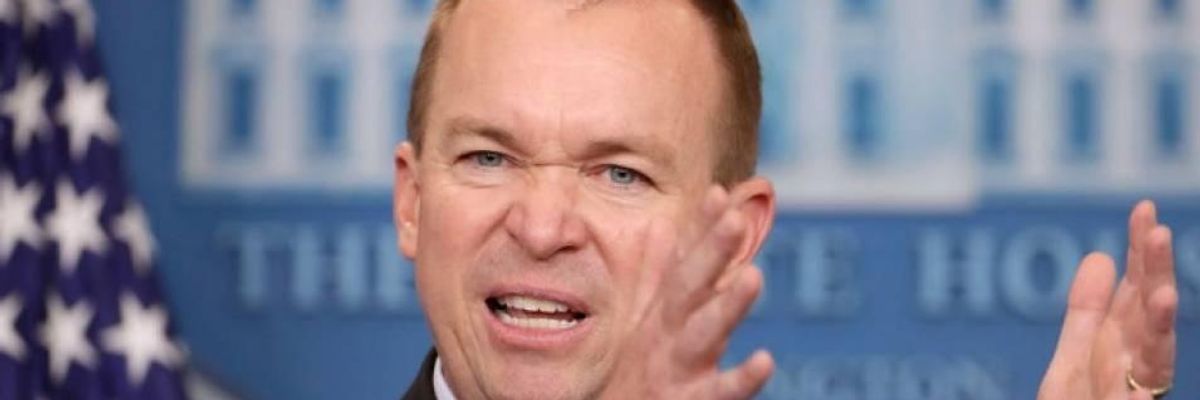
Office of Management and Budget Director Mick Mulvaney holds a news conference to discuss the Trump administration's proposed FY2017 federal budget in the Brady Press Briefing Room at the White House May 23, 2017 in Washington, D.C. (Photo by Chip Somodevilla/Getty Images)
While President Donald Trump dominates national media with racist tweets and lies, acting White House Chief of Staff Mick Mulvaney is quietly "building an empire for the right wing" and pushing Cabinet members to impose a radical and rapid deregulation agenda across the federal government, according to a new Washington Post report.
A former Republican congressman who co-founded the Freedom Caucus in 2015, Mulvaney has worn many hats in Trump's administration. He served as acting director of the Consumer Financial Protection Bureau for more than a year and is currently on leave as director of the Office of Management and Budget for the chief of staff role, a supposedly temporary appointment that Trump announced in December.
Citing interviews with dozens of sources within the White House and on Capitol Hill, the Post detailed "the growing influence wielded by Mulvaney, a former tea party lawmaker who has built what one senior administration official called 'his own fiefdom' centered on pushing conservative policies--while mostly steering clear of the Trump-related pitfalls that tripped up his predecessors by employing a 'Let Trump be Trump' ethos." Mulvaney and the White House declined to participate in the piece.
Mulvaney spends less time with Trump than his predecessors--Reince Priebus and John F. Kelly--did, and doesn't always know what's going on with Trump's foreign policy, advisers told the newspaper. "Instead, Mulvaney has focused much of his energy on creating a new White House power center revolving around the long-dormant Domestic Policy Council and encompassing broad swaths of the administration."
Reportedly pushing Cabinet members and agencies to act quickly on deregulation--in case the Democrats take control of the White House and Senate in 2020--Mulvaney appears to care "about the domestic agencies much more than the prior chiefs of staff did," one source said.
As the Post reported late Sunday:
He has helped install more than a dozen ideologically aligned advisers in the West Wing since his December hiring. Cabinet members are pressed weekly on what regulations they can strip from the books and have been told their performance will be judged on how many they remove. Policy and spending decisions are now made by the White House and dictated to Cabinet agencies, instead of vice versa. When Mulvaney cannot be in the Oval Office for a policy meeting, one of his allies is usually there.
[...]
Mulvaney spends more time in his office than his predecessors, feeling no need to sit in on all of Trump's meetings. He regularly huddles with Joe Grogan, a hard-liner who now leads the Domestic Policy Council, and Russell T. Vought, a conservative ally who runs the Office of Management and Budget in Mulvaney's absence.
The newspaper noted that while "Mulvaney's biggest successes so far have come in deregulation efforts," the chief of staff "also faces significant obstacles on Capitol Hill, where he made enemies on both sides of the aisle during his three terms as a bomb-throwing House conservative."
Dear Common Dreams reader, It’s been nearly 30 years since I co-founded Common Dreams with my late wife, Lina Newhouser. We had the radical notion that journalism should serve the public good, not corporate profits. It was clear to us from the outset what it would take to build such a project. No paid advertisements. No corporate sponsors. No millionaire publisher telling us what to think or do. Many people said we wouldn't last a year, but we proved those doubters wrong. Together with a tremendous team of journalists and dedicated staff, we built an independent media outlet free from the constraints of profits and corporate control. Our mission has always been simple: To inform. To inspire. To ignite change for the common good. Building Common Dreams was not easy. Our survival was never guaranteed. When you take on the most powerful forces—Wall Street greed, fossil fuel industry destruction, Big Tech lobbyists, and uber-rich oligarchs who have spent billions upon billions rigging the economy and democracy in their favor—the only bulwark you have is supporters who believe in your work. But here’s the urgent message from me today. It's never been this bad out there. And it's never been this hard to keep us going. At the very moment Common Dreams is most needed, the threats we face are intensifying. We need your support now more than ever. We don't accept corporate advertising and never will. We don't have a paywall because we don't think people should be blocked from critical news based on their ability to pay. Everything we do is funded by the donations of readers like you. When everyone does the little they can afford, we are strong. But if that support retreats or dries up, so do we. Will you donate now to make sure Common Dreams not only survives but thrives? —Craig Brown, Co-founder |
While President Donald Trump dominates national media with racist tweets and lies, acting White House Chief of Staff Mick Mulvaney is quietly "building an empire for the right wing" and pushing Cabinet members to impose a radical and rapid deregulation agenda across the federal government, according to a new Washington Post report.
A former Republican congressman who co-founded the Freedom Caucus in 2015, Mulvaney has worn many hats in Trump's administration. He served as acting director of the Consumer Financial Protection Bureau for more than a year and is currently on leave as director of the Office of Management and Budget for the chief of staff role, a supposedly temporary appointment that Trump announced in December.
Citing interviews with dozens of sources within the White House and on Capitol Hill, the Post detailed "the growing influence wielded by Mulvaney, a former tea party lawmaker who has built what one senior administration official called 'his own fiefdom' centered on pushing conservative policies--while mostly steering clear of the Trump-related pitfalls that tripped up his predecessors by employing a 'Let Trump be Trump' ethos." Mulvaney and the White House declined to participate in the piece.
Mulvaney spends less time with Trump than his predecessors--Reince Priebus and John F. Kelly--did, and doesn't always know what's going on with Trump's foreign policy, advisers told the newspaper. "Instead, Mulvaney has focused much of his energy on creating a new White House power center revolving around the long-dormant Domestic Policy Council and encompassing broad swaths of the administration."
Reportedly pushing Cabinet members and agencies to act quickly on deregulation--in case the Democrats take control of the White House and Senate in 2020--Mulvaney appears to care "about the domestic agencies much more than the prior chiefs of staff did," one source said.
As the Post reported late Sunday:
He has helped install more than a dozen ideologically aligned advisers in the West Wing since his December hiring. Cabinet members are pressed weekly on what regulations they can strip from the books and have been told their performance will be judged on how many they remove. Policy and spending decisions are now made by the White House and dictated to Cabinet agencies, instead of vice versa. When Mulvaney cannot be in the Oval Office for a policy meeting, one of his allies is usually there.
[...]
Mulvaney spends more time in his office than his predecessors, feeling no need to sit in on all of Trump's meetings. He regularly huddles with Joe Grogan, a hard-liner who now leads the Domestic Policy Council, and Russell T. Vought, a conservative ally who runs the Office of Management and Budget in Mulvaney's absence.
The newspaper noted that while "Mulvaney's biggest successes so far have come in deregulation efforts," the chief of staff "also faces significant obstacles on Capitol Hill, where he made enemies on both sides of the aisle during his three terms as a bomb-throwing House conservative."
While President Donald Trump dominates national media with racist tweets and lies, acting White House Chief of Staff Mick Mulvaney is quietly "building an empire for the right wing" and pushing Cabinet members to impose a radical and rapid deregulation agenda across the federal government, according to a new Washington Post report.
A former Republican congressman who co-founded the Freedom Caucus in 2015, Mulvaney has worn many hats in Trump's administration. He served as acting director of the Consumer Financial Protection Bureau for more than a year and is currently on leave as director of the Office of Management and Budget for the chief of staff role, a supposedly temporary appointment that Trump announced in December.
Citing interviews with dozens of sources within the White House and on Capitol Hill, the Post detailed "the growing influence wielded by Mulvaney, a former tea party lawmaker who has built what one senior administration official called 'his own fiefdom' centered on pushing conservative policies--while mostly steering clear of the Trump-related pitfalls that tripped up his predecessors by employing a 'Let Trump be Trump' ethos." Mulvaney and the White House declined to participate in the piece.
Mulvaney spends less time with Trump than his predecessors--Reince Priebus and John F. Kelly--did, and doesn't always know what's going on with Trump's foreign policy, advisers told the newspaper. "Instead, Mulvaney has focused much of his energy on creating a new White House power center revolving around the long-dormant Domestic Policy Council and encompassing broad swaths of the administration."
Reportedly pushing Cabinet members and agencies to act quickly on deregulation--in case the Democrats take control of the White House and Senate in 2020--Mulvaney appears to care "about the domestic agencies much more than the prior chiefs of staff did," one source said.
As the Post reported late Sunday:
He has helped install more than a dozen ideologically aligned advisers in the West Wing since his December hiring. Cabinet members are pressed weekly on what regulations they can strip from the books and have been told their performance will be judged on how many they remove. Policy and spending decisions are now made by the White House and dictated to Cabinet agencies, instead of vice versa. When Mulvaney cannot be in the Oval Office for a policy meeting, one of his allies is usually there.
[...]
Mulvaney spends more time in his office than his predecessors, feeling no need to sit in on all of Trump's meetings. He regularly huddles with Joe Grogan, a hard-liner who now leads the Domestic Policy Council, and Russell T. Vought, a conservative ally who runs the Office of Management and Budget in Mulvaney's absence.
The newspaper noted that while "Mulvaney's biggest successes so far have come in deregulation efforts," the chief of staff "also faces significant obstacles on Capitol Hill, where he made enemies on both sides of the aisle during his three terms as a bomb-throwing House conservative."