SUBSCRIBE TO OUR FREE NEWSLETTER
Daily news & progressive opinion—funded by the people, not the corporations—delivered straight to your inbox.
5
#000000
#FFFFFF
To donate by check, phone, or other method, see our More Ways to Give page.
Daily news & progressive opinion—funded by the people, not the corporations—delivered straight to your inbox.
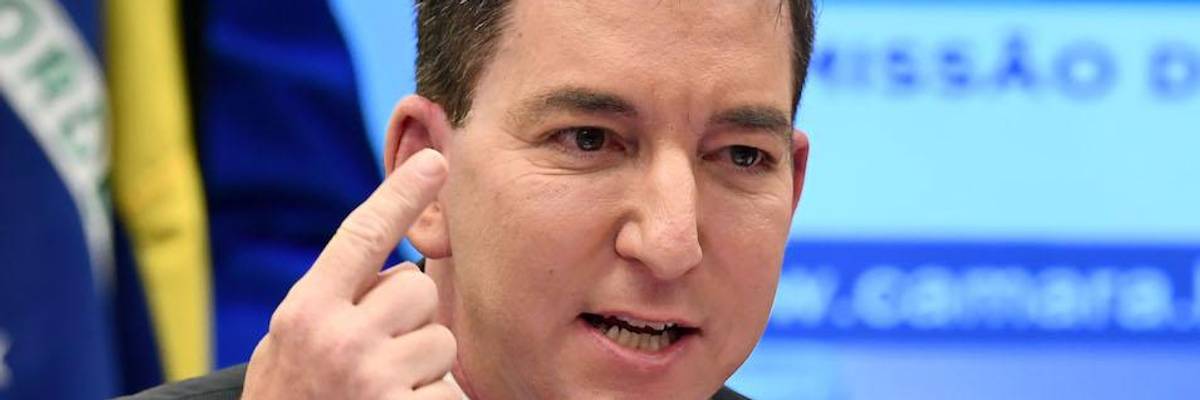
Glenn Greenwald, founder and editor of The Intercept, gestures during a hearing at the Lower House's Human Rights Commission in Brasilia, Brazil, on June 25, 2019. (Photo: Evaristo Sa/AFP/Getty Images)
The Brazilian government is targeting one of its biggest critics, journalist Glenn Greenwald, in a move that has been decried by observers as an intimidation tactic designed to stifle opposition to right-wing President Jair Bolsonaro.
The government's finance ministry's money laundering unit was asked by federal police to investigate Greenwald's finances, O Antagonista reported Tuesday. The right-wing Brazilian news site said that the investigation would focus on whether Greenwald paid for access to leaked records he used in reporting on the Bolsonaro government's "Operation Car Wash" sting.
"If there is an investigation for doing journalism it is illegal and it is an attempt at intimidation," University of Sao Paulo law professor Pierpaolo Bottini told The Guardian.
Attacks on Greenwald and his family, including husband David Miranda, a member of Brazil's Congress, were criticized by U.N. and Organization of American States (OAS) Edison Lanza and David Kaye. In a joint press release, Lanza and Kaye called on Brazil "to conduct an exhaustive, effective, and impartial investigation on the threats against the journalist and his family."
"The Special Rapporteurs remind the Brazilian State that it has an obligation to prevent, protect, investigate, and punish violence against journalists, particularly those who have been subjected to harassment and threats or other acts of violence," the rapporteurs' statement said.
Greenwald, co-founder of independent news organization The Intercept, published in the online magazine's Brazilian edition a number of investigations that use leaked documents to prove that the prosecution of former President Lula da Silva for corruption was steered by now Justice Minister Sergio Moro. The reporting has impacted Brazil's politics and thrown the Bolsonaro presidency into crisis.
Given the impact of the reporting, said Jose Guimaraes, a congressman who is a member of da Silva's Workers' Party, the investigation appears to be "a brutal violation of press freedom."
That point was echoed by Trevor Timm of the Freedom of the Press Foundation. In a statement, Timm said that an investigation into Greenwald would be "not only an outrageous attack on press freedom, but a gross abuse of power."
"Criminally investigating journalist Glenn Greenwald for reporting on corruption within the Bolsonaro government is a shocking violation of his rights as a reporter," Timm said. "Worse, the same person who is the primary subject of The Intercept's reporting--Minister of Justice Sergio Moro--would also have ultimate authority over any Federal Police investigation."
The fallout from Greenwald's reporting is having a major affect on Brazilian politics. On Tuesday, Moro appeared in front of the Brazilian Congress to answer questions on "Operation Car Wash" in a hearing that devolved at one point into near-violence.
Greenwald, who spoke to the lower house of Brazil's Congress about his reporting in June, was invited this week to testify in front of the Brazilian Senate. A date for that testimony has yet to be set.
Dear Common Dreams reader, It’s been nearly 30 years since I co-founded Common Dreams with my late wife, Lina Newhouser. We had the radical notion that journalism should serve the public good, not corporate profits. It was clear to us from the outset what it would take to build such a project. No paid advertisements. No corporate sponsors. No millionaire publisher telling us what to think or do. Many people said we wouldn't last a year, but we proved those doubters wrong. Together with a tremendous team of journalists and dedicated staff, we built an independent media outlet free from the constraints of profits and corporate control. Our mission has always been simple: To inform. To inspire. To ignite change for the common good. Building Common Dreams was not easy. Our survival was never guaranteed. When you take on the most powerful forces—Wall Street greed, fossil fuel industry destruction, Big Tech lobbyists, and uber-rich oligarchs who have spent billions upon billions rigging the economy and democracy in their favor—the only bulwark you have is supporters who believe in your work. But here’s the urgent message from me today. It's never been this bad out there. And it's never been this hard to keep us going. At the very moment Common Dreams is most needed, the threats we face are intensifying. We need your support now more than ever. We don't accept corporate advertising and never will. We don't have a paywall because we don't think people should be blocked from critical news based on their ability to pay. Everything we do is funded by the donations of readers like you. When everyone does the little they can afford, we are strong. But if that support retreats or dries up, so do we. Will you donate now to make sure Common Dreams not only survives but thrives? —Craig Brown, Co-founder |
The Brazilian government is targeting one of its biggest critics, journalist Glenn Greenwald, in a move that has been decried by observers as an intimidation tactic designed to stifle opposition to right-wing President Jair Bolsonaro.
The government's finance ministry's money laundering unit was asked by federal police to investigate Greenwald's finances, O Antagonista reported Tuesday. The right-wing Brazilian news site said that the investigation would focus on whether Greenwald paid for access to leaked records he used in reporting on the Bolsonaro government's "Operation Car Wash" sting.
"If there is an investigation for doing journalism it is illegal and it is an attempt at intimidation," University of Sao Paulo law professor Pierpaolo Bottini told The Guardian.
Attacks on Greenwald and his family, including husband David Miranda, a member of Brazil's Congress, were criticized by U.N. and Organization of American States (OAS) Edison Lanza and David Kaye. In a joint press release, Lanza and Kaye called on Brazil "to conduct an exhaustive, effective, and impartial investigation on the threats against the journalist and his family."
"The Special Rapporteurs remind the Brazilian State that it has an obligation to prevent, protect, investigate, and punish violence against journalists, particularly those who have been subjected to harassment and threats or other acts of violence," the rapporteurs' statement said.
Greenwald, co-founder of independent news organization The Intercept, published in the online magazine's Brazilian edition a number of investigations that use leaked documents to prove that the prosecution of former President Lula da Silva for corruption was steered by now Justice Minister Sergio Moro. The reporting has impacted Brazil's politics and thrown the Bolsonaro presidency into crisis.
Given the impact of the reporting, said Jose Guimaraes, a congressman who is a member of da Silva's Workers' Party, the investigation appears to be "a brutal violation of press freedom."
That point was echoed by Trevor Timm of the Freedom of the Press Foundation. In a statement, Timm said that an investigation into Greenwald would be "not only an outrageous attack on press freedom, but a gross abuse of power."
"Criminally investigating journalist Glenn Greenwald for reporting on corruption within the Bolsonaro government is a shocking violation of his rights as a reporter," Timm said. "Worse, the same person who is the primary subject of The Intercept's reporting--Minister of Justice Sergio Moro--would also have ultimate authority over any Federal Police investigation."
The fallout from Greenwald's reporting is having a major affect on Brazilian politics. On Tuesday, Moro appeared in front of the Brazilian Congress to answer questions on "Operation Car Wash" in a hearing that devolved at one point into near-violence.
Greenwald, who spoke to the lower house of Brazil's Congress about his reporting in June, was invited this week to testify in front of the Brazilian Senate. A date for that testimony has yet to be set.
The Brazilian government is targeting one of its biggest critics, journalist Glenn Greenwald, in a move that has been decried by observers as an intimidation tactic designed to stifle opposition to right-wing President Jair Bolsonaro.
The government's finance ministry's money laundering unit was asked by federal police to investigate Greenwald's finances, O Antagonista reported Tuesday. The right-wing Brazilian news site said that the investigation would focus on whether Greenwald paid for access to leaked records he used in reporting on the Bolsonaro government's "Operation Car Wash" sting.
"If there is an investigation for doing journalism it is illegal and it is an attempt at intimidation," University of Sao Paulo law professor Pierpaolo Bottini told The Guardian.
Attacks on Greenwald and his family, including husband David Miranda, a member of Brazil's Congress, were criticized by U.N. and Organization of American States (OAS) Edison Lanza and David Kaye. In a joint press release, Lanza and Kaye called on Brazil "to conduct an exhaustive, effective, and impartial investigation on the threats against the journalist and his family."
"The Special Rapporteurs remind the Brazilian State that it has an obligation to prevent, protect, investigate, and punish violence against journalists, particularly those who have been subjected to harassment and threats or other acts of violence," the rapporteurs' statement said.
Greenwald, co-founder of independent news organization The Intercept, published in the online magazine's Brazilian edition a number of investigations that use leaked documents to prove that the prosecution of former President Lula da Silva for corruption was steered by now Justice Minister Sergio Moro. The reporting has impacted Brazil's politics and thrown the Bolsonaro presidency into crisis.
Given the impact of the reporting, said Jose Guimaraes, a congressman who is a member of da Silva's Workers' Party, the investigation appears to be "a brutal violation of press freedom."
That point was echoed by Trevor Timm of the Freedom of the Press Foundation. In a statement, Timm said that an investigation into Greenwald would be "not only an outrageous attack on press freedom, but a gross abuse of power."
"Criminally investigating journalist Glenn Greenwald for reporting on corruption within the Bolsonaro government is a shocking violation of his rights as a reporter," Timm said. "Worse, the same person who is the primary subject of The Intercept's reporting--Minister of Justice Sergio Moro--would also have ultimate authority over any Federal Police investigation."
The fallout from Greenwald's reporting is having a major affect on Brazilian politics. On Tuesday, Moro appeared in front of the Brazilian Congress to answer questions on "Operation Car Wash" in a hearing that devolved at one point into near-violence.
Greenwald, who spoke to the lower house of Brazil's Congress about his reporting in June, was invited this week to testify in front of the Brazilian Senate. A date for that testimony has yet to be set.