

SUBSCRIBE TO OUR FREE NEWSLETTER
Daily news & progressive opinion—funded by the people, not the corporations—delivered straight to your inbox.
5
#000000
#FFFFFF
To donate by check, phone, or other method, see our More Ways to Give page.
Daily news & progressive opinion—funded by the people, not the corporations—delivered straight to your inbox.
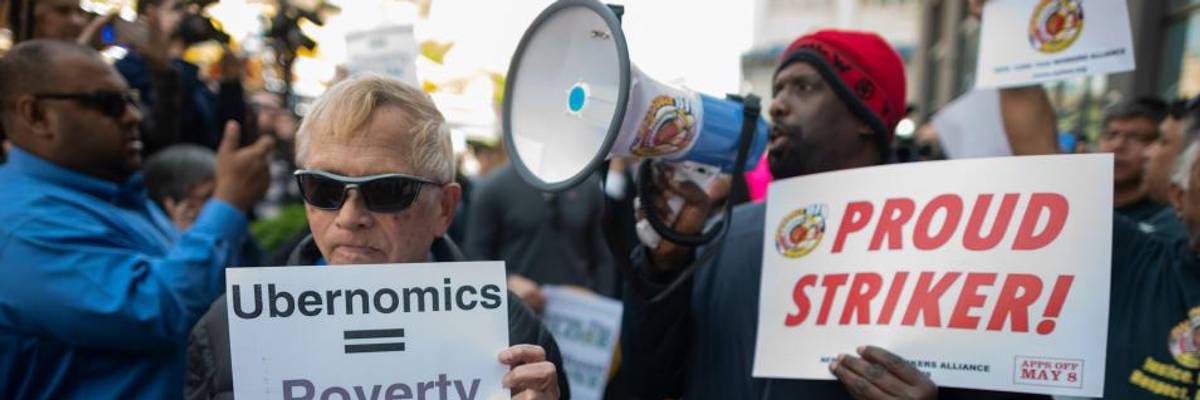
Drivers take part in a rally demanding more job security and livable incomes at Uber and Lyft New York City headquarters on May 8, 2019. (Photo: Johannes Eisele/AFP/Getty Images)
As rideshare drivers across the U.S. and around the world continue to struggle for decent wages, benefits, and the basic right to organize, Uber co-founder Garrett Camp reportedly purchased a Beverly Hills mansion for a record-breaking $72.5 million.
"It's a slap in everyone's face. The capitalist system we have has unduly rewarded him with extraordinary, in-your-face wealth."
--Veena Dubal, University of California, HastingsUber drivers, many of whom are homeless due to the $82-billion company's notoriously low rates, reacted to the Camp's purchase with outrage, describing it as a striking encapsulation of how the wealthiest Americans live in luxury on the backs of exploited workers.
"This is a perfect example of the one percent stealing from the rest of us," Nicole Moore, a ride-share driver in Los Angeles, told The Guardian in an interview. "Drivers are living in their cars. We're fighting for fair wages. At least share that wealth with the people who have actually built your company."
Uber driver and labor organizer Karim Bayumi said Camp's mansion was purchased with "our hard-earned money that they are unjustly taking from us."
"It's exploitation," Bayumi said.
Camp's "residential splurge," first reported Monday by Variety, comes just weeks after Uber and Lyft workers across the globe went on strike in May to protest poverty wages ahead of Uber's stock market debut.
As Common Dreams reported at the time, President Donald Trump's National Labor Relations Board gave Uber a boost shortly after its public market debut by ruling that the company's drivers are independent contractors and not entitled to the organizing rights of traditional employees.
Veena Dubal, an associate professor of employment law at the University of California, Hastings, told The Guardian on Tuesday that Uber became an immensely powerful company by evading labor laws and mistreating workers.
"It's a slap in everyone's face," Dubal said of Camp's mansion purchase, which comes in the midst of a homelessness crisis in Los Angeles. "The capitalist system we have has unduly rewarded him with extraordinary, in-your-face wealth.... This amount of money could change people's lives."
Dear Common Dreams reader, It’s been nearly 30 years since I co-founded Common Dreams with my late wife, Lina Newhouser. We had the radical notion that journalism should serve the public good, not corporate profits. It was clear to us from the outset what it would take to build such a project. No paid advertisements. No corporate sponsors. No millionaire publisher telling us what to think or do. Many people said we wouldn't last a year, but we proved those doubters wrong. Together with a tremendous team of journalists and dedicated staff, we built an independent media outlet free from the constraints of profits and corporate control. Our mission has always been simple: To inform. To inspire. To ignite change for the common good. Building Common Dreams was not easy. Our survival was never guaranteed. When you take on the most powerful forces—Wall Street greed, fossil fuel industry destruction, Big Tech lobbyists, and uber-rich oligarchs who have spent billions upon billions rigging the economy and democracy in their favor—the only bulwark you have is supporters who believe in your work. But here’s the urgent message from me today. It's never been this bad out there. And it's never been this hard to keep us going. At the very moment Common Dreams is most needed, the threats we face are intensifying. We need your support now more than ever. We don't accept corporate advertising and never will. We don't have a paywall because we don't think people should be blocked from critical news based on their ability to pay. Everything we do is funded by the donations of readers like you. When everyone does the little they can afford, we are strong. But if that support retreats or dries up, so do we. Will you donate now to make sure Common Dreams not only survives but thrives? —Craig Brown, Co-founder |
As rideshare drivers across the U.S. and around the world continue to struggle for decent wages, benefits, and the basic right to organize, Uber co-founder Garrett Camp reportedly purchased a Beverly Hills mansion for a record-breaking $72.5 million.
"It's a slap in everyone's face. The capitalist system we have has unduly rewarded him with extraordinary, in-your-face wealth."
--Veena Dubal, University of California, HastingsUber drivers, many of whom are homeless due to the $82-billion company's notoriously low rates, reacted to the Camp's purchase with outrage, describing it as a striking encapsulation of how the wealthiest Americans live in luxury on the backs of exploited workers.
"This is a perfect example of the one percent stealing from the rest of us," Nicole Moore, a ride-share driver in Los Angeles, told The Guardian in an interview. "Drivers are living in their cars. We're fighting for fair wages. At least share that wealth with the people who have actually built your company."
Uber driver and labor organizer Karim Bayumi said Camp's mansion was purchased with "our hard-earned money that they are unjustly taking from us."
"It's exploitation," Bayumi said.
Camp's "residential splurge," first reported Monday by Variety, comes just weeks after Uber and Lyft workers across the globe went on strike in May to protest poverty wages ahead of Uber's stock market debut.
As Common Dreams reported at the time, President Donald Trump's National Labor Relations Board gave Uber a boost shortly after its public market debut by ruling that the company's drivers are independent contractors and not entitled to the organizing rights of traditional employees.
Veena Dubal, an associate professor of employment law at the University of California, Hastings, told The Guardian on Tuesday that Uber became an immensely powerful company by evading labor laws and mistreating workers.
"It's a slap in everyone's face," Dubal said of Camp's mansion purchase, which comes in the midst of a homelessness crisis in Los Angeles. "The capitalist system we have has unduly rewarded him with extraordinary, in-your-face wealth.... This amount of money could change people's lives."
As rideshare drivers across the U.S. and around the world continue to struggle for decent wages, benefits, and the basic right to organize, Uber co-founder Garrett Camp reportedly purchased a Beverly Hills mansion for a record-breaking $72.5 million.
"It's a slap in everyone's face. The capitalist system we have has unduly rewarded him with extraordinary, in-your-face wealth."
--Veena Dubal, University of California, HastingsUber drivers, many of whom are homeless due to the $82-billion company's notoriously low rates, reacted to the Camp's purchase with outrage, describing it as a striking encapsulation of how the wealthiest Americans live in luxury on the backs of exploited workers.
"This is a perfect example of the one percent stealing from the rest of us," Nicole Moore, a ride-share driver in Los Angeles, told The Guardian in an interview. "Drivers are living in their cars. We're fighting for fair wages. At least share that wealth with the people who have actually built your company."
Uber driver and labor organizer Karim Bayumi said Camp's mansion was purchased with "our hard-earned money that they are unjustly taking from us."
"It's exploitation," Bayumi said.
Camp's "residential splurge," first reported Monday by Variety, comes just weeks after Uber and Lyft workers across the globe went on strike in May to protest poverty wages ahead of Uber's stock market debut.
As Common Dreams reported at the time, President Donald Trump's National Labor Relations Board gave Uber a boost shortly after its public market debut by ruling that the company's drivers are independent contractors and not entitled to the organizing rights of traditional employees.
Veena Dubal, an associate professor of employment law at the University of California, Hastings, told The Guardian on Tuesday that Uber became an immensely powerful company by evading labor laws and mistreating workers.
"It's a slap in everyone's face," Dubal said of Camp's mansion purchase, which comes in the midst of a homelessness crisis in Los Angeles. "The capitalist system we have has unduly rewarded him with extraordinary, in-your-face wealth.... This amount of money could change people's lives."

