SUBSCRIBE TO OUR FREE NEWSLETTER
Daily news & progressive opinion—funded by the people, not the corporations—delivered straight to your inbox.
5
#000000
#FFFFFF
To donate by check, phone, or other method, see our More Ways to Give page.
Daily news & progressive opinion—funded by the people, not the corporations—delivered straight to your inbox.
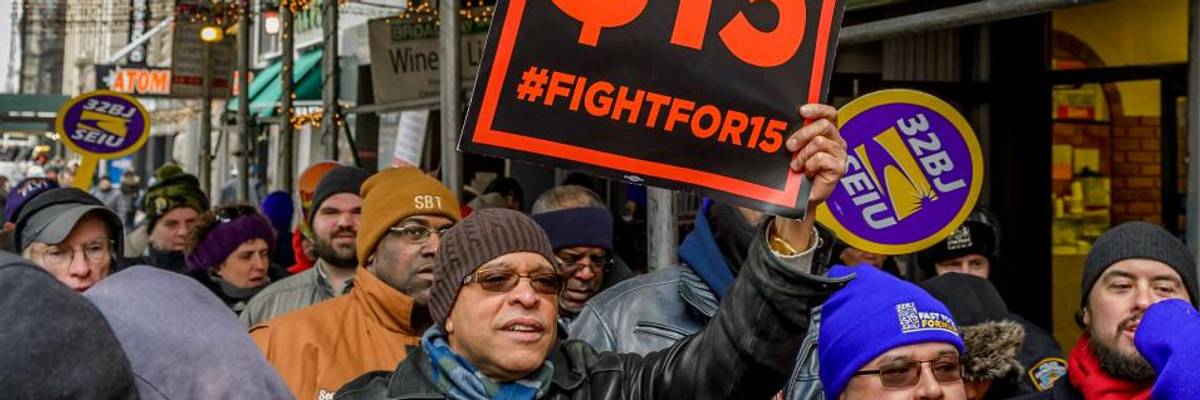
Several workers in the Fight for $15 movement took their opposition to downtown New York's McDonald's during the lunchtime rush on February 13, 2017. (Photo: Erik Mcgregor/Pacific Press/LightRocket via Getty Images)
New research published Tuesday by economists at the University of California, Berkeley showed that raising the federal minimum wage to $15 by 2024 would significantly reduce poverty without causing job losses in low-wage states--a finding that further undermines fearmongering by conservatives and centrist Democrats.
"Put in practical terms, the new Berkeley study is further evidence that workers, and not the nation's conservative columnists, are right."
--Sarah Jones
Anna Godoey and Michael Reich of U.C. Berkeley's Center on Wage and Employment Dynamics, the authors of the study (pdf), examined 51 minimum wage increases in 750 low-wage counties across 45 states between 2004 and 2016.
The researchers found "substantial declines in household and child poverty" in low-wage areas--such as Mississippi and Alabama--without detecting any negative impact on employment or hours.
"The results of our research show that we can raise pay to $15, even in low-cost states," Godoey said in a statement. "The data show that the minimum wage has positive effects, especially in areas where the highest proportion of workers received minimum wage increases."
The "groundbreaking" new research comes as so-called moderate Democrats in the House are working to water down legislation that would raise the federal minimum wage to $15 by 2024.
Led by Rep. Terri Sewell (D-Ala.), a group of around a dozen Democrats is pushing for a "regional wage" adjusted to local costs of living. Raising the federal minimum wage to $15 across the board, they argue, would result in job losses.
"More than doubling the wage over five years is going to result in lost jobs," an aide to a member of Congress in favor of a regional wage bill told Politico in April. "A lot of people would prefer to have a $10 wage than no job."
Reich said in a statement that his research provides strong evidence against this argument.
"These new findings considerably extend our knowledge of the effects of minimum wage increases in the lowest wage areas of the U.S.," Reich said in a statement. "They suggest that a $15 federal minimum wage by 2024 will have widespread positive effects for working women and men, kids and communities of color, without causing any job loss."
As New York Magazine's Sarah Jones wrote Tuesday, "Godoey and Reich's research isn't anomalous."
Previous research from U.C. Berkeley "found that six major U.S. cities--Oakland, Chicago, and San Francisco among them--didn't experience significant job losses after they raised their minimum wages," Jones noted.
"Put in practical terms, the new Berkeley study is further evidence that workers, and not the nation's conservative columnists, are right," Jones added. "Bills like the Raise the Wage Act of 2019, which would raise the minimum wage to $15 an hour by 2024, aren't just liberal performance art but sound policies that would meaningfully reduce poverty without driving vulnerable people out of work."
Dear Common Dreams reader, It’s been nearly 30 years since I co-founded Common Dreams with my late wife, Lina Newhouser. We had the radical notion that journalism should serve the public good, not corporate profits. It was clear to us from the outset what it would take to build such a project. No paid advertisements. No corporate sponsors. No millionaire publisher telling us what to think or do. Many people said we wouldn't last a year, but we proved those doubters wrong. Together with a tremendous team of journalists and dedicated staff, we built an independent media outlet free from the constraints of profits and corporate control. Our mission has always been simple: To inform. To inspire. To ignite change for the common good. Building Common Dreams was not easy. Our survival was never guaranteed. When you take on the most powerful forces—Wall Street greed, fossil fuel industry destruction, Big Tech lobbyists, and uber-rich oligarchs who have spent billions upon billions rigging the economy and democracy in their favor—the only bulwark you have is supporters who believe in your work. But here’s the urgent message from me today. It's never been this bad out there. And it's never been this hard to keep us going. At the very moment Common Dreams is most needed, the threats we face are intensifying. We need your support now more than ever. We don't accept corporate advertising and never will. We don't have a paywall because we don't think people should be blocked from critical news based on their ability to pay. Everything we do is funded by the donations of readers like you. When everyone does the little they can afford, we are strong. But if that support retreats or dries up, so do we. Will you donate now to make sure Common Dreams not only survives but thrives? —Craig Brown, Co-founder |
New research published Tuesday by economists at the University of California, Berkeley showed that raising the federal minimum wage to $15 by 2024 would significantly reduce poverty without causing job losses in low-wage states--a finding that further undermines fearmongering by conservatives and centrist Democrats.
"Put in practical terms, the new Berkeley study is further evidence that workers, and not the nation's conservative columnists, are right."
--Sarah Jones
Anna Godoey and Michael Reich of U.C. Berkeley's Center on Wage and Employment Dynamics, the authors of the study (pdf), examined 51 minimum wage increases in 750 low-wage counties across 45 states between 2004 and 2016.
The researchers found "substantial declines in household and child poverty" in low-wage areas--such as Mississippi and Alabama--without detecting any negative impact on employment or hours.
"The results of our research show that we can raise pay to $15, even in low-cost states," Godoey said in a statement. "The data show that the minimum wage has positive effects, especially in areas where the highest proportion of workers received minimum wage increases."
The "groundbreaking" new research comes as so-called moderate Democrats in the House are working to water down legislation that would raise the federal minimum wage to $15 by 2024.
Led by Rep. Terri Sewell (D-Ala.), a group of around a dozen Democrats is pushing for a "regional wage" adjusted to local costs of living. Raising the federal minimum wage to $15 across the board, they argue, would result in job losses.
"More than doubling the wage over five years is going to result in lost jobs," an aide to a member of Congress in favor of a regional wage bill told Politico in April. "A lot of people would prefer to have a $10 wage than no job."
Reich said in a statement that his research provides strong evidence against this argument.
"These new findings considerably extend our knowledge of the effects of minimum wage increases in the lowest wage areas of the U.S.," Reich said in a statement. "They suggest that a $15 federal minimum wage by 2024 will have widespread positive effects for working women and men, kids and communities of color, without causing any job loss."
As New York Magazine's Sarah Jones wrote Tuesday, "Godoey and Reich's research isn't anomalous."
Previous research from U.C. Berkeley "found that six major U.S. cities--Oakland, Chicago, and San Francisco among them--didn't experience significant job losses after they raised their minimum wages," Jones noted.
"Put in practical terms, the new Berkeley study is further evidence that workers, and not the nation's conservative columnists, are right," Jones added. "Bills like the Raise the Wage Act of 2019, which would raise the minimum wage to $15 an hour by 2024, aren't just liberal performance art but sound policies that would meaningfully reduce poverty without driving vulnerable people out of work."
New research published Tuesday by economists at the University of California, Berkeley showed that raising the federal minimum wage to $15 by 2024 would significantly reduce poverty without causing job losses in low-wage states--a finding that further undermines fearmongering by conservatives and centrist Democrats.
"Put in practical terms, the new Berkeley study is further evidence that workers, and not the nation's conservative columnists, are right."
--Sarah Jones
Anna Godoey and Michael Reich of U.C. Berkeley's Center on Wage and Employment Dynamics, the authors of the study (pdf), examined 51 minimum wage increases in 750 low-wage counties across 45 states between 2004 and 2016.
The researchers found "substantial declines in household and child poverty" in low-wage areas--such as Mississippi and Alabama--without detecting any negative impact on employment or hours.
"The results of our research show that we can raise pay to $15, even in low-cost states," Godoey said in a statement. "The data show that the minimum wage has positive effects, especially in areas where the highest proportion of workers received minimum wage increases."
The "groundbreaking" new research comes as so-called moderate Democrats in the House are working to water down legislation that would raise the federal minimum wage to $15 by 2024.
Led by Rep. Terri Sewell (D-Ala.), a group of around a dozen Democrats is pushing for a "regional wage" adjusted to local costs of living. Raising the federal minimum wage to $15 across the board, they argue, would result in job losses.
"More than doubling the wage over five years is going to result in lost jobs," an aide to a member of Congress in favor of a regional wage bill told Politico in April. "A lot of people would prefer to have a $10 wage than no job."
Reich said in a statement that his research provides strong evidence against this argument.
"These new findings considerably extend our knowledge of the effects of minimum wage increases in the lowest wage areas of the U.S.," Reich said in a statement. "They suggest that a $15 federal minimum wage by 2024 will have widespread positive effects for working women and men, kids and communities of color, without causing any job loss."
As New York Magazine's Sarah Jones wrote Tuesday, "Godoey and Reich's research isn't anomalous."
Previous research from U.C. Berkeley "found that six major U.S. cities--Oakland, Chicago, and San Francisco among them--didn't experience significant job losses after they raised their minimum wages," Jones noted.
"Put in practical terms, the new Berkeley study is further evidence that workers, and not the nation's conservative columnists, are right," Jones added. "Bills like the Raise the Wage Act of 2019, which would raise the minimum wage to $15 an hour by 2024, aren't just liberal performance art but sound policies that would meaningfully reduce poverty without driving vulnerable people out of work."