SUBSCRIBE TO OUR FREE NEWSLETTER
Daily news & progressive opinion—funded by the people, not the corporations—delivered straight to your inbox.
5
#000000
#FFFFFF
To donate by check, phone, or other method, see our More Ways to Give page.
Daily news & progressive opinion—funded by the people, not the corporations—delivered straight to your inbox.
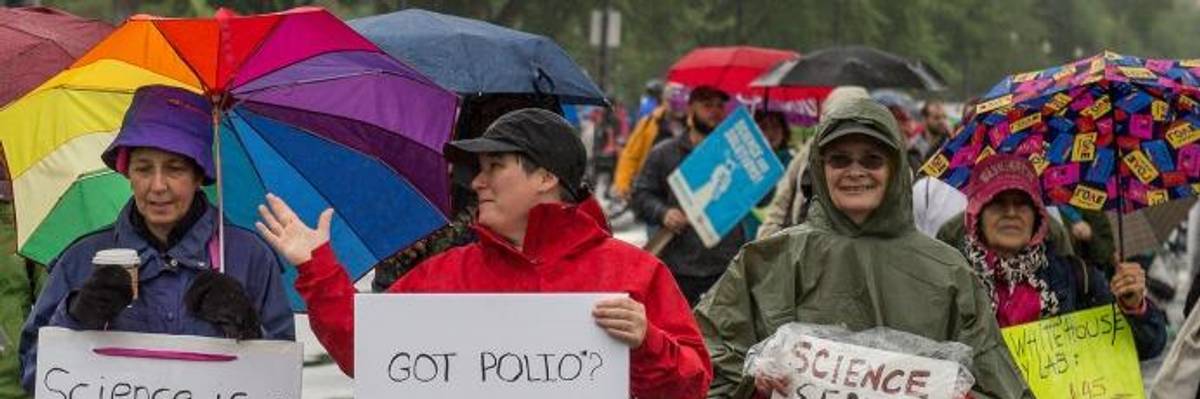
Demonstrators walk during the 2017 March for Science. (Photo: Mobilus In Mobili/flickr/cc)
In a move celebrated by anti-choicers, the Trump-Pence administration on Wednesday announced it is barring government researchers from using fetal tissue.
Research using fetal tissue has led to major medical advances including the polio vaccine, and is used in developing vaccines for other diseases including HIV.
But given that the tissue comes from abortions, the anti-choice movement has utilized the issue to further its attack on reproductive rights.
In its new statement, the Department of Health and Human Services (HHS) said it will not renew its contract with the University of California, San Francisco (UCSF) regarding research involving human fetal tissue from elective abortions. Research conducted within the National Institutes of Health (NIH) involving the use of human fetal tissue from elective abortion is stopped, the statement said, and NIH grant-funded research projects conducted outside NIH will be subjected to a new ethics advisory board.
In addition, "HHS is continuing to review whether adequate alternatives exist to the use of human fetal tissue from elective abortions in HHS-funded research and will ensure that efforts to develop such alternatives are funded and accelerated," the statement adds.
Though the administration has put migrant children in cages and moved to threaten poor people's access to food, the HHS statement said that "[p]romoting the dignity of human life from conception to natural death is one of the very top priorities of President Trump's administration."
Crirtics blasted the move on social media, calling it a further attack on science that puts life-saving research in danger.
When HHS announced in September that it was beginning a review of human fetal tissue research, experts expressed concern about the possible motivations and likely effects.
Among those sounding alarm was Warner Greene, MD, PhD, a senior investigator and director of the Center for HIV Cure Research at the Gladstone Institutes.
"If the ban on the use of fetal tissue is extended to all NIH grantees, it could really thwart the progress of science," said Greene. "More specifically, blocking the use of fetal tissue could seriously hinder our hopes of finding a cure for HIV."
Alta Charo, a professor of law and bioethics at the University of Wisconsin in Madison, summed up what she felt was behind the administration's move.
"My instinct is that this is driven by politics," she previously told Science magazine, "and is part of the overall effort to stigmatize and eventually criminalize abortion, as well as part of a larger campaign to roll back the clock on sexual and reproductive rights."
Dear Common Dreams reader, It’s been nearly 30 years since I co-founded Common Dreams with my late wife, Lina Newhouser. We had the radical notion that journalism should serve the public good, not corporate profits. It was clear to us from the outset what it would take to build such a project. No paid advertisements. No corporate sponsors. No millionaire publisher telling us what to think or do. Many people said we wouldn't last a year, but we proved those doubters wrong. Together with a tremendous team of journalists and dedicated staff, we built an independent media outlet free from the constraints of profits and corporate control. Our mission has always been simple: To inform. To inspire. To ignite change for the common good. Building Common Dreams was not easy. Our survival was never guaranteed. When you take on the most powerful forces—Wall Street greed, fossil fuel industry destruction, Big Tech lobbyists, and uber-rich oligarchs who have spent billions upon billions rigging the economy and democracy in their favor—the only bulwark you have is supporters who believe in your work. But here’s the urgent message from me today. It's never been this bad out there. And it's never been this hard to keep us going. At the very moment Common Dreams is most needed, the threats we face are intensifying. We need your support now more than ever. We don't accept corporate advertising and never will. We don't have a paywall because we don't think people should be blocked from critical news based on their ability to pay. Everything we do is funded by the donations of readers like you. When everyone does the little they can afford, we are strong. But if that support retreats or dries up, so do we. Will you donate now to make sure Common Dreams not only survives but thrives? —Craig Brown, Co-founder |
In a move celebrated by anti-choicers, the Trump-Pence administration on Wednesday announced it is barring government researchers from using fetal tissue.
Research using fetal tissue has led to major medical advances including the polio vaccine, and is used in developing vaccines for other diseases including HIV.
But given that the tissue comes from abortions, the anti-choice movement has utilized the issue to further its attack on reproductive rights.
In its new statement, the Department of Health and Human Services (HHS) said it will not renew its contract with the University of California, San Francisco (UCSF) regarding research involving human fetal tissue from elective abortions. Research conducted within the National Institutes of Health (NIH) involving the use of human fetal tissue from elective abortion is stopped, the statement said, and NIH grant-funded research projects conducted outside NIH will be subjected to a new ethics advisory board.
In addition, "HHS is continuing to review whether adequate alternatives exist to the use of human fetal tissue from elective abortions in HHS-funded research and will ensure that efforts to develop such alternatives are funded and accelerated," the statement adds.
Though the administration has put migrant children in cages and moved to threaten poor people's access to food, the HHS statement said that "[p]romoting the dignity of human life from conception to natural death is one of the very top priorities of President Trump's administration."
Crirtics blasted the move on social media, calling it a further attack on science that puts life-saving research in danger.
When HHS announced in September that it was beginning a review of human fetal tissue research, experts expressed concern about the possible motivations and likely effects.
Among those sounding alarm was Warner Greene, MD, PhD, a senior investigator and director of the Center for HIV Cure Research at the Gladstone Institutes.
"If the ban on the use of fetal tissue is extended to all NIH grantees, it could really thwart the progress of science," said Greene. "More specifically, blocking the use of fetal tissue could seriously hinder our hopes of finding a cure for HIV."
Alta Charo, a professor of law and bioethics at the University of Wisconsin in Madison, summed up what she felt was behind the administration's move.
"My instinct is that this is driven by politics," she previously told Science magazine, "and is part of the overall effort to stigmatize and eventually criminalize abortion, as well as part of a larger campaign to roll back the clock on sexual and reproductive rights."
In a move celebrated by anti-choicers, the Trump-Pence administration on Wednesday announced it is barring government researchers from using fetal tissue.
Research using fetal tissue has led to major medical advances including the polio vaccine, and is used in developing vaccines for other diseases including HIV.
But given that the tissue comes from abortions, the anti-choice movement has utilized the issue to further its attack on reproductive rights.
In its new statement, the Department of Health and Human Services (HHS) said it will not renew its contract with the University of California, San Francisco (UCSF) regarding research involving human fetal tissue from elective abortions. Research conducted within the National Institutes of Health (NIH) involving the use of human fetal tissue from elective abortion is stopped, the statement said, and NIH grant-funded research projects conducted outside NIH will be subjected to a new ethics advisory board.
In addition, "HHS is continuing to review whether adequate alternatives exist to the use of human fetal tissue from elective abortions in HHS-funded research and will ensure that efforts to develop such alternatives are funded and accelerated," the statement adds.
Though the administration has put migrant children in cages and moved to threaten poor people's access to food, the HHS statement said that "[p]romoting the dignity of human life from conception to natural death is one of the very top priorities of President Trump's administration."
Crirtics blasted the move on social media, calling it a further attack on science that puts life-saving research in danger.
When HHS announced in September that it was beginning a review of human fetal tissue research, experts expressed concern about the possible motivations and likely effects.
Among those sounding alarm was Warner Greene, MD, PhD, a senior investigator and director of the Center for HIV Cure Research at the Gladstone Institutes.
"If the ban on the use of fetal tissue is extended to all NIH grantees, it could really thwart the progress of science," said Greene. "More specifically, blocking the use of fetal tissue could seriously hinder our hopes of finding a cure for HIV."
Alta Charo, a professor of law and bioethics at the University of Wisconsin in Madison, summed up what she felt was behind the administration's move.
"My instinct is that this is driven by politics," she previously told Science magazine, "and is part of the overall effort to stigmatize and eventually criminalize abortion, as well as part of a larger campaign to roll back the clock on sexual and reproductive rights."