SUBSCRIBE TO OUR FREE NEWSLETTER
Daily news & progressive opinion—funded by the people, not the corporations—delivered straight to your inbox.
5
#000000
#FFFFFF
To donate by check, phone, or other method, see our More Ways to Give page.
Daily news & progressive opinion—funded by the people, not the corporations—delivered straight to your inbox.
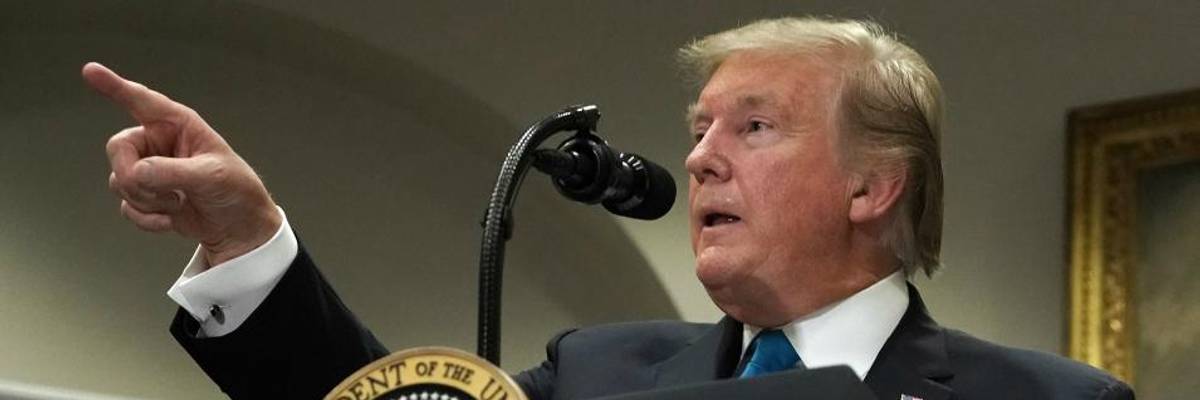
President Donald Trump delivers remarks in the Roosevelt Room at the White House May 23, 2019 in Washington, D.C. (Photo: Chip Somodevilla/Getty Images)
Joining lawmakers, progressive critics, and economists in the U.S. who denounced President Donald Trump's tariff threat against Mexico Thursday as a reckless move that will harm American consumers, Mexican trade negotiator Jesus Seade warned that the proposed duty on his country's goods would have "disastrous" consequences.
"This threat, taken to action, would be extremely serious, and Mexico will not stand with arms crossed," Seade told reporters following Trump's policy announcement.
"Trump's reckless tariff decision removes any pretense that he cares about anything other than exacerbating the border crisis and exploiting it for political gain."
--Rep. Raul Grijalva
Seade said Mexico "will respond energetically" if the tariff takes effect, but added that it will seek talks with the Trump administration before retaliating.
In a letter to his U.S. counterpart on Thursday, President Andres Manuel Lopez Obrador of Mexico emphasized the need for dialogue and said he does not want a confrontation.
If talks fail, Seade warned, "it would mean a trade war."
As with so many of his enormously consequential policy moves, Trump announced his decision to impose a 5 percent tariff on imported Mexican goods by June 10 on Twitter.
If Mexico does not ramp up its crackdown on migrants crossing to the U.S., Trump tweeted, the tariff "will gradually increase until the illegal immigration problem is remedied."
In a statement on Thursday, the White House said the tariffs "will be increased to 15 percent on August 1, 2019, to 20 percent on September 1, 2019, and to 25 percent on October 1, 2019. Tariffs will permanently remain at the 25 percent level unless and until Mexico substantially stops the illegal inflow of aliens coming through its territory."
As the New York Times reported, "Mexico is Washington's largest trading partner, sending across the border items like tomatoes, cars, and rugs. Mexico sent the United States $346.5 billion of goods last year--meaning that a 5 percent tariff on those products would amount to a tax increase of more than $17 billion."
"Most of the costs," according to the Times, "would then be passed on to businesses and consumers."
On top of the harms to U.S. consumers, immigration experts and rights advocates said tariffs would do nothing to remedy humanitarian issues at the border, which many critics argue are a direct consequence of Trump's anti-immigrant agenda.
In a series of tweets late Thursday, Rep. Raul Grijalva (D-Ariz.) accused Trump of using "asylum seekers, children, the economy, and American values" as "disposable pawns in his cruel game."
"Trump's reckless tariff decision that puts the lives and jobs of Arizona's workers and their families at stake," Grijalva said, "removes any pretense that he cares about anything other than exacerbating the border crisis and exploiting it for political gain."
Dear Common Dreams reader, It’s been nearly 30 years since I co-founded Common Dreams with my late wife, Lina Newhouser. We had the radical notion that journalism should serve the public good, not corporate profits. It was clear to us from the outset what it would take to build such a project. No paid advertisements. No corporate sponsors. No millionaire publisher telling us what to think or do. Many people said we wouldn't last a year, but we proved those doubters wrong. Together with a tremendous team of journalists and dedicated staff, we built an independent media outlet free from the constraints of profits and corporate control. Our mission has always been simple: To inform. To inspire. To ignite change for the common good. Building Common Dreams was not easy. Our survival was never guaranteed. When you take on the most powerful forces—Wall Street greed, fossil fuel industry destruction, Big Tech lobbyists, and uber-rich oligarchs who have spent billions upon billions rigging the economy and democracy in their favor—the only bulwark you have is supporters who believe in your work. But here’s the urgent message from me today. It's never been this bad out there. And it's never been this hard to keep us going. At the very moment Common Dreams is most needed, the threats we face are intensifying. We need your support now more than ever. We don't accept corporate advertising and never will. We don't have a paywall because we don't think people should be blocked from critical news based on their ability to pay. Everything we do is funded by the donations of readers like you. When everyone does the little they can afford, we are strong. But if that support retreats or dries up, so do we. Will you donate now to make sure Common Dreams not only survives but thrives? —Craig Brown, Co-founder |
Joining lawmakers, progressive critics, and economists in the U.S. who denounced President Donald Trump's tariff threat against Mexico Thursday as a reckless move that will harm American consumers, Mexican trade negotiator Jesus Seade warned that the proposed duty on his country's goods would have "disastrous" consequences.
"This threat, taken to action, would be extremely serious, and Mexico will not stand with arms crossed," Seade told reporters following Trump's policy announcement.
"Trump's reckless tariff decision removes any pretense that he cares about anything other than exacerbating the border crisis and exploiting it for political gain."
--Rep. Raul Grijalva
Seade said Mexico "will respond energetically" if the tariff takes effect, but added that it will seek talks with the Trump administration before retaliating.
In a letter to his U.S. counterpart on Thursday, President Andres Manuel Lopez Obrador of Mexico emphasized the need for dialogue and said he does not want a confrontation.
If talks fail, Seade warned, "it would mean a trade war."
As with so many of his enormously consequential policy moves, Trump announced his decision to impose a 5 percent tariff on imported Mexican goods by June 10 on Twitter.
If Mexico does not ramp up its crackdown on migrants crossing to the U.S., Trump tweeted, the tariff "will gradually increase until the illegal immigration problem is remedied."
In a statement on Thursday, the White House said the tariffs "will be increased to 15 percent on August 1, 2019, to 20 percent on September 1, 2019, and to 25 percent on October 1, 2019. Tariffs will permanently remain at the 25 percent level unless and until Mexico substantially stops the illegal inflow of aliens coming through its territory."
As the New York Times reported, "Mexico is Washington's largest trading partner, sending across the border items like tomatoes, cars, and rugs. Mexico sent the United States $346.5 billion of goods last year--meaning that a 5 percent tariff on those products would amount to a tax increase of more than $17 billion."
"Most of the costs," according to the Times, "would then be passed on to businesses and consumers."
On top of the harms to U.S. consumers, immigration experts and rights advocates said tariffs would do nothing to remedy humanitarian issues at the border, which many critics argue are a direct consequence of Trump's anti-immigrant agenda.
In a series of tweets late Thursday, Rep. Raul Grijalva (D-Ariz.) accused Trump of using "asylum seekers, children, the economy, and American values" as "disposable pawns in his cruel game."
"Trump's reckless tariff decision that puts the lives and jobs of Arizona's workers and their families at stake," Grijalva said, "removes any pretense that he cares about anything other than exacerbating the border crisis and exploiting it for political gain."
Joining lawmakers, progressive critics, and economists in the U.S. who denounced President Donald Trump's tariff threat against Mexico Thursday as a reckless move that will harm American consumers, Mexican trade negotiator Jesus Seade warned that the proposed duty on his country's goods would have "disastrous" consequences.
"This threat, taken to action, would be extremely serious, and Mexico will not stand with arms crossed," Seade told reporters following Trump's policy announcement.
"Trump's reckless tariff decision removes any pretense that he cares about anything other than exacerbating the border crisis and exploiting it for political gain."
--Rep. Raul Grijalva
Seade said Mexico "will respond energetically" if the tariff takes effect, but added that it will seek talks with the Trump administration before retaliating.
In a letter to his U.S. counterpart on Thursday, President Andres Manuel Lopez Obrador of Mexico emphasized the need for dialogue and said he does not want a confrontation.
If talks fail, Seade warned, "it would mean a trade war."
As with so many of his enormously consequential policy moves, Trump announced his decision to impose a 5 percent tariff on imported Mexican goods by June 10 on Twitter.
If Mexico does not ramp up its crackdown on migrants crossing to the U.S., Trump tweeted, the tariff "will gradually increase until the illegal immigration problem is remedied."
In a statement on Thursday, the White House said the tariffs "will be increased to 15 percent on August 1, 2019, to 20 percent on September 1, 2019, and to 25 percent on October 1, 2019. Tariffs will permanently remain at the 25 percent level unless and until Mexico substantially stops the illegal inflow of aliens coming through its territory."
As the New York Times reported, "Mexico is Washington's largest trading partner, sending across the border items like tomatoes, cars, and rugs. Mexico sent the United States $346.5 billion of goods last year--meaning that a 5 percent tariff on those products would amount to a tax increase of more than $17 billion."
"Most of the costs," according to the Times, "would then be passed on to businesses and consumers."
On top of the harms to U.S. consumers, immigration experts and rights advocates said tariffs would do nothing to remedy humanitarian issues at the border, which many critics argue are a direct consequence of Trump's anti-immigrant agenda.
In a series of tweets late Thursday, Rep. Raul Grijalva (D-Ariz.) accused Trump of using "asylum seekers, children, the economy, and American values" as "disposable pawns in his cruel game."
"Trump's reckless tariff decision that puts the lives and jobs of Arizona's workers and their families at stake," Grijalva said, "removes any pretense that he cares about anything other than exacerbating the border crisis and exploiting it for political gain."