

SUBSCRIBE TO OUR FREE NEWSLETTER
Daily news & progressive opinion—funded by the people, not the corporations—delivered straight to your inbox.
5
#000000
#FFFFFF
To donate by check, phone, or other method, see our More Ways to Give page.
Daily news & progressive opinion—funded by the people, not the corporations—delivered straight to your inbox.
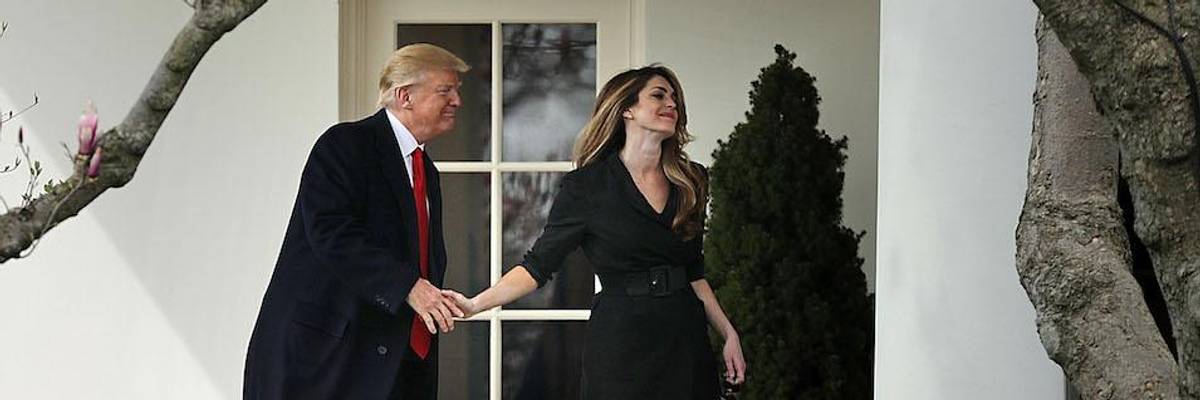
Hope Hicks at the White House, March 2018. The former Trump aide is unlikely to honor a congressional subpoena next month. (Photo: Chip Somodevilla/Getty Images)
The contrast between media coverage of two women, Hope Hicks and Chelsea Manning, who are each refusing to cooperate with federal investigations did not go unnoticed on Memorial Day Weekend.
"Give Chelsea Manning the glamour shot and charitable take she deserves."
--Bob Bland
On Thursday evening, The New York Times unveiled an article about Hope Hicks, former aide to President Donald Trump, and what the paper portrayed in a tweet as an "existential crisis" for the former White House staffer: her likely refusal to comply with a congressional subpoena to appear before the House Judiciary Committee on June 19.
The article was derided as being too friendly to Hicks as opposed to holding the former Trump aide to account for blatantly breaking the law. House Democrats are increasingly frustrated with Trump and his allies flouting of congressional oversight.
Per ThinkProgress:
Hicks, who worked for President Donald Trump during his campaign and the first two years of his presidency, is reportedly considering becoming the latest ex-Trump official to defy a subpoena--which is supposed to be illegal.
To journalist Soledad O'Brien, the photo choice and tone of the Times piece reflected "bias."
"A picture of a person who is considering not complying with a subpoena is basically a glam shot," O'Brien said on Twitter, "and it's framed as a thoughtful, perfectly equal choice.
Critics pointed to the lack of glossy profiles and complimentary coverage for another woman who refused a subpoena: Army veteran Chelsea Manning. Manning has been held in federal custody for 75 of the past 82 days, with a brief seven day interlude.
"Oddly, the NYT didn't frame Chelsea Manning's refusal to testify against Assange in the same way," said journalist Dan Gilmor.
The coverage contrast was pointed to by a number of journalists and activists, many of whom demanded that the paper treat Manning with the same respect as Hicks.
Journalist Marcy Wheeler used her Twitter account to make the contrast clear, tweeting pictures of the relative coverage for each woman.
"Chelsea Manning doesn't get this treatment," said comedian Ryan Houlihan.
Documentarian and investigative journalist Lindsay Beyerstein, in a series of tweets, laid out the difference between the two women's actions.
"Regardless of how you feel about Chelsea Manning's stance, it comes at real cost to her," Beyerstein said. "And she has ideological reasons for not complying. Hope Hicks just doesn't feel like it."
Women's March co-president Bob Bland called for Manning to be given, at minimum, at least the respect Hicks got from the Times.
"If this is how The New York Times is covering government subpoenas now, please retract and give Chelsea Manning the glamour shot and charitable take she deserves," tweeted Bland. "After all--she's the one actually protecting democracy instead of trying to dismantle it for profit!"
Dear Common Dreams reader, It’s been nearly 30 years since I co-founded Common Dreams with my late wife, Lina Newhouser. We had the radical notion that journalism should serve the public good, not corporate profits. It was clear to us from the outset what it would take to build such a project. No paid advertisements. No corporate sponsors. No millionaire publisher telling us what to think or do. Many people said we wouldn't last a year, but we proved those doubters wrong. Together with a tremendous team of journalists and dedicated staff, we built an independent media outlet free from the constraints of profits and corporate control. Our mission has always been simple: To inform. To inspire. To ignite change for the common good. Building Common Dreams was not easy. Our survival was never guaranteed. When you take on the most powerful forces—Wall Street greed, fossil fuel industry destruction, Big Tech lobbyists, and uber-rich oligarchs who have spent billions upon billions rigging the economy and democracy in their favor—the only bulwark you have is supporters who believe in your work. But here’s the urgent message from me today. It's never been this bad out there. And it's never been this hard to keep us going. At the very moment Common Dreams is most needed, the threats we face are intensifying. We need your support now more than ever. We don't accept corporate advertising and never will. We don't have a paywall because we don't think people should be blocked from critical news based on their ability to pay. Everything we do is funded by the donations of readers like you. When everyone does the little they can afford, we are strong. But if that support retreats or dries up, so do we. Will you donate now to make sure Common Dreams not only survives but thrives? —Craig Brown, Co-founder |
The contrast between media coverage of two women, Hope Hicks and Chelsea Manning, who are each refusing to cooperate with federal investigations did not go unnoticed on Memorial Day Weekend.
"Give Chelsea Manning the glamour shot and charitable take she deserves."
--Bob Bland
On Thursday evening, The New York Times unveiled an article about Hope Hicks, former aide to President Donald Trump, and what the paper portrayed in a tweet as an "existential crisis" for the former White House staffer: her likely refusal to comply with a congressional subpoena to appear before the House Judiciary Committee on June 19.
The article was derided as being too friendly to Hicks as opposed to holding the former Trump aide to account for blatantly breaking the law. House Democrats are increasingly frustrated with Trump and his allies flouting of congressional oversight.
Per ThinkProgress:
Hicks, who worked for President Donald Trump during his campaign and the first two years of his presidency, is reportedly considering becoming the latest ex-Trump official to defy a subpoena--which is supposed to be illegal.
To journalist Soledad O'Brien, the photo choice and tone of the Times piece reflected "bias."
"A picture of a person who is considering not complying with a subpoena is basically a glam shot," O'Brien said on Twitter, "and it's framed as a thoughtful, perfectly equal choice.
Critics pointed to the lack of glossy profiles and complimentary coverage for another woman who refused a subpoena: Army veteran Chelsea Manning. Manning has been held in federal custody for 75 of the past 82 days, with a brief seven day interlude.
"Oddly, the NYT didn't frame Chelsea Manning's refusal to testify against Assange in the same way," said journalist Dan Gilmor.
The coverage contrast was pointed to by a number of journalists and activists, many of whom demanded that the paper treat Manning with the same respect as Hicks.
Journalist Marcy Wheeler used her Twitter account to make the contrast clear, tweeting pictures of the relative coverage for each woman.
"Chelsea Manning doesn't get this treatment," said comedian Ryan Houlihan.
Documentarian and investigative journalist Lindsay Beyerstein, in a series of tweets, laid out the difference between the two women's actions.
"Regardless of how you feel about Chelsea Manning's stance, it comes at real cost to her," Beyerstein said. "And she has ideological reasons for not complying. Hope Hicks just doesn't feel like it."
Women's March co-president Bob Bland called for Manning to be given, at minimum, at least the respect Hicks got from the Times.
"If this is how The New York Times is covering government subpoenas now, please retract and give Chelsea Manning the glamour shot and charitable take she deserves," tweeted Bland. "After all--she's the one actually protecting democracy instead of trying to dismantle it for profit!"
The contrast between media coverage of two women, Hope Hicks and Chelsea Manning, who are each refusing to cooperate with federal investigations did not go unnoticed on Memorial Day Weekend.
"Give Chelsea Manning the glamour shot and charitable take she deserves."
--Bob Bland
On Thursday evening, The New York Times unveiled an article about Hope Hicks, former aide to President Donald Trump, and what the paper portrayed in a tweet as an "existential crisis" for the former White House staffer: her likely refusal to comply with a congressional subpoena to appear before the House Judiciary Committee on June 19.
The article was derided as being too friendly to Hicks as opposed to holding the former Trump aide to account for blatantly breaking the law. House Democrats are increasingly frustrated with Trump and his allies flouting of congressional oversight.
Per ThinkProgress:
Hicks, who worked for President Donald Trump during his campaign and the first two years of his presidency, is reportedly considering becoming the latest ex-Trump official to defy a subpoena--which is supposed to be illegal.
To journalist Soledad O'Brien, the photo choice and tone of the Times piece reflected "bias."
"A picture of a person who is considering not complying with a subpoena is basically a glam shot," O'Brien said on Twitter, "and it's framed as a thoughtful, perfectly equal choice.
Critics pointed to the lack of glossy profiles and complimentary coverage for another woman who refused a subpoena: Army veteran Chelsea Manning. Manning has been held in federal custody for 75 of the past 82 days, with a brief seven day interlude.
"Oddly, the NYT didn't frame Chelsea Manning's refusal to testify against Assange in the same way," said journalist Dan Gilmor.
The coverage contrast was pointed to by a number of journalists and activists, many of whom demanded that the paper treat Manning with the same respect as Hicks.
Journalist Marcy Wheeler used her Twitter account to make the contrast clear, tweeting pictures of the relative coverage for each woman.
"Chelsea Manning doesn't get this treatment," said comedian Ryan Houlihan.
Documentarian and investigative journalist Lindsay Beyerstein, in a series of tweets, laid out the difference between the two women's actions.
"Regardless of how you feel about Chelsea Manning's stance, it comes at real cost to her," Beyerstein said. "And she has ideological reasons for not complying. Hope Hicks just doesn't feel like it."
Women's March co-president Bob Bland called for Manning to be given, at minimum, at least the respect Hicks got from the Times.
"If this is how The New York Times is covering government subpoenas now, please retract and give Chelsea Manning the glamour shot and charitable take she deserves," tweeted Bland. "After all--she's the one actually protecting democracy instead of trying to dismantle it for profit!"

