

SUBSCRIBE TO OUR FREE NEWSLETTER
Daily news & progressive opinion—funded by the people, not the corporations—delivered straight to your inbox.
5
#000000
#FFFFFF
To donate by check, phone, or other method, see our More Ways to Give page.
Daily news & progressive opinion—funded by the people, not the corporations—delivered straight to your inbox.
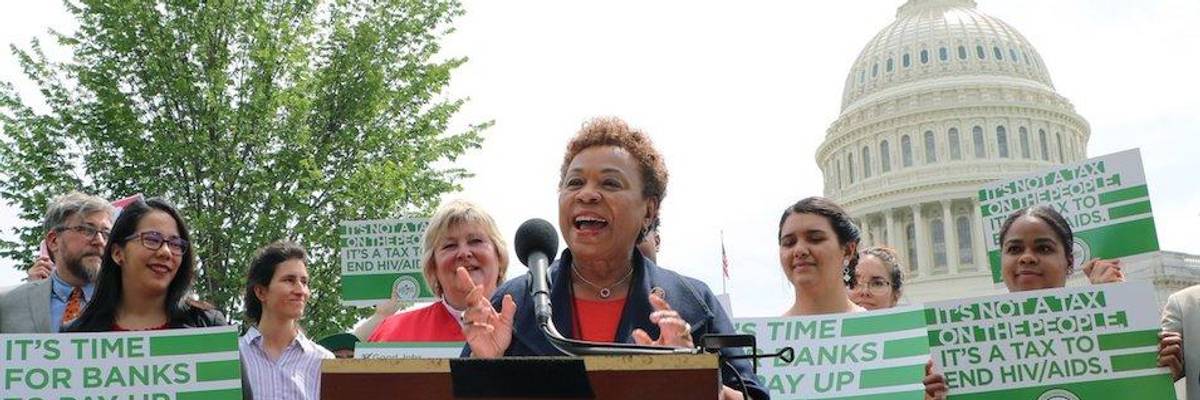
Rep. Barbara Lee (D-Calif.) speaks to supporters of legislation she introduced Wednesday with Sen. Bernie Sanders (I-Vt.) that would impose a fractional tax on Wall Street transactions. (Photo: Rep. Lee, Twitter)
Sen. Bernie Sanders and Rep. Barbara Lee unveiled legislation on Wednesday that will fractionally tax Wall Street transactions to produce trillions of dollars in public revenue.
"It's a small tax on Wall Street to make big change on Main Street."
--Mitch Jones, Food and Water Watch
The Inclusive Prosperity Act (pdf) was introduced in the Senate by Sanders, an Independent who caucuses with Democrats, and Sen. Kirsten Gillibrand (D-N.Y.), and in the House by Lee, a Democrat from California, and a dozen of her colleagues.
"Wall Street gets away with no taxes, even when conducting high-risk financial transactions," Lee said in a statement. "This has to stop. It's past time to make sure Wall Street pays their fair share so that we can provide funding for things that make us a better nation like jobs, housing, infrastructure, and college education."
The tax is a tiny levy on the hundreds of billions of transactions on Wall Street each day.
According to a statement from Sanders's office:
The legislation sets different rates on stocks, bonds, and derivatives based on the existing transaction costs in each market--0.5 percent for stocks, 0.1 percent for bonds, and 0.005 for derivatives. This more targeted approach roughly equalizes the increase in transaction costs across securities due to the tax and thus reduces the economic distortions and tax avoidance possibilities created by it.
A number of groups signed onto the measure as well, citing the potential for higher tax revenues that could be spent on social programs as well as a sense of moral justice that the tax would bring.
"Nurses know that economic inequality and poor health go hand in hand," said Jean Ross, president of National Nurses United. "Every day, we see people who come into our emergency rooms in medical crisis because they went without preventative care or medicine because they couldn't afford it. This small tax on Wall Street will improve the lives of millions of people by funding Medicare for All, public college for all, critical environmental and climate change mitigation programs, job creation, housing assistance, and HIV/AIDS treatment and prevention programs."
Wall Street speculation has caused enough harm, said the Take on Wall Street campaign's Luisa Galvao.
"Working families pay sales taxes on almost everything from a pair of shoes to a can of soup, yet Wall Street traders aren't subject to taxes when they buy or sell financial products," Galvao said. "In fact, not only is Wall Street being allowed to trade tax-free, they are skimming off profit from the real economy by using high-speed, algorithm-based trading which has no social value."
With all the problems in the world, not the least of which is the ongoing climate catastrophe, a potential solution for funding solutions can't be ignored, said Food and Water Watch's Climate and Energy program director Mitch Jones.
"The Inclusive Prosperity Act is essential," said Jones. "It's a small tax on Wall Street to make big change on Main Street."
In a statement, Sanders put the bill in the context of his longstanding fight for everyday Americans and against the rich.
"It is long past time for Congress to rein in the recklessness of Wall Street billionaires and build an economy that works for all Americans," said Sanders.
Sanders and Lee were joined at the Capitol Wednesday afternoon by supporters.
Watch the press conference:
Dear Common Dreams reader, It’s been nearly 30 years since I co-founded Common Dreams with my late wife, Lina Newhouser. We had the radical notion that journalism should serve the public good, not corporate profits. It was clear to us from the outset what it would take to build such a project. No paid advertisements. No corporate sponsors. No millionaire publisher telling us what to think or do. Many people said we wouldn't last a year, but we proved those doubters wrong. Together with a tremendous team of journalists and dedicated staff, we built an independent media outlet free from the constraints of profits and corporate control. Our mission has always been simple: To inform. To inspire. To ignite change for the common good. Building Common Dreams was not easy. Our survival was never guaranteed. When you take on the most powerful forces—Wall Street greed, fossil fuel industry destruction, Big Tech lobbyists, and uber-rich oligarchs who have spent billions upon billions rigging the economy and democracy in their favor—the only bulwark you have is supporters who believe in your work. But here’s the urgent message from me today. It's never been this bad out there. And it's never been this hard to keep us going. At the very moment Common Dreams is most needed, the threats we face are intensifying. We need your support now more than ever. We don't accept corporate advertising and never will. We don't have a paywall because we don't think people should be blocked from critical news based on their ability to pay. Everything we do is funded by the donations of readers like you. When everyone does the little they can afford, we are strong. But if that support retreats or dries up, so do we. Will you donate now to make sure Common Dreams not only survives but thrives? —Craig Brown, Co-founder |
Sen. Bernie Sanders and Rep. Barbara Lee unveiled legislation on Wednesday that will fractionally tax Wall Street transactions to produce trillions of dollars in public revenue.
"It's a small tax on Wall Street to make big change on Main Street."
--Mitch Jones, Food and Water Watch
The Inclusive Prosperity Act (pdf) was introduced in the Senate by Sanders, an Independent who caucuses with Democrats, and Sen. Kirsten Gillibrand (D-N.Y.), and in the House by Lee, a Democrat from California, and a dozen of her colleagues.
"Wall Street gets away with no taxes, even when conducting high-risk financial transactions," Lee said in a statement. "This has to stop. It's past time to make sure Wall Street pays their fair share so that we can provide funding for things that make us a better nation like jobs, housing, infrastructure, and college education."
The tax is a tiny levy on the hundreds of billions of transactions on Wall Street each day.
According to a statement from Sanders's office:
The legislation sets different rates on stocks, bonds, and derivatives based on the existing transaction costs in each market--0.5 percent for stocks, 0.1 percent for bonds, and 0.005 for derivatives. This more targeted approach roughly equalizes the increase in transaction costs across securities due to the tax and thus reduces the economic distortions and tax avoidance possibilities created by it.
A number of groups signed onto the measure as well, citing the potential for higher tax revenues that could be spent on social programs as well as a sense of moral justice that the tax would bring.
"Nurses know that economic inequality and poor health go hand in hand," said Jean Ross, president of National Nurses United. "Every day, we see people who come into our emergency rooms in medical crisis because they went without preventative care or medicine because they couldn't afford it. This small tax on Wall Street will improve the lives of millions of people by funding Medicare for All, public college for all, critical environmental and climate change mitigation programs, job creation, housing assistance, and HIV/AIDS treatment and prevention programs."
Wall Street speculation has caused enough harm, said the Take on Wall Street campaign's Luisa Galvao.
"Working families pay sales taxes on almost everything from a pair of shoes to a can of soup, yet Wall Street traders aren't subject to taxes when they buy or sell financial products," Galvao said. "In fact, not only is Wall Street being allowed to trade tax-free, they are skimming off profit from the real economy by using high-speed, algorithm-based trading which has no social value."
With all the problems in the world, not the least of which is the ongoing climate catastrophe, a potential solution for funding solutions can't be ignored, said Food and Water Watch's Climate and Energy program director Mitch Jones.
"The Inclusive Prosperity Act is essential," said Jones. "It's a small tax on Wall Street to make big change on Main Street."
In a statement, Sanders put the bill in the context of his longstanding fight for everyday Americans and against the rich.
"It is long past time for Congress to rein in the recklessness of Wall Street billionaires and build an economy that works for all Americans," said Sanders.
Sanders and Lee were joined at the Capitol Wednesday afternoon by supporters.
Watch the press conference:
Sen. Bernie Sanders and Rep. Barbara Lee unveiled legislation on Wednesday that will fractionally tax Wall Street transactions to produce trillions of dollars in public revenue.
"It's a small tax on Wall Street to make big change on Main Street."
--Mitch Jones, Food and Water Watch
The Inclusive Prosperity Act (pdf) was introduced in the Senate by Sanders, an Independent who caucuses with Democrats, and Sen. Kirsten Gillibrand (D-N.Y.), and in the House by Lee, a Democrat from California, and a dozen of her colleagues.
"Wall Street gets away with no taxes, even when conducting high-risk financial transactions," Lee said in a statement. "This has to stop. It's past time to make sure Wall Street pays their fair share so that we can provide funding for things that make us a better nation like jobs, housing, infrastructure, and college education."
The tax is a tiny levy on the hundreds of billions of transactions on Wall Street each day.
According to a statement from Sanders's office:
The legislation sets different rates on stocks, bonds, and derivatives based on the existing transaction costs in each market--0.5 percent for stocks, 0.1 percent for bonds, and 0.005 for derivatives. This more targeted approach roughly equalizes the increase in transaction costs across securities due to the tax and thus reduces the economic distortions and tax avoidance possibilities created by it.
A number of groups signed onto the measure as well, citing the potential for higher tax revenues that could be spent on social programs as well as a sense of moral justice that the tax would bring.
"Nurses know that economic inequality and poor health go hand in hand," said Jean Ross, president of National Nurses United. "Every day, we see people who come into our emergency rooms in medical crisis because they went without preventative care or medicine because they couldn't afford it. This small tax on Wall Street will improve the lives of millions of people by funding Medicare for All, public college for all, critical environmental and climate change mitigation programs, job creation, housing assistance, and HIV/AIDS treatment and prevention programs."
Wall Street speculation has caused enough harm, said the Take on Wall Street campaign's Luisa Galvao.
"Working families pay sales taxes on almost everything from a pair of shoes to a can of soup, yet Wall Street traders aren't subject to taxes when they buy or sell financial products," Galvao said. "In fact, not only is Wall Street being allowed to trade tax-free, they are skimming off profit from the real economy by using high-speed, algorithm-based trading which has no social value."
With all the problems in the world, not the least of which is the ongoing climate catastrophe, a potential solution for funding solutions can't be ignored, said Food and Water Watch's Climate and Energy program director Mitch Jones.
"The Inclusive Prosperity Act is essential," said Jones. "It's a small tax on Wall Street to make big change on Main Street."
In a statement, Sanders put the bill in the context of his longstanding fight for everyday Americans and against the rich.
"It is long past time for Congress to rein in the recklessness of Wall Street billionaires and build an economy that works for all Americans," said Sanders.
Sanders and Lee were joined at the Capitol Wednesday afternoon by supporters.
Watch the press conference:

