SUBSCRIBE TO OUR FREE NEWSLETTER
Daily news & progressive opinion—funded by the people, not the corporations—delivered straight to your inbox.
5
#000000
#FFFFFF
To donate by check, phone, or other method, see our More Ways to Give page.
Daily news & progressive opinion—funded by the people, not the corporations—delivered straight to your inbox.
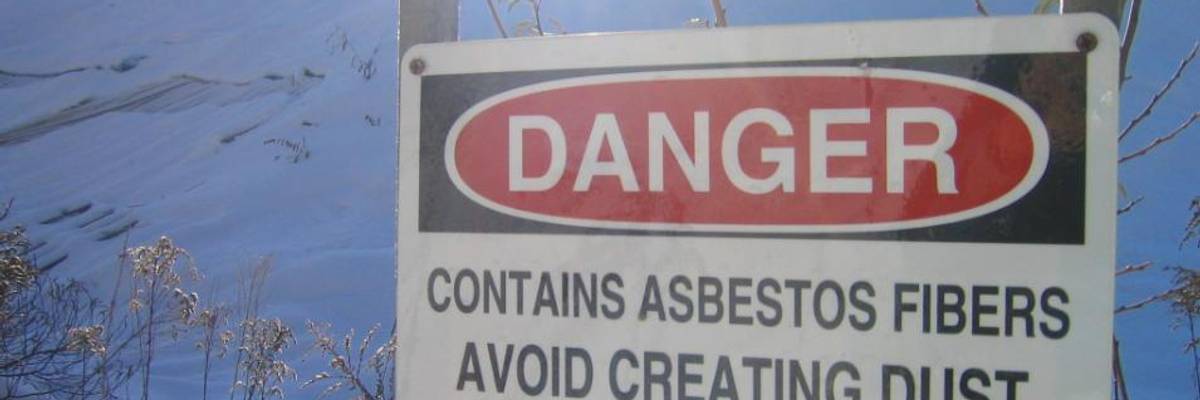
"All types of asbestos cause lung cancer, mesothelioma, cancer of the larynx and ovary, and asbestosis (fibrosis of the lungs)," according to the World Health Organization. (Photo: DoctorButtsMD/Flickr/cc)
In a report that elicited calls for congressional action, the New York Times revealed Wednesday that "senior officials at the Environmental Protection Agency disregarded the advice of their own scientists and lawyers in April when the agency issued a rule that restricted but did not ban asbestos."
"I can't think of an easier vote for members of Congress to cast than for a bill that bans a substance responsible for the deaths of so many."
--Melanie Benesh, EWG
Asbestos is a group of fibrous, heat-resistant minerals used in manufactured goods, particularly building materials. According to the World Health Organization, "All types of asbestos cause lung cancer, mesothelioma, cancer of the larynx and ovary, and asbestosis (fibrosis of the lungs)."
EPA Administrator Andrew Wheeler said in a statement last month that the agency's new rule "gives us unprecedented authorities to protect public health" and block certain products from the market. However, environmental and public health advocates raised concerns at the time about loopholes that remain, with one critic calling the regulation "toothless."
Criticism of the rule resurfaced Wednesday when the Times reported on a pair of internal EPA memos (pdf) from last August, in which more than a dozen agency experts wrote:
Rather than allow for (even with restrictions) any new uses for asbestos, EPA should seek to ban all new uses of asbestos because the extreme harm from this chemical substance outweighs any benefit--and because there are adequate alternatives to asbestos.
Melanie Benesh, legislative attorney at the Environmental Working Group (EWG), was among those who demanded action from federal lawmakers following the "bombshell" report.
"The sheer number of lives cut short and families destroyed from asbestos exposure demand nothing less than an outright ban," Benesh said in a statement. "I can't think of an easier vote for members of Congress to cast than for a bill that bans a substance responsible for the deaths of so many."
The reporting came as a subcommittee of the U.S. House Committee on Energy and Commerce held a hearing Wednesday morning to consider legislation that would amend the Toxic Substances Control Act (TSCA) "to prohibit the manufacture, processing, and distribution in commerce of asbestos and asbestos-containing mixtures and articles."
"If Administrator Wheeler and the Trump administration won't act," said Benesh, "then Congress must by passing this critical piece of legislation that finally bans asbestos."
Sharing a link to the Times article on Twitter, Rep. Frank Pallone Jr. (D-N.J.), the committee's chairman, said, "This is exactly why we need to ban asbestos and why my committee is holding a hearing today on legislation that would fully ban this toxic material."
During the committee hearing, Pallone noted that it has been 40 years since the EPA started its work to ban asbestos under the TSCA, 30 years since the agency finalized its ban, and 28 years since the ban was struck down in court--and yet, "asbestos is still being imported into the United States, it is still being used in this country, and it is still killing about 40,000 Americans every year."
"Twenty-eight years of frustration, of sickness, and loss," he said. "We have known the dangers of asbestos for decades. Enough is enough."
The hearing centered on H.R. 1603 (pdf)--also known as the Alan Reinstein Ban Asbestos Now Act of 2019. Rep. Suzanne Bonamici (D-Ore.), the bill's sponsor, took to Twitter Wednesday to highlight a testimony from the widow of the legislation's namesake.
After Alan Reinstein was diagnosed with mesothelioma in 2003, Linda Reinstein and Doug Larkin co-founded the Asbestos Disease Awareness Organization (ADAO). Alan Reinstein and Larkin both died in the years that followed, but Linda Reinstein remains ADAO's president and CEO.
"I'm honored to have H.R. 1603 named after my husband," Linda Reinstein told lawmakers Wednesday, "but it's really for the hundreds of thousands of Alans who have paid a price for this man-made disaster with their lives."
Dear Common Dreams reader, It’s been nearly 30 years since I co-founded Common Dreams with my late wife, Lina Newhouser. We had the radical notion that journalism should serve the public good, not corporate profits. It was clear to us from the outset what it would take to build such a project. No paid advertisements. No corporate sponsors. No millionaire publisher telling us what to think or do. Many people said we wouldn't last a year, but we proved those doubters wrong. Together with a tremendous team of journalists and dedicated staff, we built an independent media outlet free from the constraints of profits and corporate control. Our mission has always been simple: To inform. To inspire. To ignite change for the common good. Building Common Dreams was not easy. Our survival was never guaranteed. When you take on the most powerful forces—Wall Street greed, fossil fuel industry destruction, Big Tech lobbyists, and uber-rich oligarchs who have spent billions upon billions rigging the economy and democracy in their favor—the only bulwark you have is supporters who believe in your work. But here’s the urgent message from me today. It's never been this bad out there. And it's never been this hard to keep us going. At the very moment Common Dreams is most needed, the threats we face are intensifying. We need your support now more than ever. We don't accept corporate advertising and never will. We don't have a paywall because we don't think people should be blocked from critical news based on their ability to pay. Everything we do is funded by the donations of readers like you. When everyone does the little they can afford, we are strong. But if that support retreats or dries up, so do we. Will you donate now to make sure Common Dreams not only survives but thrives? —Craig Brown, Co-founder |
In a report that elicited calls for congressional action, the New York Times revealed Wednesday that "senior officials at the Environmental Protection Agency disregarded the advice of their own scientists and lawyers in April when the agency issued a rule that restricted but did not ban asbestos."
"I can't think of an easier vote for members of Congress to cast than for a bill that bans a substance responsible for the deaths of so many."
--Melanie Benesh, EWG
Asbestos is a group of fibrous, heat-resistant minerals used in manufactured goods, particularly building materials. According to the World Health Organization, "All types of asbestos cause lung cancer, mesothelioma, cancer of the larynx and ovary, and asbestosis (fibrosis of the lungs)."
EPA Administrator Andrew Wheeler said in a statement last month that the agency's new rule "gives us unprecedented authorities to protect public health" and block certain products from the market. However, environmental and public health advocates raised concerns at the time about loopholes that remain, with one critic calling the regulation "toothless."
Criticism of the rule resurfaced Wednesday when the Times reported on a pair of internal EPA memos (pdf) from last August, in which more than a dozen agency experts wrote:
Rather than allow for (even with restrictions) any new uses for asbestos, EPA should seek to ban all new uses of asbestos because the extreme harm from this chemical substance outweighs any benefit--and because there are adequate alternatives to asbestos.
Melanie Benesh, legislative attorney at the Environmental Working Group (EWG), was among those who demanded action from federal lawmakers following the "bombshell" report.
"The sheer number of lives cut short and families destroyed from asbestos exposure demand nothing less than an outright ban," Benesh said in a statement. "I can't think of an easier vote for members of Congress to cast than for a bill that bans a substance responsible for the deaths of so many."
The reporting came as a subcommittee of the U.S. House Committee on Energy and Commerce held a hearing Wednesday morning to consider legislation that would amend the Toxic Substances Control Act (TSCA) "to prohibit the manufacture, processing, and distribution in commerce of asbestos and asbestos-containing mixtures and articles."
"If Administrator Wheeler and the Trump administration won't act," said Benesh, "then Congress must by passing this critical piece of legislation that finally bans asbestos."
Sharing a link to the Times article on Twitter, Rep. Frank Pallone Jr. (D-N.J.), the committee's chairman, said, "This is exactly why we need to ban asbestos and why my committee is holding a hearing today on legislation that would fully ban this toxic material."
During the committee hearing, Pallone noted that it has been 40 years since the EPA started its work to ban asbestos under the TSCA, 30 years since the agency finalized its ban, and 28 years since the ban was struck down in court--and yet, "asbestos is still being imported into the United States, it is still being used in this country, and it is still killing about 40,000 Americans every year."
"Twenty-eight years of frustration, of sickness, and loss," he said. "We have known the dangers of asbestos for decades. Enough is enough."
The hearing centered on H.R. 1603 (pdf)--also known as the Alan Reinstein Ban Asbestos Now Act of 2019. Rep. Suzanne Bonamici (D-Ore.), the bill's sponsor, took to Twitter Wednesday to highlight a testimony from the widow of the legislation's namesake.
After Alan Reinstein was diagnosed with mesothelioma in 2003, Linda Reinstein and Doug Larkin co-founded the Asbestos Disease Awareness Organization (ADAO). Alan Reinstein and Larkin both died in the years that followed, but Linda Reinstein remains ADAO's president and CEO.
"I'm honored to have H.R. 1603 named after my husband," Linda Reinstein told lawmakers Wednesday, "but it's really for the hundreds of thousands of Alans who have paid a price for this man-made disaster with their lives."
In a report that elicited calls for congressional action, the New York Times revealed Wednesday that "senior officials at the Environmental Protection Agency disregarded the advice of their own scientists and lawyers in April when the agency issued a rule that restricted but did not ban asbestos."
"I can't think of an easier vote for members of Congress to cast than for a bill that bans a substance responsible for the deaths of so many."
--Melanie Benesh, EWG
Asbestos is a group of fibrous, heat-resistant minerals used in manufactured goods, particularly building materials. According to the World Health Organization, "All types of asbestos cause lung cancer, mesothelioma, cancer of the larynx and ovary, and asbestosis (fibrosis of the lungs)."
EPA Administrator Andrew Wheeler said in a statement last month that the agency's new rule "gives us unprecedented authorities to protect public health" and block certain products from the market. However, environmental and public health advocates raised concerns at the time about loopholes that remain, with one critic calling the regulation "toothless."
Criticism of the rule resurfaced Wednesday when the Times reported on a pair of internal EPA memos (pdf) from last August, in which more than a dozen agency experts wrote:
Rather than allow for (even with restrictions) any new uses for asbestos, EPA should seek to ban all new uses of asbestos because the extreme harm from this chemical substance outweighs any benefit--and because there are adequate alternatives to asbestos.
Melanie Benesh, legislative attorney at the Environmental Working Group (EWG), was among those who demanded action from federal lawmakers following the "bombshell" report.
"The sheer number of lives cut short and families destroyed from asbestos exposure demand nothing less than an outright ban," Benesh said in a statement. "I can't think of an easier vote for members of Congress to cast than for a bill that bans a substance responsible for the deaths of so many."
The reporting came as a subcommittee of the U.S. House Committee on Energy and Commerce held a hearing Wednesday morning to consider legislation that would amend the Toxic Substances Control Act (TSCA) "to prohibit the manufacture, processing, and distribution in commerce of asbestos and asbestos-containing mixtures and articles."
"If Administrator Wheeler and the Trump administration won't act," said Benesh, "then Congress must by passing this critical piece of legislation that finally bans asbestos."
Sharing a link to the Times article on Twitter, Rep. Frank Pallone Jr. (D-N.J.), the committee's chairman, said, "This is exactly why we need to ban asbestos and why my committee is holding a hearing today on legislation that would fully ban this toxic material."
During the committee hearing, Pallone noted that it has been 40 years since the EPA started its work to ban asbestos under the TSCA, 30 years since the agency finalized its ban, and 28 years since the ban was struck down in court--and yet, "asbestos is still being imported into the United States, it is still being used in this country, and it is still killing about 40,000 Americans every year."
"Twenty-eight years of frustration, of sickness, and loss," he said. "We have known the dangers of asbestos for decades. Enough is enough."
The hearing centered on H.R. 1603 (pdf)--also known as the Alan Reinstein Ban Asbestos Now Act of 2019. Rep. Suzanne Bonamici (D-Ore.), the bill's sponsor, took to Twitter Wednesday to highlight a testimony from the widow of the legislation's namesake.
After Alan Reinstein was diagnosed with mesothelioma in 2003, Linda Reinstein and Doug Larkin co-founded the Asbestos Disease Awareness Organization (ADAO). Alan Reinstein and Larkin both died in the years that followed, but Linda Reinstein remains ADAO's president and CEO.
"I'm honored to have H.R. 1603 named after my husband," Linda Reinstein told lawmakers Wednesday, "but it's really for the hundreds of thousands of Alans who have paid a price for this man-made disaster with their lives."