SUBSCRIBE TO OUR FREE NEWSLETTER
Daily news & progressive opinion—funded by the people, not the corporations—delivered straight to your inbox.
5
#000000
#FFFFFF
To donate by check, phone, or other method, see our More Ways to Give page.
Daily news & progressive opinion—funded by the people, not the corporations—delivered straight to your inbox.
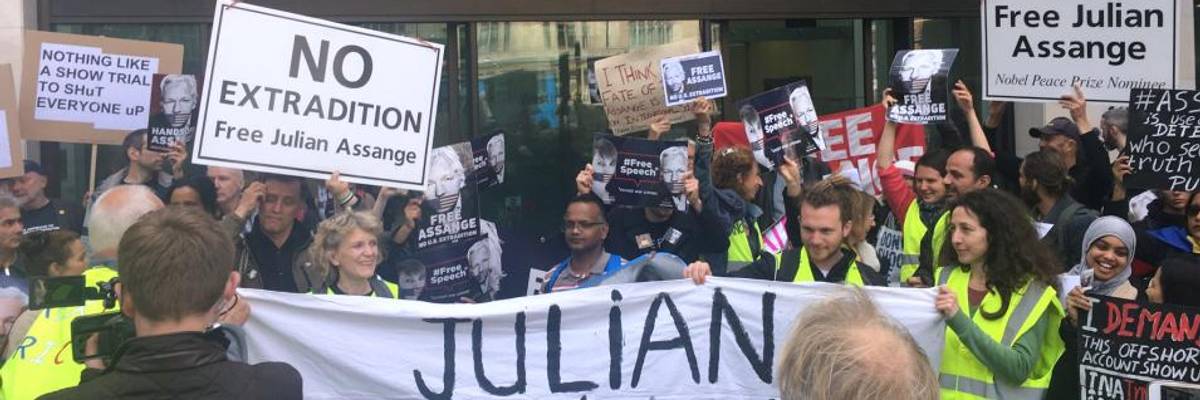
WikiLeaks founder Julian Assange spoke to a British court by video link Thursday as supporters gathered outside. (Photo: Emmy B/Twitter)
"I do not wish to surrender myself for extradition for doing journalism that has won many, many awards and protected many, many people," WikiLeaks founder Julian Assange told a British court Thursday, speaking by video link from London's Belmarsh Prison.
Assange's first hearing in the Westminster Magistrates Court about his potential extradition to the United States came just a day after another British court sentenced the 47-year old Australian to 50 weeks in prison for skipping bail when he took refuge in Ecuador's embassy in London seven years ago.
After Ecuador revoked Assanges's asylum protections in April, British authorities arrested him and dragged him out of the embassy--provoking widespread condemnation--and the U.S. Justice Department unsealed an indictment that accuses Assange of conspiring with Army whistleblower Chelsea Manning to hack a Pentagon computer to access classified government documents.
Manning's 35-year prison sentence for espionage, which came after the documents she leaked to WikiLeaks generated intense criticism about U.S. military action in Afghanistan and Iraq, was commuted two years ago. However, Manning was jailed again in March of this year for refusing to testify before a grand jury investigating WikiLeaks and remains behind bars.
Assange, meanwhile, now faces a likely lengthy legal battle against the Trump administration's extradition request. One of his attorneys, Jennifer Robinson, told reporters outside court on Thursday that "despite what you heard from the prosecutor in the courtroom today, this case is not about hacking."
"This case is about a journalist and a publisher who had conversations with a source about accessing material, encouraged that source to provide material, and spoke to that source about how to protect their identity," she said. "This is protected activity that journalists engage in all the time."
Extraditing Assange to the United States would cause a "massive chill on investigative journalism," Robinson told the New York Times. "No democratic nation would behave this way."
Judge Michael Snow announced Thursday that there will be a procedural hearing May 30 followed by a more substantive hearing on June 12. Both Snow and legal experts who spoke with The Associated Press said they expect the extradition case to continue for "many months."
"The fight has just begun," said WikiLeaks editor-in-chief Kristinn Hrafnsson. "It will be a long one and a hard one, but we count on the general public to understand the importance of this case and we will fight till victory."
Hrafnsson added that Assange is being held in "appalling" conditions at Belmarsh Prison and has been confined to his cell 23 to 24 hours per day, "what we call in general terms solitary confinement."
Assange supporters gathered outside the courthouse and the Ecuadorian Embassy in London Thursday.
DiEM25 and Demokratie in Europa also held a "We are all Julian Assange!" demonstration at the Brandenburger Gate in Berlin, near the U.S. and U.K. embassies.
Dear Common Dreams reader, It’s been nearly 30 years since I co-founded Common Dreams with my late wife, Lina Newhouser. We had the radical notion that journalism should serve the public good, not corporate profits. It was clear to us from the outset what it would take to build such a project. No paid advertisements. No corporate sponsors. No millionaire publisher telling us what to think or do. Many people said we wouldn't last a year, but we proved those doubters wrong. Together with a tremendous team of journalists and dedicated staff, we built an independent media outlet free from the constraints of profits and corporate control. Our mission has always been simple: To inform. To inspire. To ignite change for the common good. Building Common Dreams was not easy. Our survival was never guaranteed. When you take on the most powerful forces—Wall Street greed, fossil fuel industry destruction, Big Tech lobbyists, and uber-rich oligarchs who have spent billions upon billions rigging the economy and democracy in their favor—the only bulwark you have is supporters who believe in your work. But here’s the urgent message from me today. It's never been this bad out there. And it's never been this hard to keep us going. At the very moment Common Dreams is most needed, the threats we face are intensifying. We need your support now more than ever. We don't accept corporate advertising and never will. We don't have a paywall because we don't think people should be blocked from critical news based on their ability to pay. Everything we do is funded by the donations of readers like you. When everyone does the little they can afford, we are strong. But if that support retreats or dries up, so do we. Will you donate now to make sure Common Dreams not only survives but thrives? —Craig Brown, Co-founder |
"I do not wish to surrender myself for extradition for doing journalism that has won many, many awards and protected many, many people," WikiLeaks founder Julian Assange told a British court Thursday, speaking by video link from London's Belmarsh Prison.
Assange's first hearing in the Westminster Magistrates Court about his potential extradition to the United States came just a day after another British court sentenced the 47-year old Australian to 50 weeks in prison for skipping bail when he took refuge in Ecuador's embassy in London seven years ago.
After Ecuador revoked Assanges's asylum protections in April, British authorities arrested him and dragged him out of the embassy--provoking widespread condemnation--and the U.S. Justice Department unsealed an indictment that accuses Assange of conspiring with Army whistleblower Chelsea Manning to hack a Pentagon computer to access classified government documents.
Manning's 35-year prison sentence for espionage, which came after the documents she leaked to WikiLeaks generated intense criticism about U.S. military action in Afghanistan and Iraq, was commuted two years ago. However, Manning was jailed again in March of this year for refusing to testify before a grand jury investigating WikiLeaks and remains behind bars.
Assange, meanwhile, now faces a likely lengthy legal battle against the Trump administration's extradition request. One of his attorneys, Jennifer Robinson, told reporters outside court on Thursday that "despite what you heard from the prosecutor in the courtroom today, this case is not about hacking."
"This case is about a journalist and a publisher who had conversations with a source about accessing material, encouraged that source to provide material, and spoke to that source about how to protect their identity," she said. "This is protected activity that journalists engage in all the time."
Extraditing Assange to the United States would cause a "massive chill on investigative journalism," Robinson told the New York Times. "No democratic nation would behave this way."
Judge Michael Snow announced Thursday that there will be a procedural hearing May 30 followed by a more substantive hearing on June 12. Both Snow and legal experts who spoke with The Associated Press said they expect the extradition case to continue for "many months."
"The fight has just begun," said WikiLeaks editor-in-chief Kristinn Hrafnsson. "It will be a long one and a hard one, but we count on the general public to understand the importance of this case and we will fight till victory."
Hrafnsson added that Assange is being held in "appalling" conditions at Belmarsh Prison and has been confined to his cell 23 to 24 hours per day, "what we call in general terms solitary confinement."
Assange supporters gathered outside the courthouse and the Ecuadorian Embassy in London Thursday.
DiEM25 and Demokratie in Europa also held a "We are all Julian Assange!" demonstration at the Brandenburger Gate in Berlin, near the U.S. and U.K. embassies.
"I do not wish to surrender myself for extradition for doing journalism that has won many, many awards and protected many, many people," WikiLeaks founder Julian Assange told a British court Thursday, speaking by video link from London's Belmarsh Prison.
Assange's first hearing in the Westminster Magistrates Court about his potential extradition to the United States came just a day after another British court sentenced the 47-year old Australian to 50 weeks in prison for skipping bail when he took refuge in Ecuador's embassy in London seven years ago.
After Ecuador revoked Assanges's asylum protections in April, British authorities arrested him and dragged him out of the embassy--provoking widespread condemnation--and the U.S. Justice Department unsealed an indictment that accuses Assange of conspiring with Army whistleblower Chelsea Manning to hack a Pentagon computer to access classified government documents.
Manning's 35-year prison sentence for espionage, which came after the documents she leaked to WikiLeaks generated intense criticism about U.S. military action in Afghanistan and Iraq, was commuted two years ago. However, Manning was jailed again in March of this year for refusing to testify before a grand jury investigating WikiLeaks and remains behind bars.
Assange, meanwhile, now faces a likely lengthy legal battle against the Trump administration's extradition request. One of his attorneys, Jennifer Robinson, told reporters outside court on Thursday that "despite what you heard from the prosecutor in the courtroom today, this case is not about hacking."
"This case is about a journalist and a publisher who had conversations with a source about accessing material, encouraged that source to provide material, and spoke to that source about how to protect their identity," she said. "This is protected activity that journalists engage in all the time."
Extraditing Assange to the United States would cause a "massive chill on investigative journalism," Robinson told the New York Times. "No democratic nation would behave this way."
Judge Michael Snow announced Thursday that there will be a procedural hearing May 30 followed by a more substantive hearing on June 12. Both Snow and legal experts who spoke with The Associated Press said they expect the extradition case to continue for "many months."
"The fight has just begun," said WikiLeaks editor-in-chief Kristinn Hrafnsson. "It will be a long one and a hard one, but we count on the general public to understand the importance of this case and we will fight till victory."
Hrafnsson added that Assange is being held in "appalling" conditions at Belmarsh Prison and has been confined to his cell 23 to 24 hours per day, "what we call in general terms solitary confinement."
Assange supporters gathered outside the courthouse and the Ecuadorian Embassy in London Thursday.
DiEM25 and Demokratie in Europa also held a "We are all Julian Assange!" demonstration at the Brandenburger Gate in Berlin, near the U.S. and U.K. embassies.