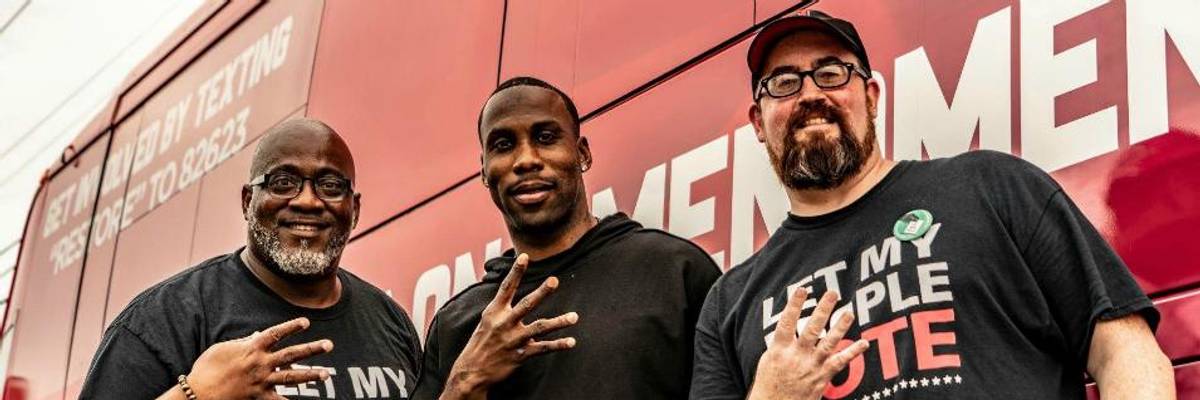
Last year, the Florida Rights Restoration Coalition led the fight for Amendment 4, a ballot measure to restore voting rights for people who had served their sentences for felony convictions. (Photo: @FLRightsRestore/Twitter)
Florida GOP Condemned for Undermining Hard-Won Voting Rights for Felons With 'Modern Day Poll Tax'
"Disturbingly, this legislation will cause de facto lifetime disenfranchisement for large swaths of formerly incarcerated individuals who have completed their sentences."
Florida state lawmakers are under fire for passing legislation critics call a "modern day poll tax" on the state's newly re-enfranchised felon voters.
The legislation, H.B. 7089, would undermine last year's successful ballot initiative to restore voting rights for more than a million Floridians who have completed felony sentences by requiring them to pay all court fines and fees before they can participate in elections.
The bill passed Florida's Republican-controlled state House 71-45 Wednesday, largely along party lines. Though it still needs final approval from state senators and Republican Gov. Ron DeSantis, progressive politicians, voting rights advocates, and civil liberties groups are speaking out against it.
Kara Gross, the ACLU of Florida's legislative director, warned that "disturbingly, this legislation will cause de facto lifetime disenfranchisement for large swaths of formerly incarcerated individuals who have completed their sentences--precisely the opposite of the entire purpose of Amendment 4."
As Common Dreams reported last November, some 64 percent of voters supported the amendment to the state constitution to allow people who have served their sentences--excluding those convicted of murder or felony sexual crimes--to vote. The "huge and hard fought victory," was celebrated as a repeal of "one of the country's worst Jim Crow laws" and "the largest expansion in voting rights since the Voting Rights Act."
Opponents charge that the legislation defies the will of Florida voters and, as Gross put it, "merely replaces one unjust system for another."
"Florida's citizens spoke clearly on election day--1.4 million disenfranchised individuals deserve a second chance," said Gross. "This historic citizens initiative will only be thwarted by this legislation."
"The Florida House just subverted their wishes by passing a poll tax that will continue to disenfranchise low-income citizens," tweeted Georgetown University public policy professor Don Moynihan.
Neil Volz, political director of the Florida Rights Restoration Coalition, which led the fight for the constitutional amendment, told HuffPost in a statement that the "partisan vote in the House represented a failure to live up to the bipartisan commitment Florida voters showed with the passage of Amendment 4."
Looking ahead, HuffPost reported that the final legislation could look different after the state Senate votes on its companion bill.
The Florida Senate is still considering its own version of the legislation. The Senate version requires people with felonies to repay all restitution before they can vote again. But unlike the House version, the Senate bill would allow people to vote if fines and fees are converted to a civil lien. Lawmakers are expected to eventually negotiate a final version of the bill, according to Florida Politics.
While Volz still has concerns with the Senate bill, he said it was closer to something advocates could support.
"We believe the Senate bill better reflects the spirit of Amendment 4 and hope that Republicans and Democrats can come together to produce a bipartisan bill that aligns with the will of Florida's voters," he said.
The legislative battle in Florida comes amid a lively national debate about restoring voting rights not only for people who were formerly incarcerated for felonies, but also those who are currently behind bars.
After the Florida House approved the bill Wednesday, multiple candidates for the Democratic nomination for president took to Twitter to denounce it.
"This is a poll tax," said Sen. Cory Booker (D-N.J.), who called for a "new Voting Rights Act" last week.
Sen. Bernie Sanders (I-Vt.)--the first 2020 hopeful to publicly support allowing all people who are currently in prison to retain their right to vote--tweeted: "Enough with the racist and unconstitutional efforts to deny people the right to vote. If you are an American citizen you must be able to vote. End of discussion."
We are at a crossroads
This country and this world are at a monumental crossroads. In a few short weeks, US voters will have an opportunity to beat back the forces of fascism and confront the billionaires who are rigging the economy, our media system, and our democracy, making it increasingly impossible for ordinary people to get by. We’re not just talking about the election. We’re talking about what must be done once these fascist elements are vanquished from power. We need a bolder set of solutions than what either major party has so far been willing to offer and a working-class movement ready to fight like hell for it. Trump didn't emerge from nowhere. The conditions that fueled MAGA authoritarianism were created by decades of radical neoliberal economic policies and a corrupt political system dominated by corporate interests. They slashed taxes on the super-rich, promising that the benefits would trickle down. They said giveaways to the corporate titans would make life more affordable for the rest of us. It was all bullshit. And when a bitter, betrayed populace searches for someone to blame, right-wing demagogues have little trouble finding scapegoats. People know when they're being lied to, but you won't hear any of this from the corporate media. Only independent journalism—powered and funded by people who believe in building a better world—can deliver truly trustworthy daily news. Our Fall Campaign is underway, and we need your help. To power our newsroom through the rest of the year, we need to raise $125,000 by midnight on October 31. So if you share our vision, please contribute whatever you can to sustain our work. |
Florida state lawmakers are under fire for passing legislation critics call a "modern day poll tax" on the state's newly re-enfranchised felon voters.
The legislation, H.B. 7089, would undermine last year's successful ballot initiative to restore voting rights for more than a million Floridians who have completed felony sentences by requiring them to pay all court fines and fees before they can participate in elections.
The bill passed Florida's Republican-controlled state House 71-45 Wednesday, largely along party lines. Though it still needs final approval from state senators and Republican Gov. Ron DeSantis, progressive politicians, voting rights advocates, and civil liberties groups are speaking out against it.
Kara Gross, the ACLU of Florida's legislative director, warned that "disturbingly, this legislation will cause de facto lifetime disenfranchisement for large swaths of formerly incarcerated individuals who have completed their sentences--precisely the opposite of the entire purpose of Amendment 4."
As Common Dreams reported last November, some 64 percent of voters supported the amendment to the state constitution to allow people who have served their sentences--excluding those convicted of murder or felony sexual crimes--to vote. The "huge and hard fought victory," was celebrated as a repeal of "one of the country's worst Jim Crow laws" and "the largest expansion in voting rights since the Voting Rights Act."
Opponents charge that the legislation defies the will of Florida voters and, as Gross put it, "merely replaces one unjust system for another."
"Florida's citizens spoke clearly on election day--1.4 million disenfranchised individuals deserve a second chance," said Gross. "This historic citizens initiative will only be thwarted by this legislation."
"The Florida House just subverted their wishes by passing a poll tax that will continue to disenfranchise low-income citizens," tweeted Georgetown University public policy professor Don Moynihan.
Neil Volz, political director of the Florida Rights Restoration Coalition, which led the fight for the constitutional amendment, told HuffPost in a statement that the "partisan vote in the House represented a failure to live up to the bipartisan commitment Florida voters showed with the passage of Amendment 4."
Looking ahead, HuffPost reported that the final legislation could look different after the state Senate votes on its companion bill.
The Florida Senate is still considering its own version of the legislation. The Senate version requires people with felonies to repay all restitution before they can vote again. But unlike the House version, the Senate bill would allow people to vote if fines and fees are converted to a civil lien. Lawmakers are expected to eventually negotiate a final version of the bill, according to Florida Politics.
While Volz still has concerns with the Senate bill, he said it was closer to something advocates could support.
"We believe the Senate bill better reflects the spirit of Amendment 4 and hope that Republicans and Democrats can come together to produce a bipartisan bill that aligns with the will of Florida's voters," he said.
The legislative battle in Florida comes amid a lively national debate about restoring voting rights not only for people who were formerly incarcerated for felonies, but also those who are currently behind bars.
After the Florida House approved the bill Wednesday, multiple candidates for the Democratic nomination for president took to Twitter to denounce it.
"This is a poll tax," said Sen. Cory Booker (D-N.J.), who called for a "new Voting Rights Act" last week.
Sen. Bernie Sanders (I-Vt.)--the first 2020 hopeful to publicly support allowing all people who are currently in prison to retain their right to vote--tweeted: "Enough with the racist and unconstitutional efforts to deny people the right to vote. If you are an American citizen you must be able to vote. End of discussion."
Florida state lawmakers are under fire for passing legislation critics call a "modern day poll tax" on the state's newly re-enfranchised felon voters.
The legislation, H.B. 7089, would undermine last year's successful ballot initiative to restore voting rights for more than a million Floridians who have completed felony sentences by requiring them to pay all court fines and fees before they can participate in elections.
The bill passed Florida's Republican-controlled state House 71-45 Wednesday, largely along party lines. Though it still needs final approval from state senators and Republican Gov. Ron DeSantis, progressive politicians, voting rights advocates, and civil liberties groups are speaking out against it.
Kara Gross, the ACLU of Florida's legislative director, warned that "disturbingly, this legislation will cause de facto lifetime disenfranchisement for large swaths of formerly incarcerated individuals who have completed their sentences--precisely the opposite of the entire purpose of Amendment 4."
As Common Dreams reported last November, some 64 percent of voters supported the amendment to the state constitution to allow people who have served their sentences--excluding those convicted of murder or felony sexual crimes--to vote. The "huge and hard fought victory," was celebrated as a repeal of "one of the country's worst Jim Crow laws" and "the largest expansion in voting rights since the Voting Rights Act."
Opponents charge that the legislation defies the will of Florida voters and, as Gross put it, "merely replaces one unjust system for another."
"Florida's citizens spoke clearly on election day--1.4 million disenfranchised individuals deserve a second chance," said Gross. "This historic citizens initiative will only be thwarted by this legislation."
"The Florida House just subverted their wishes by passing a poll tax that will continue to disenfranchise low-income citizens," tweeted Georgetown University public policy professor Don Moynihan.
Neil Volz, political director of the Florida Rights Restoration Coalition, which led the fight for the constitutional amendment, told HuffPost in a statement that the "partisan vote in the House represented a failure to live up to the bipartisan commitment Florida voters showed with the passage of Amendment 4."
Looking ahead, HuffPost reported that the final legislation could look different after the state Senate votes on its companion bill.
The Florida Senate is still considering its own version of the legislation. The Senate version requires people with felonies to repay all restitution before they can vote again. But unlike the House version, the Senate bill would allow people to vote if fines and fees are converted to a civil lien. Lawmakers are expected to eventually negotiate a final version of the bill, according to Florida Politics.
While Volz still has concerns with the Senate bill, he said it was closer to something advocates could support.
"We believe the Senate bill better reflects the spirit of Amendment 4 and hope that Republicans and Democrats can come together to produce a bipartisan bill that aligns with the will of Florida's voters," he said.
The legislative battle in Florida comes amid a lively national debate about restoring voting rights not only for people who were formerly incarcerated for felonies, but also those who are currently behind bars.
After the Florida House approved the bill Wednesday, multiple candidates for the Democratic nomination for president took to Twitter to denounce it.
"This is a poll tax," said Sen. Cory Booker (D-N.J.), who called for a "new Voting Rights Act" last week.
Sen. Bernie Sanders (I-Vt.)--the first 2020 hopeful to publicly support allowing all people who are currently in prison to retain their right to vote--tweeted: "Enough with the racist and unconstitutional efforts to deny people the right to vote. If you are an American citizen you must be able to vote. End of discussion."