

SUBSCRIBE TO OUR FREE NEWSLETTER
Daily news & progressive opinion—funded by the people, not the corporations—delivered straight to your inbox.
5
#000000
#FFFFFF
To donate by check, phone, or other method, see our More Ways to Give page.
Daily news & progressive opinion—funded by the people, not the corporations—delivered straight to your inbox.
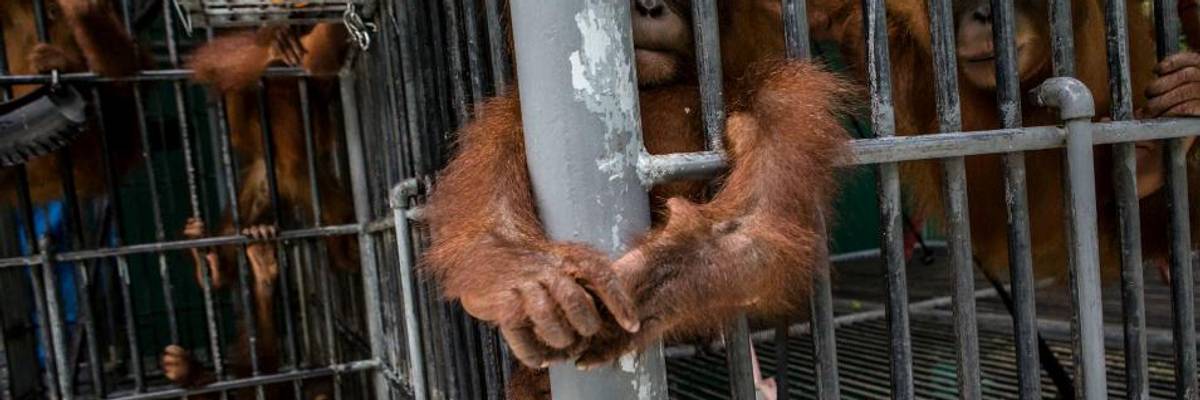
Sumatran orangutans (Pongo abelii) are seen inside a cage at a rehabilitation center in Kuta Mbelin, North Sumatra, Indonesia. The orangutans in the country are on the verge of extinction because of deforestation and poaching. (Photo: Ulet Ifansasti/Getty Images)
On the heels of an Earth Day that featured calls for radical action to address the current "age of environmental breakdown," Agence France-Presse revealed Tuesday that up to a million species face possible extinction because of destructive human behavior.
The warning comes from a forthcoming United Nations report, a draft of which was obtained by AFP, that "painstakingly catalogues how humanity has undermined the natural resources upon which its very survival depends."
A product of the Intergovernmental Science-Policy Platform on Biodiversity and Ecosystem Services (IPBES), the landmark three-year assessment was prepared by 150 experts from 50 countries, with additions from another 250 contributors.
As John Vidal wrote in a preview of the study for HuffPost last month, "It is the greatest attempt yet to assess the state of life on Earth and will show how tens of thousands of species are at high risk of extinction, how countries are using nature at a rate that far exceeds its ability to renew itself, and how nature's ability to contribute food and fresh water to a growing human population is being compromised in every region on Earth."
Outlining some of the experts' key findings, AFP reported Tuesday:
The accelerating loss of clean air, drinkable water, CO2-absorbing forests, pollinating insects, protein-rich fish, and storm-blocking mangroves--to name but a few of the dwindling services rendered by nature--poses no less of a threat than climate change...
The direct causes of species loss, in order of importance, are shrinking habitat and land-use change, hunting for food or illicit trade in body parts, climate change, pollution, and alien species such as rats, mosquitoes, and snakes that hitch rides on ships or planes, the report finds.
Although IPBES chair Robert Watson declined to divulge the new report's details to AFP, he said that "there are also two big indirect drivers of biodiversity loss and climate change--the number of people in the world and their growing ability to consume."
"Protecting the invaluable contributions of nature to people will be the defining challenge of decades to come. Policies, efforts, and actions--at every level--will only succeed, however, when based on the best knowledge and evidence."
--Robert Watson, IPBES chair
"We need to recognize that climate change and loss of nature are equally important, not just for the environment, but as development and economic issues as well," Watson added. "The way we produce our food and energy is undermining the regulating services that we get from nature."
As AFP reported, the draft document warns that "subsidies to fisheries, industrial agriculture, livestock raising, forestry, mining and the production of biofuel, or fossil fuel energy encourage waste, inefficiency, and over-consumption."
Unsustainable human activity, according to the document, already has "severely altered" 40 percent of the marine environment, 50 percent of inland waterways, and three-quarters of the planet's land.
Looking ahead, the report says that "half-a-million to a million species are projected to be threatened with extinction, many within decades." It also warns that indigenous peoples and poor communities--who are already at risk because of the global climate crisis--will be negatively impacted by biodiversity loss.
"The loss of species, ecosystems, and genetic diversity is already a global and generational threat to human well-being," Watson said in a statement from IPBES. "Protecting the invaluable contributions of nature to people will be the defining challenge of decades to come. Policies, efforts, and actions--at every level--will only succeed, however, when based on the best knowledge and evidence. This is what the IPBES Global Assessment provides."
Some of the language may change in the report--which echoes previous warnings about mass extinction--during the upcoming seventh session of the IPBES Plenary, scheduled for April 29 to May 4. However, the major figures and conclusions are expected to remain the same. The final document is due out May 6.
Dear Common Dreams reader, It’s been nearly 30 years since I co-founded Common Dreams with my late wife, Lina Newhouser. We had the radical notion that journalism should serve the public good, not corporate profits. It was clear to us from the outset what it would take to build such a project. No paid advertisements. No corporate sponsors. No millionaire publisher telling us what to think or do. Many people said we wouldn't last a year, but we proved those doubters wrong. Together with a tremendous team of journalists and dedicated staff, we built an independent media outlet free from the constraints of profits and corporate control. Our mission has always been simple: To inform. To inspire. To ignite change for the common good. Building Common Dreams was not easy. Our survival was never guaranteed. When you take on the most powerful forces—Wall Street greed, fossil fuel industry destruction, Big Tech lobbyists, and uber-rich oligarchs who have spent billions upon billions rigging the economy and democracy in their favor—the only bulwark you have is supporters who believe in your work. But here’s the urgent message from me today. It's never been this bad out there. And it's never been this hard to keep us going. At the very moment Common Dreams is most needed, the threats we face are intensifying. We need your support now more than ever. We don't accept corporate advertising and never will. We don't have a paywall because we don't think people should be blocked from critical news based on their ability to pay. Everything we do is funded by the donations of readers like you. When everyone does the little they can afford, we are strong. But if that support retreats or dries up, so do we. Will you donate now to make sure Common Dreams not only survives but thrives? —Craig Brown, Co-founder |
On the heels of an Earth Day that featured calls for radical action to address the current "age of environmental breakdown," Agence France-Presse revealed Tuesday that up to a million species face possible extinction because of destructive human behavior.
The warning comes from a forthcoming United Nations report, a draft of which was obtained by AFP, that "painstakingly catalogues how humanity has undermined the natural resources upon which its very survival depends."
A product of the Intergovernmental Science-Policy Platform on Biodiversity and Ecosystem Services (IPBES), the landmark three-year assessment was prepared by 150 experts from 50 countries, with additions from another 250 contributors.
As John Vidal wrote in a preview of the study for HuffPost last month, "It is the greatest attempt yet to assess the state of life on Earth and will show how tens of thousands of species are at high risk of extinction, how countries are using nature at a rate that far exceeds its ability to renew itself, and how nature's ability to contribute food and fresh water to a growing human population is being compromised in every region on Earth."
Outlining some of the experts' key findings, AFP reported Tuesday:
The accelerating loss of clean air, drinkable water, CO2-absorbing forests, pollinating insects, protein-rich fish, and storm-blocking mangroves--to name but a few of the dwindling services rendered by nature--poses no less of a threat than climate change...
The direct causes of species loss, in order of importance, are shrinking habitat and land-use change, hunting for food or illicit trade in body parts, climate change, pollution, and alien species such as rats, mosquitoes, and snakes that hitch rides on ships or planes, the report finds.
Although IPBES chair Robert Watson declined to divulge the new report's details to AFP, he said that "there are also two big indirect drivers of biodiversity loss and climate change--the number of people in the world and their growing ability to consume."
"Protecting the invaluable contributions of nature to people will be the defining challenge of decades to come. Policies, efforts, and actions--at every level--will only succeed, however, when based on the best knowledge and evidence."
--Robert Watson, IPBES chair
"We need to recognize that climate change and loss of nature are equally important, not just for the environment, but as development and economic issues as well," Watson added. "The way we produce our food and energy is undermining the regulating services that we get from nature."
As AFP reported, the draft document warns that "subsidies to fisheries, industrial agriculture, livestock raising, forestry, mining and the production of biofuel, or fossil fuel energy encourage waste, inefficiency, and over-consumption."
Unsustainable human activity, according to the document, already has "severely altered" 40 percent of the marine environment, 50 percent of inland waterways, and three-quarters of the planet's land.
Looking ahead, the report says that "half-a-million to a million species are projected to be threatened with extinction, many within decades." It also warns that indigenous peoples and poor communities--who are already at risk because of the global climate crisis--will be negatively impacted by biodiversity loss.
"The loss of species, ecosystems, and genetic diversity is already a global and generational threat to human well-being," Watson said in a statement from IPBES. "Protecting the invaluable contributions of nature to people will be the defining challenge of decades to come. Policies, efforts, and actions--at every level--will only succeed, however, when based on the best knowledge and evidence. This is what the IPBES Global Assessment provides."
Some of the language may change in the report--which echoes previous warnings about mass extinction--during the upcoming seventh session of the IPBES Plenary, scheduled for April 29 to May 4. However, the major figures and conclusions are expected to remain the same. The final document is due out May 6.
On the heels of an Earth Day that featured calls for radical action to address the current "age of environmental breakdown," Agence France-Presse revealed Tuesday that up to a million species face possible extinction because of destructive human behavior.
The warning comes from a forthcoming United Nations report, a draft of which was obtained by AFP, that "painstakingly catalogues how humanity has undermined the natural resources upon which its very survival depends."
A product of the Intergovernmental Science-Policy Platform on Biodiversity and Ecosystem Services (IPBES), the landmark three-year assessment was prepared by 150 experts from 50 countries, with additions from another 250 contributors.
As John Vidal wrote in a preview of the study for HuffPost last month, "It is the greatest attempt yet to assess the state of life on Earth and will show how tens of thousands of species are at high risk of extinction, how countries are using nature at a rate that far exceeds its ability to renew itself, and how nature's ability to contribute food and fresh water to a growing human population is being compromised in every region on Earth."
Outlining some of the experts' key findings, AFP reported Tuesday:
The accelerating loss of clean air, drinkable water, CO2-absorbing forests, pollinating insects, protein-rich fish, and storm-blocking mangroves--to name but a few of the dwindling services rendered by nature--poses no less of a threat than climate change...
The direct causes of species loss, in order of importance, are shrinking habitat and land-use change, hunting for food or illicit trade in body parts, climate change, pollution, and alien species such as rats, mosquitoes, and snakes that hitch rides on ships or planes, the report finds.
Although IPBES chair Robert Watson declined to divulge the new report's details to AFP, he said that "there are also two big indirect drivers of biodiversity loss and climate change--the number of people in the world and their growing ability to consume."
"Protecting the invaluable contributions of nature to people will be the defining challenge of decades to come. Policies, efforts, and actions--at every level--will only succeed, however, when based on the best knowledge and evidence."
--Robert Watson, IPBES chair
"We need to recognize that climate change and loss of nature are equally important, not just for the environment, but as development and economic issues as well," Watson added. "The way we produce our food and energy is undermining the regulating services that we get from nature."
As AFP reported, the draft document warns that "subsidies to fisheries, industrial agriculture, livestock raising, forestry, mining and the production of biofuel, or fossil fuel energy encourage waste, inefficiency, and over-consumption."
Unsustainable human activity, according to the document, already has "severely altered" 40 percent of the marine environment, 50 percent of inland waterways, and three-quarters of the planet's land.
Looking ahead, the report says that "half-a-million to a million species are projected to be threatened with extinction, many within decades." It also warns that indigenous peoples and poor communities--who are already at risk because of the global climate crisis--will be negatively impacted by biodiversity loss.
"The loss of species, ecosystems, and genetic diversity is already a global and generational threat to human well-being," Watson said in a statement from IPBES. "Protecting the invaluable contributions of nature to people will be the defining challenge of decades to come. Policies, efforts, and actions--at every level--will only succeed, however, when based on the best knowledge and evidence. This is what the IPBES Global Assessment provides."
Some of the language may change in the report--which echoes previous warnings about mass extinction--during the upcoming seventh session of the IPBES Plenary, scheduled for April 29 to May 4. However, the major figures and conclusions are expected to remain the same. The final document is due out May 6.

