SUBSCRIBE TO OUR FREE NEWSLETTER
Daily news & progressive opinion—funded by the people, not the corporations—delivered straight to your inbox.
5
#000000
#FFFFFF
To donate by check, phone, or other method, see our More Ways to Give page.
Daily news & progressive opinion—funded by the people, not the corporations—delivered straight to your inbox.
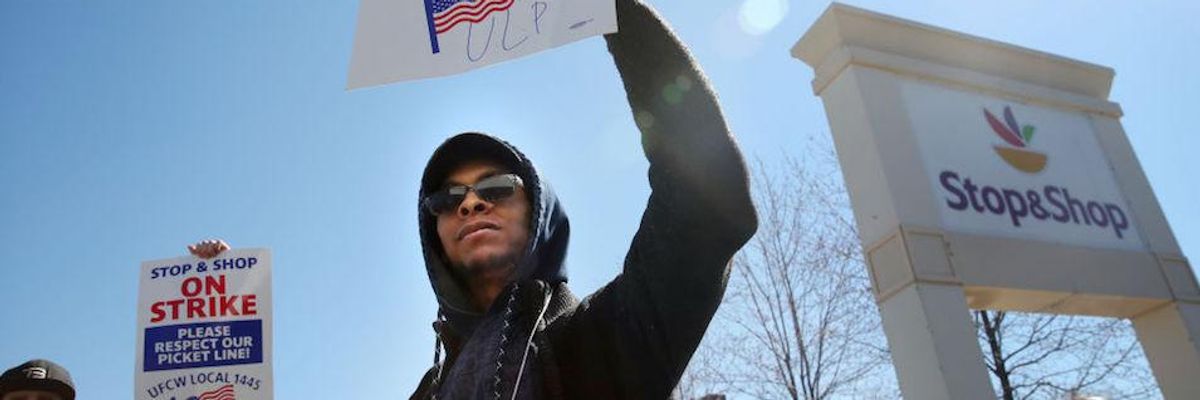
Workers on strike at Stop & Shop in New England. (Photo: Real News Reports Twitter)
Some 31,000 workers walked off the job at Stop & Shop stores across New England Thursday in response to the company cutting wages and benefits, a strike that prompted the support and praise of prominent Democrats and left wing activists.
The strike is the result of a March vote by store union members to walk off the job if a fair contract between the union and the grocery corporation could not be reached during negotiations.
Even though the labor action was not unexpected, the size of the strike was notable, as HuffPost reporter Dave Jamieson pointed out.
A strike of 31,000 workers is large by any measure, but it is particularly large in the U.S. private sector, where massive work stoppages have become increasingly rare. Excluding the wave of public-sector teacher strikes and a walkout at California public hospitals, the Stop & Shop strike appears to be the largest since 36,500 employees at Verizon (which owns HuffPost) formed picket lines in 2016, according to data from the Bureau of Labor Statistics.
Leaders from the United Food and Commercial Workers (UFCW) union, which is representing the striking workers, pointed to the company's attempts to raise healthcare cost buy-ins by workers and cut pensions as two sticking points in negotiations.
Stop & Shop owner Ahold Delhaize, a European grocery conglomerate, is withholding financial information that would justify those cuts, union leaders said in a statement.
"The company is claiming the proposed cuts are necessary but is unlawfully refusing to provide financial information to verify that claim," UFCW leaders said.
Stop & Shop, in its statement on the strike, said that the company was "ready to meet with union leaders any time" to resolve the dispute.
"We are committed to good faith bargaining and hope to reach new contracts as quickly as possible that both recognize and reward the great work of our associates and enable Stop & Shop to compete effectively in the rapidly changing New England grocery market," the company said.
Workers outside the Stop & Shop in North Adams, Mass., told reporters from local outlet iBerkshires that the company's refusal to use a fraction of its massive profits to help workers--and the subsequent decision to attempt to cut benefits--was the main issue.
"We really decided there had to be a labor action and stand up to this corporate greed," said North Adams union steward and strike coordinator Bill Laviolette.
"They wouldn't show us where they were losing money or why they were making such drastic cuts," Laviolette added.
Sen. Elizabeth Warren (D-Mass.) echoed her constituent Laviolette's call for fair treatment. In a tweet, Warren said that she backed Stop & Shop workers in their action.
"I stand in solidarity with UFCW for these hard-working families to be treated with the dignity & respect they deserve," said Warren.
Sen. Bernie Sanders (I-Vt.) also expressed his support for the strikers.
"I stand with UFCW workers in their fight to protect health care and workers' rights," said Sanders.
Both Sanders and Warren are running for the Democratic nomination for president in the party's primary next year.
The strike appears likely to continue for the foreseeable future, until one side gives in--and, as HuffPost's Jamieson put it, in a tight labor market, the advantage is with UFCW and the workers.
"They've been investing in infrastructure here but not in the workers," said North Adams' Laviolette.
Stop & Shop will need to make a decision: either invest in people power or continue to lose money.
Dear Common Dreams reader, It’s been nearly 30 years since I co-founded Common Dreams with my late wife, Lina Newhouser. We had the radical notion that journalism should serve the public good, not corporate profits. It was clear to us from the outset what it would take to build such a project. No paid advertisements. No corporate sponsors. No millionaire publisher telling us what to think or do. Many people said we wouldn't last a year, but we proved those doubters wrong. Together with a tremendous team of journalists and dedicated staff, we built an independent media outlet free from the constraints of profits and corporate control. Our mission has always been simple: To inform. To inspire. To ignite change for the common good. Building Common Dreams was not easy. Our survival was never guaranteed. When you take on the most powerful forces—Wall Street greed, fossil fuel industry destruction, Big Tech lobbyists, and uber-rich oligarchs who have spent billions upon billions rigging the economy and democracy in their favor—the only bulwark you have is supporters who believe in your work. But here’s the urgent message from me today. It's never been this bad out there. And it's never been this hard to keep us going. At the very moment Common Dreams is most needed, the threats we face are intensifying. We need your support now more than ever. We don't accept corporate advertising and never will. We don't have a paywall because we don't think people should be blocked from critical news based on their ability to pay. Everything we do is funded by the donations of readers like you. When everyone does the little they can afford, we are strong. But if that support retreats or dries up, so do we. Will you donate now to make sure Common Dreams not only survives but thrives? —Craig Brown, Co-founder |
Some 31,000 workers walked off the job at Stop & Shop stores across New England Thursday in response to the company cutting wages and benefits, a strike that prompted the support and praise of prominent Democrats and left wing activists.
The strike is the result of a March vote by store union members to walk off the job if a fair contract between the union and the grocery corporation could not be reached during negotiations.
Even though the labor action was not unexpected, the size of the strike was notable, as HuffPost reporter Dave Jamieson pointed out.
A strike of 31,000 workers is large by any measure, but it is particularly large in the U.S. private sector, where massive work stoppages have become increasingly rare. Excluding the wave of public-sector teacher strikes and a walkout at California public hospitals, the Stop & Shop strike appears to be the largest since 36,500 employees at Verizon (which owns HuffPost) formed picket lines in 2016, according to data from the Bureau of Labor Statistics.
Leaders from the United Food and Commercial Workers (UFCW) union, which is representing the striking workers, pointed to the company's attempts to raise healthcare cost buy-ins by workers and cut pensions as two sticking points in negotiations.
Stop & Shop owner Ahold Delhaize, a European grocery conglomerate, is withholding financial information that would justify those cuts, union leaders said in a statement.
"The company is claiming the proposed cuts are necessary but is unlawfully refusing to provide financial information to verify that claim," UFCW leaders said.
Stop & Shop, in its statement on the strike, said that the company was "ready to meet with union leaders any time" to resolve the dispute.
"We are committed to good faith bargaining and hope to reach new contracts as quickly as possible that both recognize and reward the great work of our associates and enable Stop & Shop to compete effectively in the rapidly changing New England grocery market," the company said.
Workers outside the Stop & Shop in North Adams, Mass., told reporters from local outlet iBerkshires that the company's refusal to use a fraction of its massive profits to help workers--and the subsequent decision to attempt to cut benefits--was the main issue.
"We really decided there had to be a labor action and stand up to this corporate greed," said North Adams union steward and strike coordinator Bill Laviolette.
"They wouldn't show us where they were losing money or why they were making such drastic cuts," Laviolette added.
Sen. Elizabeth Warren (D-Mass.) echoed her constituent Laviolette's call for fair treatment. In a tweet, Warren said that she backed Stop & Shop workers in their action.
"I stand in solidarity with UFCW for these hard-working families to be treated with the dignity & respect they deserve," said Warren.
Sen. Bernie Sanders (I-Vt.) also expressed his support for the strikers.
"I stand with UFCW workers in their fight to protect health care and workers' rights," said Sanders.
Both Sanders and Warren are running for the Democratic nomination for president in the party's primary next year.
The strike appears likely to continue for the foreseeable future, until one side gives in--and, as HuffPost's Jamieson put it, in a tight labor market, the advantage is with UFCW and the workers.
"They've been investing in infrastructure here but not in the workers," said North Adams' Laviolette.
Stop & Shop will need to make a decision: either invest in people power or continue to lose money.
Some 31,000 workers walked off the job at Stop & Shop stores across New England Thursday in response to the company cutting wages and benefits, a strike that prompted the support and praise of prominent Democrats and left wing activists.
The strike is the result of a March vote by store union members to walk off the job if a fair contract between the union and the grocery corporation could not be reached during negotiations.
Even though the labor action was not unexpected, the size of the strike was notable, as HuffPost reporter Dave Jamieson pointed out.
A strike of 31,000 workers is large by any measure, but it is particularly large in the U.S. private sector, where massive work stoppages have become increasingly rare. Excluding the wave of public-sector teacher strikes and a walkout at California public hospitals, the Stop & Shop strike appears to be the largest since 36,500 employees at Verizon (which owns HuffPost) formed picket lines in 2016, according to data from the Bureau of Labor Statistics.
Leaders from the United Food and Commercial Workers (UFCW) union, which is representing the striking workers, pointed to the company's attempts to raise healthcare cost buy-ins by workers and cut pensions as two sticking points in negotiations.
Stop & Shop owner Ahold Delhaize, a European grocery conglomerate, is withholding financial information that would justify those cuts, union leaders said in a statement.
"The company is claiming the proposed cuts are necessary but is unlawfully refusing to provide financial information to verify that claim," UFCW leaders said.
Stop & Shop, in its statement on the strike, said that the company was "ready to meet with union leaders any time" to resolve the dispute.
"We are committed to good faith bargaining and hope to reach new contracts as quickly as possible that both recognize and reward the great work of our associates and enable Stop & Shop to compete effectively in the rapidly changing New England grocery market," the company said.
Workers outside the Stop & Shop in North Adams, Mass., told reporters from local outlet iBerkshires that the company's refusal to use a fraction of its massive profits to help workers--and the subsequent decision to attempt to cut benefits--was the main issue.
"We really decided there had to be a labor action and stand up to this corporate greed," said North Adams union steward and strike coordinator Bill Laviolette.
"They wouldn't show us where they were losing money or why they were making such drastic cuts," Laviolette added.
Sen. Elizabeth Warren (D-Mass.) echoed her constituent Laviolette's call for fair treatment. In a tweet, Warren said that she backed Stop & Shop workers in their action.
"I stand in solidarity with UFCW for these hard-working families to be treated with the dignity & respect they deserve," said Warren.
Sen. Bernie Sanders (I-Vt.) also expressed his support for the strikers.
"I stand with UFCW workers in their fight to protect health care and workers' rights," said Sanders.
Both Sanders and Warren are running for the Democratic nomination for president in the party's primary next year.
The strike appears likely to continue for the foreseeable future, until one side gives in--and, as HuffPost's Jamieson put it, in a tight labor market, the advantage is with UFCW and the workers.
"They've been investing in infrastructure here but not in the workers," said North Adams' Laviolette.
Stop & Shop will need to make a decision: either invest in people power or continue to lose money.