SUBSCRIBE TO OUR FREE NEWSLETTER
Daily news & progressive opinion—funded by the people, not the corporations—delivered straight to your inbox.
5
#000000
#FFFFFF
To donate by check, phone, or other method, see our More Ways to Give page.
Daily news & progressive opinion—funded by the people, not the corporations—delivered straight to your inbox.
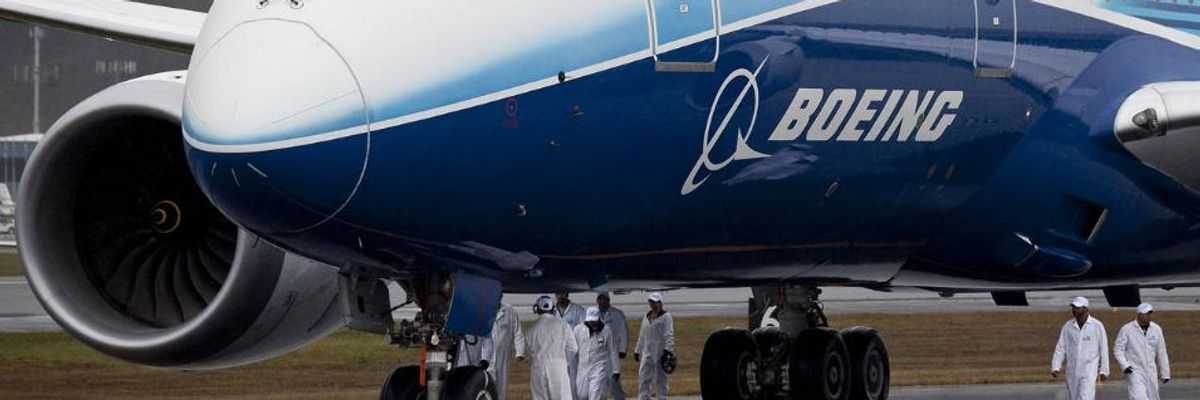
Dennis Muilenburg, Boeing's chairman and CEO, was rewarded a 27 percent pay hike in 2018, raising his total compensation to $23.4 million. (Photo: Getty Images)
As the aerospace giant and weapons manufacturer Boeing faces international outrage and government scrutiny following two deadly plane crashes in the last five months, financial filings showed the company's chief executive received a 27 percent raise in 2018.
Dennis Muilenburg, Boeing's chairman and CEO, brought home $23.4 million in total compensation last year, up from $18.5 million the previous year. When stock options are included, Muilenburg pulled in around $30 million, according to Boeing's Securities and Exchange Commission (SEC) filing.
Muilenburg's raise is part of a broader trend of soaring CEO pay following President Donald Trump's $1.5 trillion in tax cuts, which disproportionately benefited the wealthiest Americans.
According to a Wall Street Journal analysis on published Sunday, the median pay of 132 top CEOs climbed to $1 million per month in 2018.
News of Muilenburg's raise, first reported by the Seattle Times, comes just a week after one of Boeing's 737 Max 8 airplanes crashed in Ethiopia, killing 157 people.
Following an investigation, Ethiopia's transport minister said data from the crash showed "a clear similarity" with a 737 Max 8 wreck in Indonesia that killed 189 people last October.
Since the deadly crash in Ethiopia, nations around the world--including, belatedly, the United States--grounded the 737 Max 8 model, despite Muilenburg's insistence that the planes are safe.
The U.S. Department of Transportation is investigating the Federal Aviation Administration's (FAA) approval of Boeing's 737 Max 8 airliners.
As the Seattle Times reported on Sunday, FAA managers "pushed the agency's safety engineers to delegate safety assessments to Boeing itself, and to speedily approve the resulting analysis."
The rush to approve the 737 Max model resulted in a number of "crucial flaws" in the safety analysis, the Times reported, citing anonymous FAA officials.
According to the Times, "technical experts inside the FAA said October's Lion Air crash, where the [flight control system] has been clearly implicated by investigators in Indonesia, is only the latest indicator that the agency's delegation of airplane certification has gone too far, and that it's inappropriate for Boeing employees to have so much authority over safety analyses of Boeing jets."
Dear Common Dreams reader, It’s been nearly 30 years since I co-founded Common Dreams with my late wife, Lina Newhouser. We had the radical notion that journalism should serve the public good, not corporate profits. It was clear to us from the outset what it would take to build such a project. No paid advertisements. No corporate sponsors. No millionaire publisher telling us what to think or do. Many people said we wouldn't last a year, but we proved those doubters wrong. Together with a tremendous team of journalists and dedicated staff, we built an independent media outlet free from the constraints of profits and corporate control. Our mission has always been simple: To inform. To inspire. To ignite change for the common good. Building Common Dreams was not easy. Our survival was never guaranteed. When you take on the most powerful forces—Wall Street greed, fossil fuel industry destruction, Big Tech lobbyists, and uber-rich oligarchs who have spent billions upon billions rigging the economy and democracy in their favor—the only bulwark you have is supporters who believe in your work. But here’s the urgent message from me today. It's never been this bad out there. And it's never been this hard to keep us going. At the very moment Common Dreams is most needed, the threats we face are intensifying. We need your support now more than ever. We don't accept corporate advertising and never will. We don't have a paywall because we don't think people should be blocked from critical news based on their ability to pay. Everything we do is funded by the donations of readers like you. When everyone does the little they can afford, we are strong. But if that support retreats or dries up, so do we. Will you donate now to make sure Common Dreams not only survives but thrives? —Craig Brown, Co-founder |
As the aerospace giant and weapons manufacturer Boeing faces international outrage and government scrutiny following two deadly plane crashes in the last five months, financial filings showed the company's chief executive received a 27 percent raise in 2018.
Dennis Muilenburg, Boeing's chairman and CEO, brought home $23.4 million in total compensation last year, up from $18.5 million the previous year. When stock options are included, Muilenburg pulled in around $30 million, according to Boeing's Securities and Exchange Commission (SEC) filing.
Muilenburg's raise is part of a broader trend of soaring CEO pay following President Donald Trump's $1.5 trillion in tax cuts, which disproportionately benefited the wealthiest Americans.
According to a Wall Street Journal analysis on published Sunday, the median pay of 132 top CEOs climbed to $1 million per month in 2018.
News of Muilenburg's raise, first reported by the Seattle Times, comes just a week after one of Boeing's 737 Max 8 airplanes crashed in Ethiopia, killing 157 people.
Following an investigation, Ethiopia's transport minister said data from the crash showed "a clear similarity" with a 737 Max 8 wreck in Indonesia that killed 189 people last October.
Since the deadly crash in Ethiopia, nations around the world--including, belatedly, the United States--grounded the 737 Max 8 model, despite Muilenburg's insistence that the planes are safe.
The U.S. Department of Transportation is investigating the Federal Aviation Administration's (FAA) approval of Boeing's 737 Max 8 airliners.
As the Seattle Times reported on Sunday, FAA managers "pushed the agency's safety engineers to delegate safety assessments to Boeing itself, and to speedily approve the resulting analysis."
The rush to approve the 737 Max model resulted in a number of "crucial flaws" in the safety analysis, the Times reported, citing anonymous FAA officials.
According to the Times, "technical experts inside the FAA said October's Lion Air crash, where the [flight control system] has been clearly implicated by investigators in Indonesia, is only the latest indicator that the agency's delegation of airplane certification has gone too far, and that it's inappropriate for Boeing employees to have so much authority over safety analyses of Boeing jets."
As the aerospace giant and weapons manufacturer Boeing faces international outrage and government scrutiny following two deadly plane crashes in the last five months, financial filings showed the company's chief executive received a 27 percent raise in 2018.
Dennis Muilenburg, Boeing's chairman and CEO, brought home $23.4 million in total compensation last year, up from $18.5 million the previous year. When stock options are included, Muilenburg pulled in around $30 million, according to Boeing's Securities and Exchange Commission (SEC) filing.
Muilenburg's raise is part of a broader trend of soaring CEO pay following President Donald Trump's $1.5 trillion in tax cuts, which disproportionately benefited the wealthiest Americans.
According to a Wall Street Journal analysis on published Sunday, the median pay of 132 top CEOs climbed to $1 million per month in 2018.
News of Muilenburg's raise, first reported by the Seattle Times, comes just a week after one of Boeing's 737 Max 8 airplanes crashed in Ethiopia, killing 157 people.
Following an investigation, Ethiopia's transport minister said data from the crash showed "a clear similarity" with a 737 Max 8 wreck in Indonesia that killed 189 people last October.
Since the deadly crash in Ethiopia, nations around the world--including, belatedly, the United States--grounded the 737 Max 8 model, despite Muilenburg's insistence that the planes are safe.
The U.S. Department of Transportation is investigating the Federal Aviation Administration's (FAA) approval of Boeing's 737 Max 8 airliners.
As the Seattle Times reported on Sunday, FAA managers "pushed the agency's safety engineers to delegate safety assessments to Boeing itself, and to speedily approve the resulting analysis."
The rush to approve the 737 Max model resulted in a number of "crucial flaws" in the safety analysis, the Times reported, citing anonymous FAA officials.
According to the Times, "technical experts inside the FAA said October's Lion Air crash, where the [flight control system] has been clearly implicated by investigators in Indonesia, is only the latest indicator that the agency's delegation of airplane certification has gone too far, and that it's inappropriate for Boeing employees to have so much authority over safety analyses of Boeing jets."