SUBSCRIBE TO OUR FREE NEWSLETTER
Daily news & progressive opinion—funded by the people, not the corporations—delivered straight to your inbox.
5
#000000
#FFFFFF
To donate by check, phone, or other method, see our More Ways to Give page.
Daily news & progressive opinion—funded by the people, not the corporations—delivered straight to your inbox.
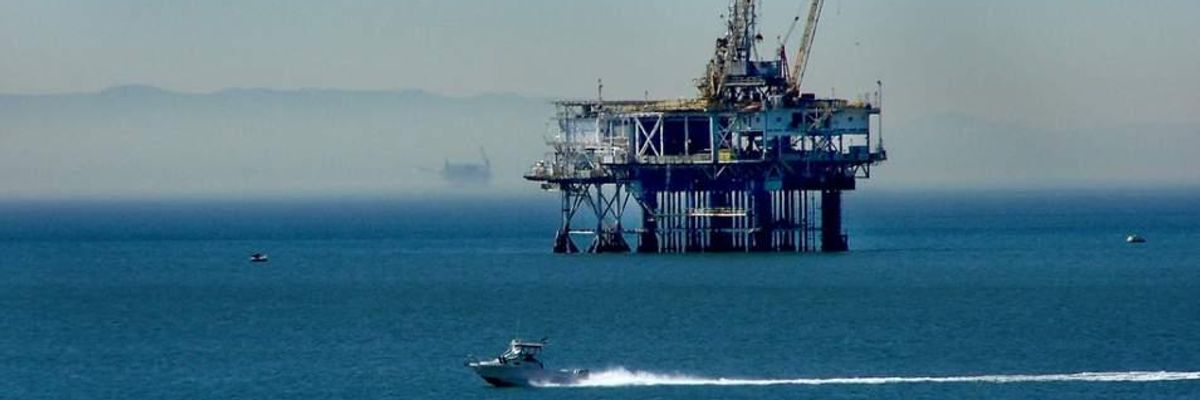
An Interior Department official told a group of oil and gas executives that President Donald Trump's frequent "distracting" conduct has helped shift public attention away from (Photo: arbyreed/Flickr/cc)
Confirming what a number of Trump critics have pointed out about the president's ability to pass some of his most dangerous policies while stoking public outrage about unrelated matters, a top Interior Department official shared with fossil fuel executives recently how this strategy has been beneficial to corporate polluters.
According to the Guardian, at a meeting of the International Association of Geophysical Contractors (IAGC) in February, assistant secretary for land and minerals management Joe Balash told the crowd that Trump's ability to distract the public has made it possible for the administration to forge ahead with a plan to open up the Atlantic Ocean to oil and gas drilling, likely beginning in the coming weeks.
"We have 120 municipalities, 1,200 elected officials, 42,000 businesses and 500,000 that have registered their opposition to offshore drilling and exploration in the Atlantic. And yet, big oil has more influence over this administration." --Vicki Clark, Business Alliance for Protecting the Atlantic Coast
A year after provoking outcry with its draft proposal for expanded offshore drilling, the Interior Department is expected to introduce its official plan for leasing parts of the Atlantic from New Jersey to Florida, up to 200 nautical miles from the coastline.
"The president has a knack for keeping the attention of the media and the public focused somewhere else while we do all the work that needs to be done on behalf of the American people," Balash told the trade group, which represents many companies that will likely vie for leases in the Atlantic.
A number of critics recently pointed out Trump's ability to distract as his cover for enacting some of his most wide-reaching and harmful policies.
The Interior Department's meeting with IAGC came weeks before the Trump administration is set to officially propose its five-year program after conferring extensively with fossil fuel interests.
Contrary to Balash's claims that the plan will be rolled out "on behalf of the American people," coastal governments and residents, lawmakers on both sides of the aisle, climate action groups, and the marine science community are overwhelmingly opposed to offshore drilling.
Meanwhile, top Interior officials including former Secretary Ryan Zinke and Balash met with fossil fuel interests about 30 times as the administration finalized its plan.
Fifty-one percent of Americans oppose offshore drilling, according to Pew Research, and 56 percent of those who live within 25 miles of a coastline are against the practice. Governors from 10 states protested the administration's draft proposal last year while a coalition of environmental groups filed suit against the U.S. government over the plan.
"We have 120 municipalities, 1,200 elected officials, 42,000 businesses and 500,000 that have registered their opposition to offshore drilling and exploration in the Atlantic," Vicki Clark of the Business Alliance for Protecting the Atlantic Coast told the Guardian. "And yet, big oil has more influence over this administration."
Ahead of the leasing process, the Trump administration is already moving to allow oil and gas companies to begin seismic surveys which will allow the fossil fuel industry to determine where in the Atlantic oil deposits exist--a practice which has been decried by marine scientists and animal rights groups. Seismic surveys can harm and even kill marine wildlife, according to a 2017 study published in Nature.
Dear Common Dreams reader, It’s been nearly 30 years since I co-founded Common Dreams with my late wife, Lina Newhouser. We had the radical notion that journalism should serve the public good, not corporate profits. It was clear to us from the outset what it would take to build such a project. No paid advertisements. No corporate sponsors. No millionaire publisher telling us what to think or do. Many people said we wouldn't last a year, but we proved those doubters wrong. Together with a tremendous team of journalists and dedicated staff, we built an independent media outlet free from the constraints of profits and corporate control. Our mission has always been simple: To inform. To inspire. To ignite change for the common good. Building Common Dreams was not easy. Our survival was never guaranteed. When you take on the most powerful forces—Wall Street greed, fossil fuel industry destruction, Big Tech lobbyists, and uber-rich oligarchs who have spent billions upon billions rigging the economy and democracy in their favor—the only bulwark you have is supporters who believe in your work. But here’s the urgent message from me today. It's never been this bad out there. And it's never been this hard to keep us going. At the very moment Common Dreams is most needed, the threats we face are intensifying. We need your support now more than ever. We don't accept corporate advertising and never will. We don't have a paywall because we don't think people should be blocked from critical news based on their ability to pay. Everything we do is funded by the donations of readers like you. When everyone does the little they can afford, we are strong. But if that support retreats or dries up, so do we. Will you donate now to make sure Common Dreams not only survives but thrives? —Craig Brown, Co-founder |
Confirming what a number of Trump critics have pointed out about the president's ability to pass some of his most dangerous policies while stoking public outrage about unrelated matters, a top Interior Department official shared with fossil fuel executives recently how this strategy has been beneficial to corporate polluters.
According to the Guardian, at a meeting of the International Association of Geophysical Contractors (IAGC) in February, assistant secretary for land and minerals management Joe Balash told the crowd that Trump's ability to distract the public has made it possible for the administration to forge ahead with a plan to open up the Atlantic Ocean to oil and gas drilling, likely beginning in the coming weeks.
"We have 120 municipalities, 1,200 elected officials, 42,000 businesses and 500,000 that have registered their opposition to offshore drilling and exploration in the Atlantic. And yet, big oil has more influence over this administration." --Vicki Clark, Business Alliance for Protecting the Atlantic Coast
A year after provoking outcry with its draft proposal for expanded offshore drilling, the Interior Department is expected to introduce its official plan for leasing parts of the Atlantic from New Jersey to Florida, up to 200 nautical miles from the coastline.
"The president has a knack for keeping the attention of the media and the public focused somewhere else while we do all the work that needs to be done on behalf of the American people," Balash told the trade group, which represents many companies that will likely vie for leases in the Atlantic.
A number of critics recently pointed out Trump's ability to distract as his cover for enacting some of his most wide-reaching and harmful policies.
The Interior Department's meeting with IAGC came weeks before the Trump administration is set to officially propose its five-year program after conferring extensively with fossil fuel interests.
Contrary to Balash's claims that the plan will be rolled out "on behalf of the American people," coastal governments and residents, lawmakers on both sides of the aisle, climate action groups, and the marine science community are overwhelmingly opposed to offshore drilling.
Meanwhile, top Interior officials including former Secretary Ryan Zinke and Balash met with fossil fuel interests about 30 times as the administration finalized its plan.
Fifty-one percent of Americans oppose offshore drilling, according to Pew Research, and 56 percent of those who live within 25 miles of a coastline are against the practice. Governors from 10 states protested the administration's draft proposal last year while a coalition of environmental groups filed suit against the U.S. government over the plan.
"We have 120 municipalities, 1,200 elected officials, 42,000 businesses and 500,000 that have registered their opposition to offshore drilling and exploration in the Atlantic," Vicki Clark of the Business Alliance for Protecting the Atlantic Coast told the Guardian. "And yet, big oil has more influence over this administration."
Ahead of the leasing process, the Trump administration is already moving to allow oil and gas companies to begin seismic surveys which will allow the fossil fuel industry to determine where in the Atlantic oil deposits exist--a practice which has been decried by marine scientists and animal rights groups. Seismic surveys can harm and even kill marine wildlife, according to a 2017 study published in Nature.
Confirming what a number of Trump critics have pointed out about the president's ability to pass some of his most dangerous policies while stoking public outrage about unrelated matters, a top Interior Department official shared with fossil fuel executives recently how this strategy has been beneficial to corporate polluters.
According to the Guardian, at a meeting of the International Association of Geophysical Contractors (IAGC) in February, assistant secretary for land and minerals management Joe Balash told the crowd that Trump's ability to distract the public has made it possible for the administration to forge ahead with a plan to open up the Atlantic Ocean to oil and gas drilling, likely beginning in the coming weeks.
"We have 120 municipalities, 1,200 elected officials, 42,000 businesses and 500,000 that have registered their opposition to offshore drilling and exploration in the Atlantic. And yet, big oil has more influence over this administration." --Vicki Clark, Business Alliance for Protecting the Atlantic Coast
A year after provoking outcry with its draft proposal for expanded offshore drilling, the Interior Department is expected to introduce its official plan for leasing parts of the Atlantic from New Jersey to Florida, up to 200 nautical miles from the coastline.
"The president has a knack for keeping the attention of the media and the public focused somewhere else while we do all the work that needs to be done on behalf of the American people," Balash told the trade group, which represents many companies that will likely vie for leases in the Atlantic.
A number of critics recently pointed out Trump's ability to distract as his cover for enacting some of his most wide-reaching and harmful policies.
The Interior Department's meeting with IAGC came weeks before the Trump administration is set to officially propose its five-year program after conferring extensively with fossil fuel interests.
Contrary to Balash's claims that the plan will be rolled out "on behalf of the American people," coastal governments and residents, lawmakers on both sides of the aisle, climate action groups, and the marine science community are overwhelmingly opposed to offshore drilling.
Meanwhile, top Interior officials including former Secretary Ryan Zinke and Balash met with fossil fuel interests about 30 times as the administration finalized its plan.
Fifty-one percent of Americans oppose offshore drilling, according to Pew Research, and 56 percent of those who live within 25 miles of a coastline are against the practice. Governors from 10 states protested the administration's draft proposal last year while a coalition of environmental groups filed suit against the U.S. government over the plan.
"We have 120 municipalities, 1,200 elected officials, 42,000 businesses and 500,000 that have registered their opposition to offshore drilling and exploration in the Atlantic," Vicki Clark of the Business Alliance for Protecting the Atlantic Coast told the Guardian. "And yet, big oil has more influence over this administration."
Ahead of the leasing process, the Trump administration is already moving to allow oil and gas companies to begin seismic surveys which will allow the fossil fuel industry to determine where in the Atlantic oil deposits exist--a practice which has been decried by marine scientists and animal rights groups. Seismic surveys can harm and even kill marine wildlife, according to a 2017 study published in Nature.