SUBSCRIBE TO OUR FREE NEWSLETTER
Daily news & progressive opinion—funded by the people, not the corporations—delivered straight to your inbox.
5
#000000
#FFFFFF
To donate by check, phone, or other method, see our More Ways to Give page.
Daily news & progressive opinion—funded by the people, not the corporations—delivered straight to your inbox.
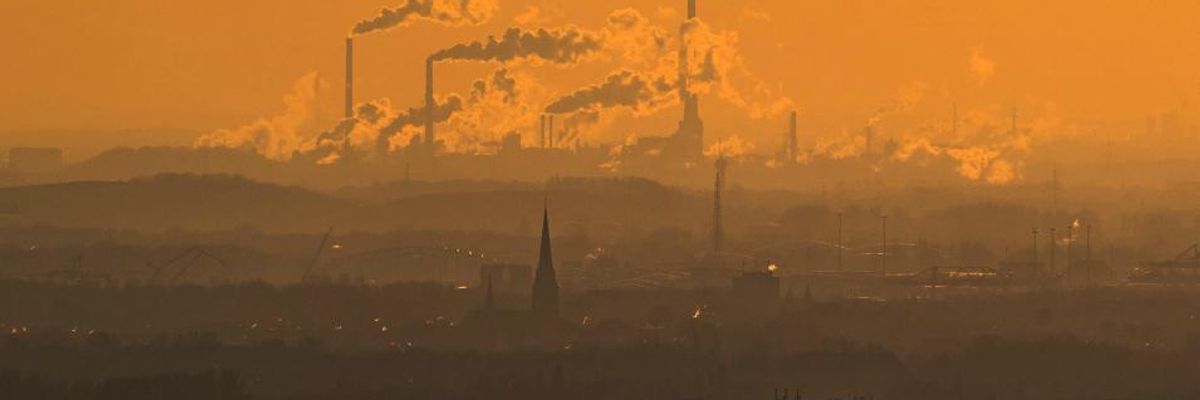
Steam and exhaust rise from different companies on a cold winter day on January 6, 2017 in Oberhausen, Germany. (Photo: Lukas Schulze/Getty Images)
A comprehensive United Nations report released on Wednesday found that while global human health is under dire threat from the climate crisis and industrial pollution, there is still a window for bold and urgent action if world leaders would but seize it.
"We are at a crossroads. Do we continue on our current path, which will lead to a bleak future for humankind, or do we pivot to a more sustainable development pathway? That is the choice our political leaders must make, now."
--Joyce Msuya, U.N. Environment
The United Nations Environment Programme's Sixth Global Environmental Outlook (GEO-6), described as the most rigorous climate assessment released by the international body in the last five years, warned that continued inaction from policy-makers could result in millions of premature deaths from air pollution and other factors throughout Asia, the Middle East, and Africa by mid-century.
The report also highlighted rapidly increasing rates of species extinction.
"At present," the authors note, "42 percent of terrestrial invertebrates, 34 percent of freshwater invertebrates, and 25 percent of marine invertebrates are considered at risk of extinction."
Without "urgent action at an unprecedented scale," the report said, the "ecological foundations of society" are at risk of collapse.
Joyeeta Gupta and Paul Ekins, co-chairs of the GEO-6 process, said in a statement that all the technology, policy ideas, and money needed to bring about ambitious global changes already exist.
"What is currently lacking is the political will to implement policies and technologies at a sufficient speed and scale," they said.
To avert the worst consequences of the climate crisis and ensure a livable future for all, the report calls on policy-makers to focus on transforming the world's food, energy, and waste systems by:
"These transformations will not be easy, but they will offer enormous opportunities for those who are ready to seize them," the report states. "What's at stake is life, and society, as the majority of us know it and enjoy it today. We have no time to lose."
"The science is clear. The health and prosperity of humanity is directly tied with the state of our environment," Joyce Msuya, acting executive director of U.N. Environment, said in a statement.
"We are at a crossroads," Msuya continued. "Do we continue on our current path, which will lead to a bleak future for humankind, or do we pivot to a more sustainable development pathway? That is the choice our political leaders must make, now."
The U.N.'s Global Environmental Outlook comes as bold policy solutions like the Green New Deal are gaining traction in the United States, with one recent survey showing that over 80 percent of Americans support the idea.
The report was released just two days before hundreds of thousands of students in over 90 countries are set to strike to demand that political leaders immediately take action to secure a habitable planet for future generations.
"I think that change is on the horizon and the people will stand up for their future," 16-year-old Swedish climate activist Greta Thunberg told the Guardian.
Dear Common Dreams reader, It’s been nearly 30 years since I co-founded Common Dreams with my late wife, Lina Newhouser. We had the radical notion that journalism should serve the public good, not corporate profits. It was clear to us from the outset what it would take to build such a project. No paid advertisements. No corporate sponsors. No millionaire publisher telling us what to think or do. Many people said we wouldn't last a year, but we proved those doubters wrong. Together with a tremendous team of journalists and dedicated staff, we built an independent media outlet free from the constraints of profits and corporate control. Our mission has always been simple: To inform. To inspire. To ignite change for the common good. Building Common Dreams was not easy. Our survival was never guaranteed. When you take on the most powerful forces—Wall Street greed, fossil fuel industry destruction, Big Tech lobbyists, and uber-rich oligarchs who have spent billions upon billions rigging the economy and democracy in their favor—the only bulwark you have is supporters who believe in your work. But here’s the urgent message from me today. It's never been this bad out there. And it's never been this hard to keep us going. At the very moment Common Dreams is most needed, the threats we face are intensifying. We need your support now more than ever. We don't accept corporate advertising and never will. We don't have a paywall because we don't think people should be blocked from critical news based on their ability to pay. Everything we do is funded by the donations of readers like you. When everyone does the little they can afford, we are strong. But if that support retreats or dries up, so do we. Will you donate now to make sure Common Dreams not only survives but thrives? —Craig Brown, Co-founder |
A comprehensive United Nations report released on Wednesday found that while global human health is under dire threat from the climate crisis and industrial pollution, there is still a window for bold and urgent action if world leaders would but seize it.
"We are at a crossroads. Do we continue on our current path, which will lead to a bleak future for humankind, or do we pivot to a more sustainable development pathway? That is the choice our political leaders must make, now."
--Joyce Msuya, U.N. Environment
The United Nations Environment Programme's Sixth Global Environmental Outlook (GEO-6), described as the most rigorous climate assessment released by the international body in the last five years, warned that continued inaction from policy-makers could result in millions of premature deaths from air pollution and other factors throughout Asia, the Middle East, and Africa by mid-century.
The report also highlighted rapidly increasing rates of species extinction.
"At present," the authors note, "42 percent of terrestrial invertebrates, 34 percent of freshwater invertebrates, and 25 percent of marine invertebrates are considered at risk of extinction."
Without "urgent action at an unprecedented scale," the report said, the "ecological foundations of society" are at risk of collapse.
Joyeeta Gupta and Paul Ekins, co-chairs of the GEO-6 process, said in a statement that all the technology, policy ideas, and money needed to bring about ambitious global changes already exist.
"What is currently lacking is the political will to implement policies and technologies at a sufficient speed and scale," they said.
To avert the worst consequences of the climate crisis and ensure a livable future for all, the report calls on policy-makers to focus on transforming the world's food, energy, and waste systems by:
"These transformations will not be easy, but they will offer enormous opportunities for those who are ready to seize them," the report states. "What's at stake is life, and society, as the majority of us know it and enjoy it today. We have no time to lose."
"The science is clear. The health and prosperity of humanity is directly tied with the state of our environment," Joyce Msuya, acting executive director of U.N. Environment, said in a statement.
"We are at a crossroads," Msuya continued. "Do we continue on our current path, which will lead to a bleak future for humankind, or do we pivot to a more sustainable development pathway? That is the choice our political leaders must make, now."
The U.N.'s Global Environmental Outlook comes as bold policy solutions like the Green New Deal are gaining traction in the United States, with one recent survey showing that over 80 percent of Americans support the idea.
The report was released just two days before hundreds of thousands of students in over 90 countries are set to strike to demand that political leaders immediately take action to secure a habitable planet for future generations.
"I think that change is on the horizon and the people will stand up for their future," 16-year-old Swedish climate activist Greta Thunberg told the Guardian.
A comprehensive United Nations report released on Wednesday found that while global human health is under dire threat from the climate crisis and industrial pollution, there is still a window for bold and urgent action if world leaders would but seize it.
"We are at a crossroads. Do we continue on our current path, which will lead to a bleak future for humankind, or do we pivot to a more sustainable development pathway? That is the choice our political leaders must make, now."
--Joyce Msuya, U.N. Environment
The United Nations Environment Programme's Sixth Global Environmental Outlook (GEO-6), described as the most rigorous climate assessment released by the international body in the last five years, warned that continued inaction from policy-makers could result in millions of premature deaths from air pollution and other factors throughout Asia, the Middle East, and Africa by mid-century.
The report also highlighted rapidly increasing rates of species extinction.
"At present," the authors note, "42 percent of terrestrial invertebrates, 34 percent of freshwater invertebrates, and 25 percent of marine invertebrates are considered at risk of extinction."
Without "urgent action at an unprecedented scale," the report said, the "ecological foundations of society" are at risk of collapse.
Joyeeta Gupta and Paul Ekins, co-chairs of the GEO-6 process, said in a statement that all the technology, policy ideas, and money needed to bring about ambitious global changes already exist.
"What is currently lacking is the political will to implement policies and technologies at a sufficient speed and scale," they said.
To avert the worst consequences of the climate crisis and ensure a livable future for all, the report calls on policy-makers to focus on transforming the world's food, energy, and waste systems by:
"These transformations will not be easy, but they will offer enormous opportunities for those who are ready to seize them," the report states. "What's at stake is life, and society, as the majority of us know it and enjoy it today. We have no time to lose."
"The science is clear. The health and prosperity of humanity is directly tied with the state of our environment," Joyce Msuya, acting executive director of U.N. Environment, said in a statement.
"We are at a crossroads," Msuya continued. "Do we continue on our current path, which will lead to a bleak future for humankind, or do we pivot to a more sustainable development pathway? That is the choice our political leaders must make, now."
The U.N.'s Global Environmental Outlook comes as bold policy solutions like the Green New Deal are gaining traction in the United States, with one recent survey showing that over 80 percent of Americans support the idea.
The report was released just two days before hundreds of thousands of students in over 90 countries are set to strike to demand that political leaders immediately take action to secure a habitable planet for future generations.
"I think that change is on the horizon and the people will stand up for their future," 16-year-old Swedish climate activist Greta Thunberg told the Guardian.