SUBSCRIBE TO OUR FREE NEWSLETTER
Daily news & progressive opinion—funded by the people, not the corporations—delivered straight to your inbox.
5
#000000
#FFFFFF
To donate by check, phone, or other method, see our More Ways to Give page.
Daily news & progressive opinion—funded by the people, not the corporations—delivered straight to your inbox.
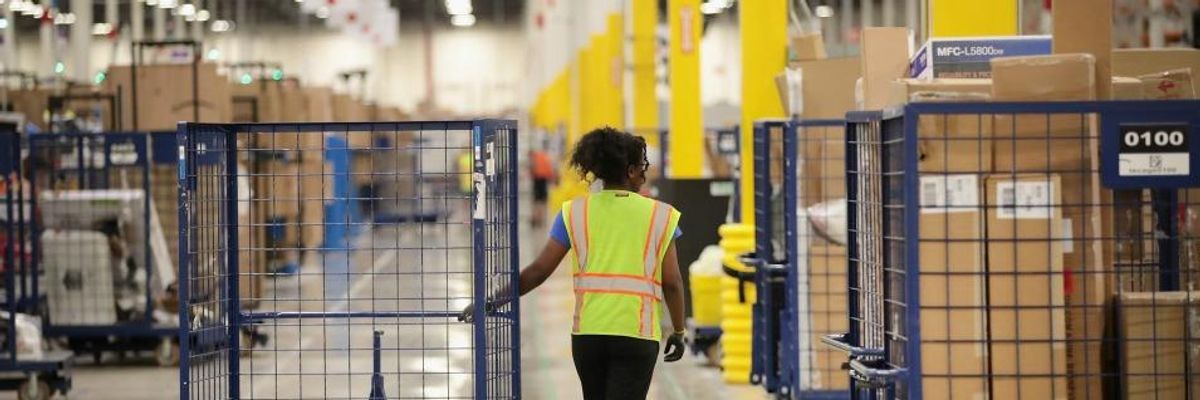
Workers pack and ship customer orders at the 750,000-square-foot Amazon fulfillment center on August 1, 2017 in Romeoville, Illinois. (Photo: Scott Olson/Getty Images)
An extensive report by the Daily Beast paints what one critic called a "worrying, distressing" picture of life for employees at Amazon's hundreds of warehouses and fulfillment centers--detailing the high volume of 911 calls that come from the facilities and why workers are so frequently driven to desperation.
Between 2013 and 2018, emergency workers responded to at least 189 calls from Amazon warehouses across the country, Max Zahn and Sharif Paget reported. The calls detailed by the Daily Beast were not an exhaustive list, but applied to only about a quarter of Amazon's U.S. facilities--46 warehouses in 17 states.
The calls detailed in the report mainly dealt with employees having mental health episodes including suicide attempts and expressing suicidal thoughts, with workers linking their episodes to the social isolation, surveillance, and break-neck pace of work they were subjected to at Amazon.
"It's this isolating colony of hell where people having breakdowns is a regular occurrence," Jace Crouch, a former employee who had worked in Lakeland, Florida, told the Daily Beast. Crouch said it had been "mentally taxing to do the same task super fast for 10-hour shifts, four or five days a week."
On social media critics noted the juxtaposition between Amazon CEO Jeff Bezos's status as the richest person in the world and his employees' alleged experiences being aggressively monitored by managers and punished for taking bathroom breaks, while British Green Party politician Natalie Bennett wrote that the "tax-dodging Great Parasite" can now also be known as the "employer from hell."
The trillion-dollar corporation's employment practices have long been the subject of criticism. Workers are stringently monitored by managers who prod them to move more quickly as they load boxes and count merchandise. Bathroom breaks are timed, employees are discouraged from interacting with one another during their 10 to 12 hour shifts, and last year Amazon worried privacy and labor rights groups when it secured a patent for a wristband that could be worn by employees and which would vibrate if the worker made an incorrect move.
"They treat us like robots," one employee based in Lebanon, Tennessee told the Daily Beast.
"The 911 calls and police reports collected through open-record requests are not evidence that Amazon staffers experience suicidal episodes more often than other American workers, in or out of a warehouse--but they do offer a visceral, real-time glimpse of employees on the edge," write Zahn and Paget.
The report described the experience of Nick Veasley, a warehouse employee who was tasked with counting boxes and was frequently prodded by his manager to count more than 100 items in an hour. He rarely spoke with coworkers, and was written up by supervisors for taking bathroom breaks too frequently due to an intestinal disease, with one report warning of a possible firing in the event of another "violation."
"That place screwed me up so much it put me into a depression where I was actually on a 72-hour hold in a psych ward," said Veasley, who described first being happy to come to work at his $14.50 per hour job, but said he quickly slid into despair, worried that the monotonous, fast-paced job still wouldn't allow him to make ends meet.
Another worker in Etna, Ohio was the subject of a 911 call in July 2018 after "the demands his employer [had] placed on him" combined with outside stress left him distressed over the company's treatment of him.
A sheriff who responded to the call wrote that the worker was "frustrated with his employment because he felt he was lied to by Amazon at his orientation."
"He keeps saying the company told him they valued his employment and would be treated as if he mattered and not just a number," the report added.
Some workers said they had suffered from mental health issues prior to their Amazon employment, but that working conditions had exacerbated their feelings of emotional distress.
Mental health experts interviewed by Daily Beast added that social isolation at work, stress-inducing surveillance by managers, and insufficient breaks like those reported at Amazon can quickly lead to mental health issues for workers.
"You've got individuals who experience stress from a variety of sources," Yeates Conwell, a professor at the University of Rochester, told the outlet. "The workplace may be one in which those things come together and get expressed as stress, mental illness, suicidal ideation behavior."
Dear Common Dreams reader, It’s been nearly 30 years since I co-founded Common Dreams with my late wife, Lina Newhouser. We had the radical notion that journalism should serve the public good, not corporate profits. It was clear to us from the outset what it would take to build such a project. No paid advertisements. No corporate sponsors. No millionaire publisher telling us what to think or do. Many people said we wouldn't last a year, but we proved those doubters wrong. Together with a tremendous team of journalists and dedicated staff, we built an independent media outlet free from the constraints of profits and corporate control. Our mission has always been simple: To inform. To inspire. To ignite change for the common good. Building Common Dreams was not easy. Our survival was never guaranteed. When you take on the most powerful forces—Wall Street greed, fossil fuel industry destruction, Big Tech lobbyists, and uber-rich oligarchs who have spent billions upon billions rigging the economy and democracy in their favor—the only bulwark you have is supporters who believe in your work. But here’s the urgent message from me today. It's never been this bad out there. And it's never been this hard to keep us going. At the very moment Common Dreams is most needed, the threats we face are intensifying. We need your support now more than ever. We don't accept corporate advertising and never will. We don't have a paywall because we don't think people should be blocked from critical news based on their ability to pay. Everything we do is funded by the donations of readers like you. When everyone does the little they can afford, we are strong. But if that support retreats or dries up, so do we. Will you donate now to make sure Common Dreams not only survives but thrives? —Craig Brown, Co-founder |
An extensive report by the Daily Beast paints what one critic called a "worrying, distressing" picture of life for employees at Amazon's hundreds of warehouses and fulfillment centers--detailing the high volume of 911 calls that come from the facilities and why workers are so frequently driven to desperation.
Between 2013 and 2018, emergency workers responded to at least 189 calls from Amazon warehouses across the country, Max Zahn and Sharif Paget reported. The calls detailed by the Daily Beast were not an exhaustive list, but applied to only about a quarter of Amazon's U.S. facilities--46 warehouses in 17 states.
The calls detailed in the report mainly dealt with employees having mental health episodes including suicide attempts and expressing suicidal thoughts, with workers linking their episodes to the social isolation, surveillance, and break-neck pace of work they were subjected to at Amazon.
"It's this isolating colony of hell where people having breakdowns is a regular occurrence," Jace Crouch, a former employee who had worked in Lakeland, Florida, told the Daily Beast. Crouch said it had been "mentally taxing to do the same task super fast for 10-hour shifts, four or five days a week."
On social media critics noted the juxtaposition between Amazon CEO Jeff Bezos's status as the richest person in the world and his employees' alleged experiences being aggressively monitored by managers and punished for taking bathroom breaks, while British Green Party politician Natalie Bennett wrote that the "tax-dodging Great Parasite" can now also be known as the "employer from hell."
The trillion-dollar corporation's employment practices have long been the subject of criticism. Workers are stringently monitored by managers who prod them to move more quickly as they load boxes and count merchandise. Bathroom breaks are timed, employees are discouraged from interacting with one another during their 10 to 12 hour shifts, and last year Amazon worried privacy and labor rights groups when it secured a patent for a wristband that could be worn by employees and which would vibrate if the worker made an incorrect move.
"They treat us like robots," one employee based in Lebanon, Tennessee told the Daily Beast.
"The 911 calls and police reports collected through open-record requests are not evidence that Amazon staffers experience suicidal episodes more often than other American workers, in or out of a warehouse--but they do offer a visceral, real-time glimpse of employees on the edge," write Zahn and Paget.
The report described the experience of Nick Veasley, a warehouse employee who was tasked with counting boxes and was frequently prodded by his manager to count more than 100 items in an hour. He rarely spoke with coworkers, and was written up by supervisors for taking bathroom breaks too frequently due to an intestinal disease, with one report warning of a possible firing in the event of another "violation."
"That place screwed me up so much it put me into a depression where I was actually on a 72-hour hold in a psych ward," said Veasley, who described first being happy to come to work at his $14.50 per hour job, but said he quickly slid into despair, worried that the monotonous, fast-paced job still wouldn't allow him to make ends meet.
Another worker in Etna, Ohio was the subject of a 911 call in July 2018 after "the demands his employer [had] placed on him" combined with outside stress left him distressed over the company's treatment of him.
A sheriff who responded to the call wrote that the worker was "frustrated with his employment because he felt he was lied to by Amazon at his orientation."
"He keeps saying the company told him they valued his employment and would be treated as if he mattered and not just a number," the report added.
Some workers said they had suffered from mental health issues prior to their Amazon employment, but that working conditions had exacerbated their feelings of emotional distress.
Mental health experts interviewed by Daily Beast added that social isolation at work, stress-inducing surveillance by managers, and insufficient breaks like those reported at Amazon can quickly lead to mental health issues for workers.
"You've got individuals who experience stress from a variety of sources," Yeates Conwell, a professor at the University of Rochester, told the outlet. "The workplace may be one in which those things come together and get expressed as stress, mental illness, suicidal ideation behavior."
An extensive report by the Daily Beast paints what one critic called a "worrying, distressing" picture of life for employees at Amazon's hundreds of warehouses and fulfillment centers--detailing the high volume of 911 calls that come from the facilities and why workers are so frequently driven to desperation.
Between 2013 and 2018, emergency workers responded to at least 189 calls from Amazon warehouses across the country, Max Zahn and Sharif Paget reported. The calls detailed by the Daily Beast were not an exhaustive list, but applied to only about a quarter of Amazon's U.S. facilities--46 warehouses in 17 states.
The calls detailed in the report mainly dealt with employees having mental health episodes including suicide attempts and expressing suicidal thoughts, with workers linking their episodes to the social isolation, surveillance, and break-neck pace of work they were subjected to at Amazon.
"It's this isolating colony of hell where people having breakdowns is a regular occurrence," Jace Crouch, a former employee who had worked in Lakeland, Florida, told the Daily Beast. Crouch said it had been "mentally taxing to do the same task super fast for 10-hour shifts, four or five days a week."
On social media critics noted the juxtaposition between Amazon CEO Jeff Bezos's status as the richest person in the world and his employees' alleged experiences being aggressively monitored by managers and punished for taking bathroom breaks, while British Green Party politician Natalie Bennett wrote that the "tax-dodging Great Parasite" can now also be known as the "employer from hell."
The trillion-dollar corporation's employment practices have long been the subject of criticism. Workers are stringently monitored by managers who prod them to move more quickly as they load boxes and count merchandise. Bathroom breaks are timed, employees are discouraged from interacting with one another during their 10 to 12 hour shifts, and last year Amazon worried privacy and labor rights groups when it secured a patent for a wristband that could be worn by employees and which would vibrate if the worker made an incorrect move.
"They treat us like robots," one employee based in Lebanon, Tennessee told the Daily Beast.
"The 911 calls and police reports collected through open-record requests are not evidence that Amazon staffers experience suicidal episodes more often than other American workers, in or out of a warehouse--but they do offer a visceral, real-time glimpse of employees on the edge," write Zahn and Paget.
The report described the experience of Nick Veasley, a warehouse employee who was tasked with counting boxes and was frequently prodded by his manager to count more than 100 items in an hour. He rarely spoke with coworkers, and was written up by supervisors for taking bathroom breaks too frequently due to an intestinal disease, with one report warning of a possible firing in the event of another "violation."
"That place screwed me up so much it put me into a depression where I was actually on a 72-hour hold in a psych ward," said Veasley, who described first being happy to come to work at his $14.50 per hour job, but said he quickly slid into despair, worried that the monotonous, fast-paced job still wouldn't allow him to make ends meet.
Another worker in Etna, Ohio was the subject of a 911 call in July 2018 after "the demands his employer [had] placed on him" combined with outside stress left him distressed over the company's treatment of him.
A sheriff who responded to the call wrote that the worker was "frustrated with his employment because he felt he was lied to by Amazon at his orientation."
"He keeps saying the company told him they valued his employment and would be treated as if he mattered and not just a number," the report added.
Some workers said they had suffered from mental health issues prior to their Amazon employment, but that working conditions had exacerbated their feelings of emotional distress.
Mental health experts interviewed by Daily Beast added that social isolation at work, stress-inducing surveillance by managers, and insufficient breaks like those reported at Amazon can quickly lead to mental health issues for workers.
"You've got individuals who experience stress from a variety of sources," Yeates Conwell, a professor at the University of Rochester, told the outlet. "The workplace may be one in which those things come together and get expressed as stress, mental illness, suicidal ideation behavior."