SUBSCRIBE TO OUR FREE NEWSLETTER
Daily news & progressive opinion—funded by the people, not the corporations—delivered straight to your inbox.
5
#000000
#FFFFFF
To donate by check, phone, or other method, see our More Ways to Give page.
Daily news & progressive opinion—funded by the people, not the corporations—delivered straight to your inbox.
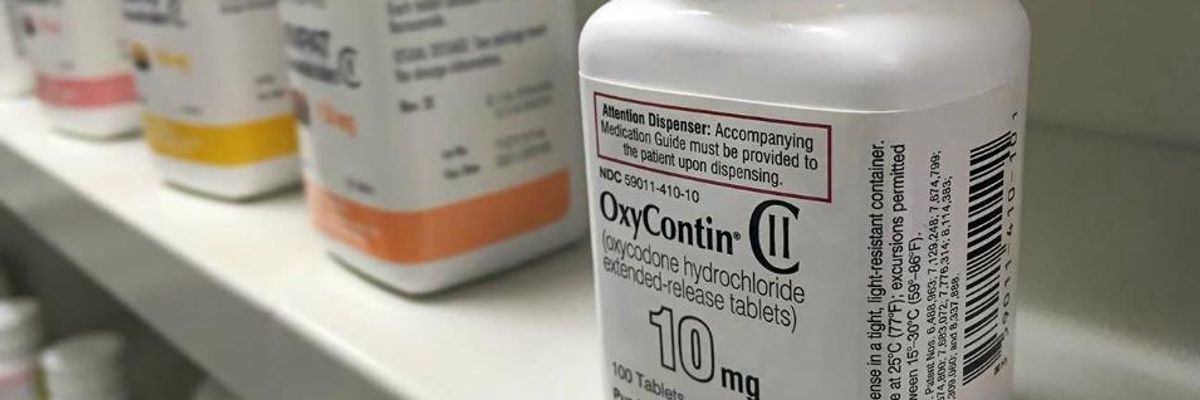
Purdue Pharma, the maker of the opioid painkiller OxyContin, is reportedly considering filing for bankruptcy as thousands sue the company over its contribution to causing the opioid abuse crisis. (Photo: VCU CNS/Flickr/cc)
After spending hundreds of millions of dollars convincing the American public that opioid painkillers are safe to use for chronic pain--and fueling a deadly, decades-long addiction epidemic as a result--the drug maker Purdue Pharma could file for bankruptcy to avoid being held accountable for its actions.
According to Reuters, Purdue is considering bankruptcy to halt thousands of lawsuits and allow the company to settle with the plaintiffs out of court.
Critics on social media slammed the manufacturer for apparently seeking a way out of its legal troubles without allowing its accusers to bring their cases to trial.
The lawsuits have been filed in dozens of states--of about 2,000, 1,600 are in a federal court in Ohio, with the remaining litigation spread across the country. A number of state attorneys general, including Maura Healy of Massachusetts and Mike Hunter of Oklahoma, are also suing the company.
Litigants say the company misled the public and the medical community about the safety of OxyContin, the opioid painkiller it released in 1996, and other opioids, which are chemically similar to heroin and are commonly prescribed in pill form for pain management. Purdue and other drug companies spent years assuring Americans that drugs like OxyContin, Vicodin, and Percocet were suitable for long-term use.
"Purdue Pharma and its executives built a multi-billion-dollar business based on deception and addiction," said Healy last year as she announced her state's suit. "The more drugs they sold, the more money they made, and the more people in Massachusetts suffered and died. These defendants must be held accountable for their role in the opioid epidemic that has ravaged our state and claimed so many lives."
Addiction experts say the drugs should only be prescribed for acute pain, such as after surgery or during end-of-life care, due to their highly addictive quality.
A Justice Department report revealed last year that Purdue began receiving reports that some patients were becoming addicted to OxyContin almost immediately after they began selling it.
Opioids were involved in more than 47,000 overdose deaths in 2017. Between 2000 and 2014, overdose deaths from opioids increased by about 200 percent as Purdue Pharma reported rising profits. The company made $45 million in sales of OxyContin the first year it was on the market and reported a 2,000 percent increase by 2000. By 2010, OxyContoin was bringing in $3.1 billion.
In 2007, the company and three of its top executives pleaded guilty to using deceptive practices to market OxyContin, paying $634.5 million in fines.
But critics have raised concerns that a bankruptcy filing by Purdue could keep victims of the epidemic the company helped fuel from being heard.
Dear Common Dreams reader, It’s been nearly 30 years since I co-founded Common Dreams with my late wife, Lina Newhouser. We had the radical notion that journalism should serve the public good, not corporate profits. It was clear to us from the outset what it would take to build such a project. No paid advertisements. No corporate sponsors. No millionaire publisher telling us what to think or do. Many people said we wouldn't last a year, but we proved those doubters wrong. Together with a tremendous team of journalists and dedicated staff, we built an independent media outlet free from the constraints of profits and corporate control. Our mission has always been simple: To inform. To inspire. To ignite change for the common good. Building Common Dreams was not easy. Our survival was never guaranteed. When you take on the most powerful forces—Wall Street greed, fossil fuel industry destruction, Big Tech lobbyists, and uber-rich oligarchs who have spent billions upon billions rigging the economy and democracy in their favor—the only bulwark you have is supporters who believe in your work. But here’s the urgent message from me today. It's never been this bad out there. And it's never been this hard to keep us going. At the very moment Common Dreams is most needed, the threats we face are intensifying. We need your support now more than ever. We don't accept corporate advertising and never will. We don't have a paywall because we don't think people should be blocked from critical news based on their ability to pay. Everything we do is funded by the donations of readers like you. When everyone does the little they can afford, we are strong. But if that support retreats or dries up, so do we. Will you donate now to make sure Common Dreams not only survives but thrives? —Craig Brown, Co-founder |
After spending hundreds of millions of dollars convincing the American public that opioid painkillers are safe to use for chronic pain--and fueling a deadly, decades-long addiction epidemic as a result--the drug maker Purdue Pharma could file for bankruptcy to avoid being held accountable for its actions.
According to Reuters, Purdue is considering bankruptcy to halt thousands of lawsuits and allow the company to settle with the plaintiffs out of court.
Critics on social media slammed the manufacturer for apparently seeking a way out of its legal troubles without allowing its accusers to bring their cases to trial.
The lawsuits have been filed in dozens of states--of about 2,000, 1,600 are in a federal court in Ohio, with the remaining litigation spread across the country. A number of state attorneys general, including Maura Healy of Massachusetts and Mike Hunter of Oklahoma, are also suing the company.
Litigants say the company misled the public and the medical community about the safety of OxyContin, the opioid painkiller it released in 1996, and other opioids, which are chemically similar to heroin and are commonly prescribed in pill form for pain management. Purdue and other drug companies spent years assuring Americans that drugs like OxyContin, Vicodin, and Percocet were suitable for long-term use.
"Purdue Pharma and its executives built a multi-billion-dollar business based on deception and addiction," said Healy last year as she announced her state's suit. "The more drugs they sold, the more money they made, and the more people in Massachusetts suffered and died. These defendants must be held accountable for their role in the opioid epidemic that has ravaged our state and claimed so many lives."
Addiction experts say the drugs should only be prescribed for acute pain, such as after surgery or during end-of-life care, due to their highly addictive quality.
A Justice Department report revealed last year that Purdue began receiving reports that some patients were becoming addicted to OxyContin almost immediately after they began selling it.
Opioids were involved in more than 47,000 overdose deaths in 2017. Between 2000 and 2014, overdose deaths from opioids increased by about 200 percent as Purdue Pharma reported rising profits. The company made $45 million in sales of OxyContin the first year it was on the market and reported a 2,000 percent increase by 2000. By 2010, OxyContoin was bringing in $3.1 billion.
In 2007, the company and three of its top executives pleaded guilty to using deceptive practices to market OxyContin, paying $634.5 million in fines.
But critics have raised concerns that a bankruptcy filing by Purdue could keep victims of the epidemic the company helped fuel from being heard.
After spending hundreds of millions of dollars convincing the American public that opioid painkillers are safe to use for chronic pain--and fueling a deadly, decades-long addiction epidemic as a result--the drug maker Purdue Pharma could file for bankruptcy to avoid being held accountable for its actions.
According to Reuters, Purdue is considering bankruptcy to halt thousands of lawsuits and allow the company to settle with the plaintiffs out of court.
Critics on social media slammed the manufacturer for apparently seeking a way out of its legal troubles without allowing its accusers to bring their cases to trial.
The lawsuits have been filed in dozens of states--of about 2,000, 1,600 are in a federal court in Ohio, with the remaining litigation spread across the country. A number of state attorneys general, including Maura Healy of Massachusetts and Mike Hunter of Oklahoma, are also suing the company.
Litigants say the company misled the public and the medical community about the safety of OxyContin, the opioid painkiller it released in 1996, and other opioids, which are chemically similar to heroin and are commonly prescribed in pill form for pain management. Purdue and other drug companies spent years assuring Americans that drugs like OxyContin, Vicodin, and Percocet were suitable for long-term use.
"Purdue Pharma and its executives built a multi-billion-dollar business based on deception and addiction," said Healy last year as she announced her state's suit. "The more drugs they sold, the more money they made, and the more people in Massachusetts suffered and died. These defendants must be held accountable for their role in the opioid epidemic that has ravaged our state and claimed so many lives."
Addiction experts say the drugs should only be prescribed for acute pain, such as after surgery or during end-of-life care, due to their highly addictive quality.
A Justice Department report revealed last year that Purdue began receiving reports that some patients were becoming addicted to OxyContin almost immediately after they began selling it.
Opioids were involved in more than 47,000 overdose deaths in 2017. Between 2000 and 2014, overdose deaths from opioids increased by about 200 percent as Purdue Pharma reported rising profits. The company made $45 million in sales of OxyContin the first year it was on the market and reported a 2,000 percent increase by 2000. By 2010, OxyContoin was bringing in $3.1 billion.
In 2007, the company and three of its top executives pleaded guilty to using deceptive practices to market OxyContin, paying $634.5 million in fines.
But critics have raised concerns that a bankruptcy filing by Purdue could keep victims of the epidemic the company helped fuel from being heard.