SUBSCRIBE TO OUR FREE NEWSLETTER
Daily news & progressive opinion—funded by the people, not the corporations—delivered straight to your inbox.
5
#000000
#FFFFFF
To donate by check, phone, or other method, see our More Ways to Give page.
Daily news & progressive opinion—funded by the people, not the corporations—delivered straight to your inbox.
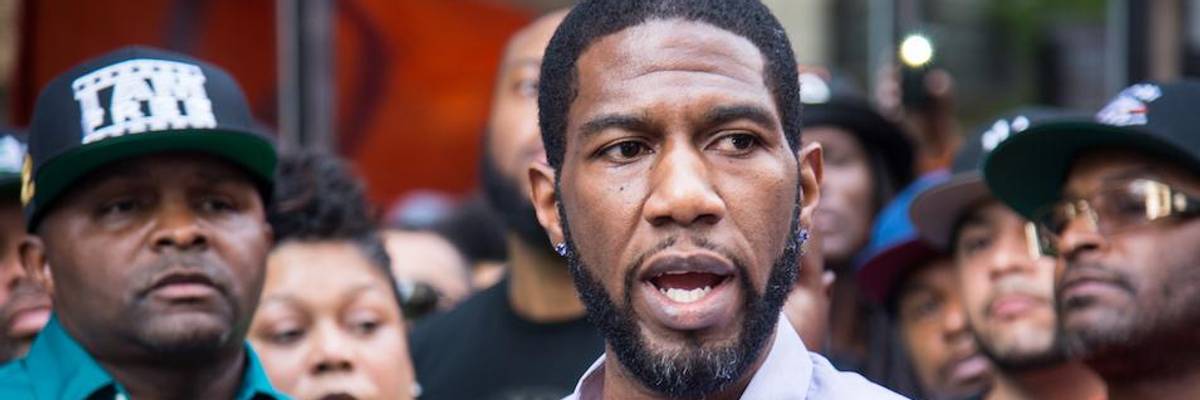
New York City Council Member Jumaane Williams attends the National Anti-Violence Community Press Conference at Irving Plaza on May 26, 2016 in New York City (Photo: Mark Sagliocco/Getty Images).
Jumaane Williams, a progressive activist, is New York City's public advocate-elect.
Williams, a city councilman from Brooklyn, won election as advocate with a plurality of votes on Tuesday, defeating 16 other candidates that included progressive journalist and activist Nomiki Konst and Queens councilman Eric Ulrich. Ulrich was the second place finisher, with 19 percent to Williams's 33 percent.
As advocate, Williams will have control over the office's $3.5 million budget and the power to hold public hearings. Williams will be the only person of color in the top of city government--Mayor Bill De Blasio, acting public advocate Corey Johnson, and comptroller Scott M. Stringer are white men.
The role of public advocate is seen as a stepping stone on the way to higher state office and the advocate replaces the mayor temporarily if the mayor leaves office early. De Blasio himself made the jump in 2013.
Congratulations for Williams on his win came from across the New York progressive spectrum.
Turnout for the special election was low for the city with only around 400,000 New Yorkers casting ballots in the race.
Williams entered the race with a recently elevated public profile after running unsuccessfully against Kathy Hochul for Lt. Governor in the Democratic primary on September 13, 2018, and had the support of prominent progressives in the city including State Senator Julia Salazar and progressive activist and Fordham University law professor Zephyr Teachout.
The position was vacated at the end of December by newly elected state Attorney General Letitia James. Acting public advocate Johnson congratulated Williams on Twitter and promised a smooth transition.
Due to the timing of James's departure and the next election, Williams could have to face off against unknown challengers in a primary for advocate in June and then again in the general election in November.
It's unclear if there will be much appetite for another free for all race, however, as Williams earned a decisive margin of victory in his plurality win.
Dear Common Dreams reader, It’s been nearly 30 years since I co-founded Common Dreams with my late wife, Lina Newhouser. We had the radical notion that journalism should serve the public good, not corporate profits. It was clear to us from the outset what it would take to build such a project. No paid advertisements. No corporate sponsors. No millionaire publisher telling us what to think or do. Many people said we wouldn't last a year, but we proved those doubters wrong. Together with a tremendous team of journalists and dedicated staff, we built an independent media outlet free from the constraints of profits and corporate control. Our mission has always been simple: To inform. To inspire. To ignite change for the common good. Building Common Dreams was not easy. Our survival was never guaranteed. When you take on the most powerful forces—Wall Street greed, fossil fuel industry destruction, Big Tech lobbyists, and uber-rich oligarchs who have spent billions upon billions rigging the economy and democracy in their favor—the only bulwark you have is supporters who believe in your work. But here’s the urgent message from me today. It's never been this bad out there. And it's never been this hard to keep us going. At the very moment Common Dreams is most needed, the threats we face are intensifying. We need your support now more than ever. We don't accept corporate advertising and never will. We don't have a paywall because we don't think people should be blocked from critical news based on their ability to pay. Everything we do is funded by the donations of readers like you. When everyone does the little they can afford, we are strong. But if that support retreats or dries up, so do we. Will you donate now to make sure Common Dreams not only survives but thrives? —Craig Brown, Co-founder |
Jumaane Williams, a progressive activist, is New York City's public advocate-elect.
Williams, a city councilman from Brooklyn, won election as advocate with a plurality of votes on Tuesday, defeating 16 other candidates that included progressive journalist and activist Nomiki Konst and Queens councilman Eric Ulrich. Ulrich was the second place finisher, with 19 percent to Williams's 33 percent.
As advocate, Williams will have control over the office's $3.5 million budget and the power to hold public hearings. Williams will be the only person of color in the top of city government--Mayor Bill De Blasio, acting public advocate Corey Johnson, and comptroller Scott M. Stringer are white men.
The role of public advocate is seen as a stepping stone on the way to higher state office and the advocate replaces the mayor temporarily if the mayor leaves office early. De Blasio himself made the jump in 2013.
Congratulations for Williams on his win came from across the New York progressive spectrum.
Turnout for the special election was low for the city with only around 400,000 New Yorkers casting ballots in the race.
Williams entered the race with a recently elevated public profile after running unsuccessfully against Kathy Hochul for Lt. Governor in the Democratic primary on September 13, 2018, and had the support of prominent progressives in the city including State Senator Julia Salazar and progressive activist and Fordham University law professor Zephyr Teachout.
The position was vacated at the end of December by newly elected state Attorney General Letitia James. Acting public advocate Johnson congratulated Williams on Twitter and promised a smooth transition.
Due to the timing of James's departure and the next election, Williams could have to face off against unknown challengers in a primary for advocate in June and then again in the general election in November.
It's unclear if there will be much appetite for another free for all race, however, as Williams earned a decisive margin of victory in his plurality win.
Jumaane Williams, a progressive activist, is New York City's public advocate-elect.
Williams, a city councilman from Brooklyn, won election as advocate with a plurality of votes on Tuesday, defeating 16 other candidates that included progressive journalist and activist Nomiki Konst and Queens councilman Eric Ulrich. Ulrich was the second place finisher, with 19 percent to Williams's 33 percent.
As advocate, Williams will have control over the office's $3.5 million budget and the power to hold public hearings. Williams will be the only person of color in the top of city government--Mayor Bill De Blasio, acting public advocate Corey Johnson, and comptroller Scott M. Stringer are white men.
The role of public advocate is seen as a stepping stone on the way to higher state office and the advocate replaces the mayor temporarily if the mayor leaves office early. De Blasio himself made the jump in 2013.
Congratulations for Williams on his win came from across the New York progressive spectrum.
Turnout for the special election was low for the city with only around 400,000 New Yorkers casting ballots in the race.
Williams entered the race with a recently elevated public profile after running unsuccessfully against Kathy Hochul for Lt. Governor in the Democratic primary on September 13, 2018, and had the support of prominent progressives in the city including State Senator Julia Salazar and progressive activist and Fordham University law professor Zephyr Teachout.
The position was vacated at the end of December by newly elected state Attorney General Letitia James. Acting public advocate Johnson congratulated Williams on Twitter and promised a smooth transition.
Due to the timing of James's departure and the next election, Williams could have to face off against unknown challengers in a primary for advocate in June and then again in the general election in November.
It's unclear if there will be much appetite for another free for all race, however, as Williams earned a decisive margin of victory in his plurality win.