

SUBSCRIBE TO OUR FREE NEWSLETTER
Daily news & progressive opinion—funded by the people, not the corporations—delivered straight to your inbox.
5
#000000
#FFFFFF
To donate by check, phone, or other method, see our More Ways to Give page.
Daily news & progressive opinion—funded by the people, not the corporations—delivered straight to your inbox.
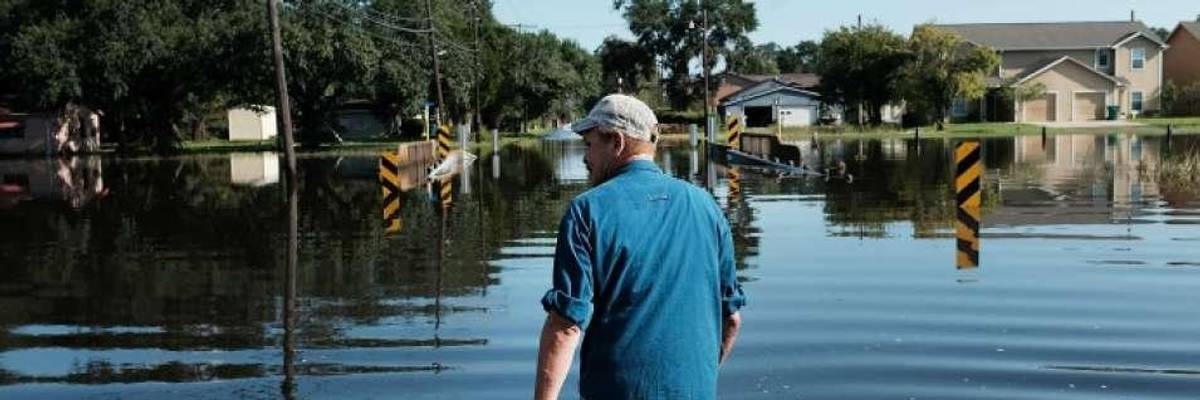
A resident of Orange, Texas walks through his flooded neighborhood on September 5, 2017 in Orange, Texas. Almost a week after Hurricane Harvey, some neighborhoods remained flooded. (Photo: Spencer Platt/Getty Images)
Warning that the world is on a path toward "environmental breakdown" that will likely trigger "runaway collapse" of social and economic systems in the vein of the 2008 global financial crisis, a new report out Tuesday calls for major shifts in understanding the scale and pace of environmental change, the implications of it, and the need for a transformational response.
"Human-induced environmental change is occurring at an unprecedented scale and pace and the window of opportunity to avoid catastrophic outcomes in societies around the world is rapidly closing."
--IPPR report
The report--titled This Is a Crisis: Facing Up to the Age of Environmental Breakdown (pdf)--from the U.K.-based progressive think tank Institute for Public Policy Research (IPPR), declares that "mainstream political and policy debates have failed to recognize that human impacts on the environment have reached a critical stage, potentially eroding the conditions upon which socioeconomic stability is possible."
"Human-induced environmental change is occurring at an unprecedented scale and pace and the window of opportunity to avoid catastrophic outcomes in societies around the world is rapidly closing," the report advises. "These outcomes include economic instability, large-scale involuntary migration, conflict, famine and the potential collapse of social, and economic systems. The historical disregard of environmental considerations in most areas of policy has been a catastrophic mistake."
The report raises alarm not only about the risks of climate change driven by human activities that produce greenhouse gases, but also about behaviors tied to declining biodiversity, ocean acidification, land degradation, high levels of phosphorous and nitrogen runoff, a waning ozone layer, and air and land pollution. Considering all these factors, it concludes, "we have entered the age of environmental breakdown."
"People are not frank enough about this. If it is discussed at all, it is the sort of thing mentioned at the end of a conversation, that makes everyone look at the floor, but we don't have time for that now."
--Laurie Laybourn-Langton, IPPR
The two-part transformational response envisioned by the authors would mean a socioeconomic overhaul "to bring human activity to within environmentally sustainable limits while tackling inequalities and providing a high quality life to all" as well as major steps to boost resilience to the impacts of environmental breakdown, including improvements to "infrastructure, markets, political processes, social cohesion, and global cooperation."
However, as lead author Laurie Laybourn-Langton emphasized to the Guardian, even considering a response that matches the scope of the crisis requires first raising public awareness: "People are not frank enough about this. If it is discussed at all, it is the sort of thing mentioned at the end of a conversation, that makes everyone look at the floor, but we don't have time for that now... It's appearing more in media, but we are not doing enough."
In a piece for Red Pepper magazine, IPPR researcher and report co-author Lesley Rankin highlighted the importance of reaching the public with "a more honest message" that fully captures the gravity of the current global conditions.
"A catastrophic prognosis and a call to action may feel incompatible... but to do so reflects the conflicting emotions which environmental breakdown inspires--despair, followed by grim determination."
--Lesley Rankin, IPPR
While noting that campaigners often fear that "doom-mongering" will turn people off and spur inaction, she charges that "a catastrophic prognosis and a call to action may feel incompatible (why try to resolve something that is already so disastrous?), but to do so reflects the conflicting emotions which environmental breakdown inspires--despair, followed by grim determination."
The report was met with widespread praise, with readers calling it "absolutely brilliant," "essential reading for policymakers," and "a clarion wake-up call to the world." It also provoked demands for a #GreenNewDeal for the U.K.--following the introduction of such a resolution in the U.S. Congress last week--as well as, more broadly, "legislation now which commits government to the recovery of nature."
Dear Common Dreams reader, It’s been nearly 30 years since I co-founded Common Dreams with my late wife, Lina Newhouser. We had the radical notion that journalism should serve the public good, not corporate profits. It was clear to us from the outset what it would take to build such a project. No paid advertisements. No corporate sponsors. No millionaire publisher telling us what to think or do. Many people said we wouldn't last a year, but we proved those doubters wrong. Together with a tremendous team of journalists and dedicated staff, we built an independent media outlet free from the constraints of profits and corporate control. Our mission has always been simple: To inform. To inspire. To ignite change for the common good. Building Common Dreams was not easy. Our survival was never guaranteed. When you take on the most powerful forces—Wall Street greed, fossil fuel industry destruction, Big Tech lobbyists, and uber-rich oligarchs who have spent billions upon billions rigging the economy and democracy in their favor—the only bulwark you have is supporters who believe in your work. But here’s the urgent message from me today. It's never been this bad out there. And it's never been this hard to keep us going. At the very moment Common Dreams is most needed, the threats we face are intensifying. We need your support now more than ever. We don't accept corporate advertising and never will. We don't have a paywall because we don't think people should be blocked from critical news based on their ability to pay. Everything we do is funded by the donations of readers like you. When everyone does the little they can afford, we are strong. But if that support retreats or dries up, so do we. Will you donate now to make sure Common Dreams not only survives but thrives? —Craig Brown, Co-founder |
Warning that the world is on a path toward "environmental breakdown" that will likely trigger "runaway collapse" of social and economic systems in the vein of the 2008 global financial crisis, a new report out Tuesday calls for major shifts in understanding the scale and pace of environmental change, the implications of it, and the need for a transformational response.
"Human-induced environmental change is occurring at an unprecedented scale and pace and the window of opportunity to avoid catastrophic outcomes in societies around the world is rapidly closing."
--IPPR report
The report--titled This Is a Crisis: Facing Up to the Age of Environmental Breakdown (pdf)--from the U.K.-based progressive think tank Institute for Public Policy Research (IPPR), declares that "mainstream political and policy debates have failed to recognize that human impacts on the environment have reached a critical stage, potentially eroding the conditions upon which socioeconomic stability is possible."
"Human-induced environmental change is occurring at an unprecedented scale and pace and the window of opportunity to avoid catastrophic outcomes in societies around the world is rapidly closing," the report advises. "These outcomes include economic instability, large-scale involuntary migration, conflict, famine and the potential collapse of social, and economic systems. The historical disregard of environmental considerations in most areas of policy has been a catastrophic mistake."
The report raises alarm not only about the risks of climate change driven by human activities that produce greenhouse gases, but also about behaviors tied to declining biodiversity, ocean acidification, land degradation, high levels of phosphorous and nitrogen runoff, a waning ozone layer, and air and land pollution. Considering all these factors, it concludes, "we have entered the age of environmental breakdown."
"People are not frank enough about this. If it is discussed at all, it is the sort of thing mentioned at the end of a conversation, that makes everyone look at the floor, but we don't have time for that now."
--Laurie Laybourn-Langton, IPPR
The two-part transformational response envisioned by the authors would mean a socioeconomic overhaul "to bring human activity to within environmentally sustainable limits while tackling inequalities and providing a high quality life to all" as well as major steps to boost resilience to the impacts of environmental breakdown, including improvements to "infrastructure, markets, political processes, social cohesion, and global cooperation."
However, as lead author Laurie Laybourn-Langton emphasized to the Guardian, even considering a response that matches the scope of the crisis requires first raising public awareness: "People are not frank enough about this. If it is discussed at all, it is the sort of thing mentioned at the end of a conversation, that makes everyone look at the floor, but we don't have time for that now... It's appearing more in media, but we are not doing enough."
In a piece for Red Pepper magazine, IPPR researcher and report co-author Lesley Rankin highlighted the importance of reaching the public with "a more honest message" that fully captures the gravity of the current global conditions.
"A catastrophic prognosis and a call to action may feel incompatible... but to do so reflects the conflicting emotions which environmental breakdown inspires--despair, followed by grim determination."
--Lesley Rankin, IPPR
While noting that campaigners often fear that "doom-mongering" will turn people off and spur inaction, she charges that "a catastrophic prognosis and a call to action may feel incompatible (why try to resolve something that is already so disastrous?), but to do so reflects the conflicting emotions which environmental breakdown inspires--despair, followed by grim determination."
The report was met with widespread praise, with readers calling it "absolutely brilliant," "essential reading for policymakers," and "a clarion wake-up call to the world." It also provoked demands for a #GreenNewDeal for the U.K.--following the introduction of such a resolution in the U.S. Congress last week--as well as, more broadly, "legislation now which commits government to the recovery of nature."
Warning that the world is on a path toward "environmental breakdown" that will likely trigger "runaway collapse" of social and economic systems in the vein of the 2008 global financial crisis, a new report out Tuesday calls for major shifts in understanding the scale and pace of environmental change, the implications of it, and the need for a transformational response.
"Human-induced environmental change is occurring at an unprecedented scale and pace and the window of opportunity to avoid catastrophic outcomes in societies around the world is rapidly closing."
--IPPR report
The report--titled This Is a Crisis: Facing Up to the Age of Environmental Breakdown (pdf)--from the U.K.-based progressive think tank Institute for Public Policy Research (IPPR), declares that "mainstream political and policy debates have failed to recognize that human impacts on the environment have reached a critical stage, potentially eroding the conditions upon which socioeconomic stability is possible."
"Human-induced environmental change is occurring at an unprecedented scale and pace and the window of opportunity to avoid catastrophic outcomes in societies around the world is rapidly closing," the report advises. "These outcomes include economic instability, large-scale involuntary migration, conflict, famine and the potential collapse of social, and economic systems. The historical disregard of environmental considerations in most areas of policy has been a catastrophic mistake."
The report raises alarm not only about the risks of climate change driven by human activities that produce greenhouse gases, but also about behaviors tied to declining biodiversity, ocean acidification, land degradation, high levels of phosphorous and nitrogen runoff, a waning ozone layer, and air and land pollution. Considering all these factors, it concludes, "we have entered the age of environmental breakdown."
"People are not frank enough about this. If it is discussed at all, it is the sort of thing mentioned at the end of a conversation, that makes everyone look at the floor, but we don't have time for that now."
--Laurie Laybourn-Langton, IPPR
The two-part transformational response envisioned by the authors would mean a socioeconomic overhaul "to bring human activity to within environmentally sustainable limits while tackling inequalities and providing a high quality life to all" as well as major steps to boost resilience to the impacts of environmental breakdown, including improvements to "infrastructure, markets, political processes, social cohesion, and global cooperation."
However, as lead author Laurie Laybourn-Langton emphasized to the Guardian, even considering a response that matches the scope of the crisis requires first raising public awareness: "People are not frank enough about this. If it is discussed at all, it is the sort of thing mentioned at the end of a conversation, that makes everyone look at the floor, but we don't have time for that now... It's appearing more in media, but we are not doing enough."
In a piece for Red Pepper magazine, IPPR researcher and report co-author Lesley Rankin highlighted the importance of reaching the public with "a more honest message" that fully captures the gravity of the current global conditions.
"A catastrophic prognosis and a call to action may feel incompatible... but to do so reflects the conflicting emotions which environmental breakdown inspires--despair, followed by grim determination."
--Lesley Rankin, IPPR
While noting that campaigners often fear that "doom-mongering" will turn people off and spur inaction, she charges that "a catastrophic prognosis and a call to action may feel incompatible (why try to resolve something that is already so disastrous?), but to do so reflects the conflicting emotions which environmental breakdown inspires--despair, followed by grim determination."
The report was met with widespread praise, with readers calling it "absolutely brilliant," "essential reading for policymakers," and "a clarion wake-up call to the world." It also provoked demands for a #GreenNewDeal for the U.K.--following the introduction of such a resolution in the U.S. Congress last week--as well as, more broadly, "legislation now which commits government to the recovery of nature."

