SUBSCRIBE TO OUR FREE NEWSLETTER
Daily news & progressive opinion—funded by the people, not the corporations—delivered straight to your inbox.
5
#000000
#FFFFFF
To donate by check, phone, or other method, see our More Ways to Give page.
Daily news & progressive opinion—funded by the people, not the corporations—delivered straight to your inbox.
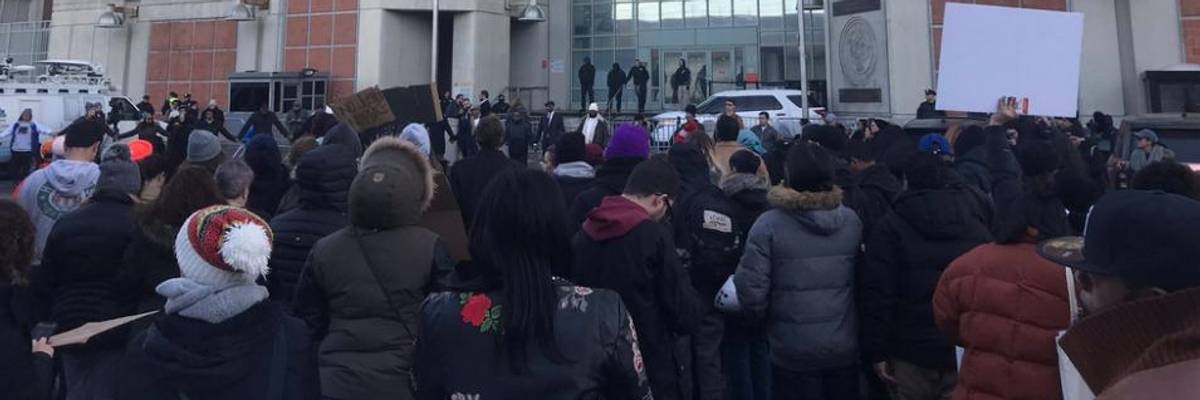
Protesters gathered outside Metropolitan Detention Center in Brooklyn over the weekend, demanding that heat and power be restored after a days-long power outage. Officials called for an investigation Sunday. (Photo: @MarisaKabas/Twitter)
A U.S. District judge called for a hearing Monday into a power outage at federal prison in Brooklyn which left 1,600 inmates without heat and hot water for more than a week amid temperatures that dropped to 2deg, after the prison warden's denial of the outage was contradicted by a Department of Justice (DOJ) statement Monday.
Judge Analisa Torres ordered an evidentiary hearing for Tuesday regarding last week's reports out of the Metropolitan Detention Center (MDC) in Brooklyn. Several federal public defenders told the New York Times that their offices had been inundated with calls from about three dozen inmates, reporting little to no heating and hot water throughout the prison while temperatures dropped as low as two degrees in New York, no extra blankets, and no access to the prison commissary where they would have been able to buy sweatshirts and extra layers, due to a partial lockdown.
Heat and hot water were finally restored Sunday at about 6:30pm, and the DOJ acknowledged that the outage had taken place--contradicting earlier claims from the prison warden, who told the Times that an electrical outage had not affected the heating system.
Sen. Kirsten Gillibrand (D-N.Y.) expressed outrage at the violation of prisoners' rights as well as the lack of transparency regarding the prison conditions.
"Original attempts by my office and many others to receive a full, honest, and straightforward assessment of the situation were met with little information about the current conditions--and no apparent urgency to provide a remedy and explanation," Gillibrand wrote to acting Attorney General Matthew Whitaker on Sunday.
"There continues to be discrepancies regarding the depth and breadth of the conditions at MDC--and a lack of sufficient action. This lack of transparency is a failing of the most basic duties of the Federal Bureau of Prisons, and appears to reflect a lack of compassion for the well-being of detainees in its care and control," the senator added.
When the Justice Department finally said Monday that it would investigate what had taken place at MDC, it was only after outraged calls from officials and family members of inmates.
New York Gov. Andrew Cuomo called the power and heat outage "a violation of human decency and dignity."
"They also raise questions of potential violations of law," Cuomo said. "Government owes a fundamental responsibility to serve all people and the Federal Bureau of Prisons needs to live up to that responsibility."
Inmates' family members and rights advocates had held demonstrations outside the facility, chanting, "Heat is a human right!" and "Where is the warden? Where is the heat?"
The Times and local officials reported that police used pepper spray to try to disperse the crowd.
The Times editorial board, calling the prolonged circumstances a "vivid display of the Trump administration's callousness toward vulnerable people," was among those that gave credit to the demonstrations and online campaigners for refusing to allow the DOJ to ignore the prison conditions:
The history of abuses in federal jails, prisons and detention centers, whose populations are disproportionately black and Hispanic, long predates the Trump administration--and rarely draws much attention. Maybe current officials thought they could treat people callously at the Metropolitan Detention Center because they were mostly poor, and black and brown.
Maybe they assumed no one would notice or care.
Not this time.
This country and this world are at a monumental crossroads. US voters have an opportunity to beat back the forces of fascism and confront the billionaires who are rigging the economy, our media system, and our democracy, making it increasingly impossible for ordinary people to get by. We’re not just talking about the election. We’re talking about what must be done once these fascist elements are vanquished from power. We need a bolder set of solutions than what either major party has so far been willing to offer and a working-class movement ready to fight like hell for it. Trump didn't emerge from nowhere. The conditions that fueled MAGA authoritarianism were created by decades of radical neoliberal economic policies and a corrupt political system dominated by corporate interests. They slashed taxes on the super-rich, promising that the benefits would trickle down. They said giveaways to the corporate titans would make life more affordable for the rest of us. It was all bullshit. And when a bitter, betrayed populace searches for someone to blame, right-wing demagogues have little trouble finding scapegoats. People know when they're being lied to, but you won't hear any of this from the corporate media. Only independent journalism—powered and funded by people who believe in building a better world—can deliver truly trustworthy daily news. If you share our vision, please contribute whatever you can to sustain our work. |
A U.S. District judge called for a hearing Monday into a power outage at federal prison in Brooklyn which left 1,600 inmates without heat and hot water for more than a week amid temperatures that dropped to 2deg, after the prison warden's denial of the outage was contradicted by a Department of Justice (DOJ) statement Monday.
Judge Analisa Torres ordered an evidentiary hearing for Tuesday regarding last week's reports out of the Metropolitan Detention Center (MDC) in Brooklyn. Several federal public defenders told the New York Times that their offices had been inundated with calls from about three dozen inmates, reporting little to no heating and hot water throughout the prison while temperatures dropped as low as two degrees in New York, no extra blankets, and no access to the prison commissary where they would have been able to buy sweatshirts and extra layers, due to a partial lockdown.
Heat and hot water were finally restored Sunday at about 6:30pm, and the DOJ acknowledged that the outage had taken place--contradicting earlier claims from the prison warden, who told the Times that an electrical outage had not affected the heating system.
Sen. Kirsten Gillibrand (D-N.Y.) expressed outrage at the violation of prisoners' rights as well as the lack of transparency regarding the prison conditions.
"Original attempts by my office and many others to receive a full, honest, and straightforward assessment of the situation were met with little information about the current conditions--and no apparent urgency to provide a remedy and explanation," Gillibrand wrote to acting Attorney General Matthew Whitaker on Sunday.
"There continues to be discrepancies regarding the depth and breadth of the conditions at MDC--and a lack of sufficient action. This lack of transparency is a failing of the most basic duties of the Federal Bureau of Prisons, and appears to reflect a lack of compassion for the well-being of detainees in its care and control," the senator added.
When the Justice Department finally said Monday that it would investigate what had taken place at MDC, it was only after outraged calls from officials and family members of inmates.
New York Gov. Andrew Cuomo called the power and heat outage "a violation of human decency and dignity."
"They also raise questions of potential violations of law," Cuomo said. "Government owes a fundamental responsibility to serve all people and the Federal Bureau of Prisons needs to live up to that responsibility."
Inmates' family members and rights advocates had held demonstrations outside the facility, chanting, "Heat is a human right!" and "Where is the warden? Where is the heat?"
The Times and local officials reported that police used pepper spray to try to disperse the crowd.
The Times editorial board, calling the prolonged circumstances a "vivid display of the Trump administration's callousness toward vulnerable people," was among those that gave credit to the demonstrations and online campaigners for refusing to allow the DOJ to ignore the prison conditions:
The history of abuses in federal jails, prisons and detention centers, whose populations are disproportionately black and Hispanic, long predates the Trump administration--and rarely draws much attention. Maybe current officials thought they could treat people callously at the Metropolitan Detention Center because they were mostly poor, and black and brown.
Maybe they assumed no one would notice or care.
Not this time.