

SUBSCRIBE TO OUR FREE NEWSLETTER
Daily news & progressive opinion—funded by the people, not the corporations—delivered straight to your inbox.
5
#000000
#FFFFFF
To donate by check, phone, or other method, see our More Ways to Give page.
Daily news & progressive opinion—funded by the people, not the corporations—delivered straight to your inbox.
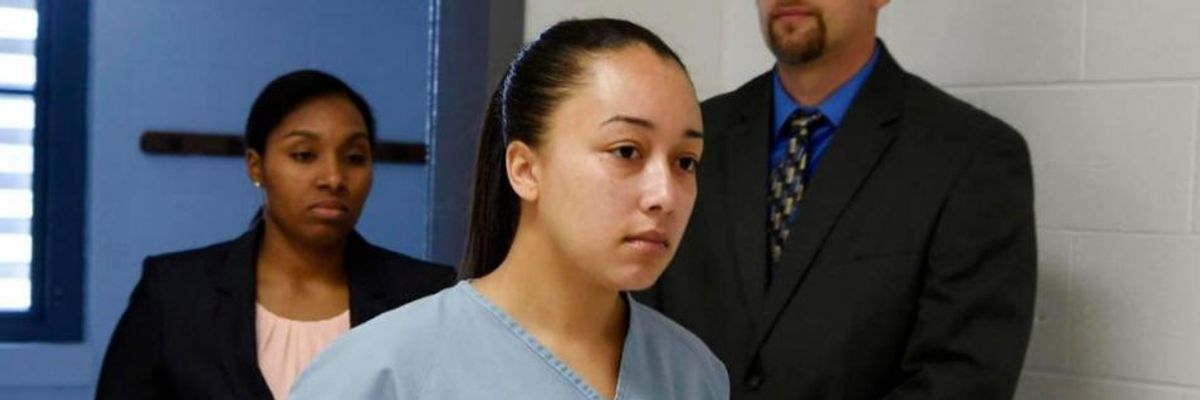
Sex-trafficking survivor Cyntoia Brown was granted clemency on Monday after serving 14 years in prison for killing a man who had paid to have sex with her when she was 16. (Photo: @CBSNews/Twitter)
A decade-long campaign which garnered national headlines in recent months came to fruition on Monday, as Gov. Bill Haslam (R-Tenn.) granted clemency to Cyntoia Brown, a sex-trafficking survivor who has been behind bars for 15 years for murder.
After facing pressure from human rights groups, hundreds of thousands of Americans who signed petitions and wrote letters protesting Brown's imprisonment, and celebrities who helped bring attention to her case, Haslam announced days before he is to leave office that Brown will be released from prison in August.
On social media, many of Brown's supporters gave credit to the groundswell of activism on her behalf that gained national attention in recent months, as well as efforts by Tennesseeans who have been fighting for her release for at least a decade.
After thanking Haslam, Brown herself also expressed gratitude to those who have fought for her early release.
"I am thankful for all the support, prayers, and encouragement I have received," Brown said. "I am thankful to my lawyers and their staffs, and all the others who, for the last decade have freely given of their time and expertise to help me get to this day. I love all of you and will be forever grateful.
"With God's help, I am committed to live the rest of my life helping others, especially young people. My hope is to help other young girls avoid ending up where I have been."
Brown was tried as an adult in 2004 after she shot a man who had paid to have sex with her when she was 16 years old. She killed the man after she thought he was reaching for a gun to shoot her. Brown was working for a pimp at the time who had raped her and forced her into prostitution. Before Haslam announced her clemency, she was serving a life sentence and was not scheduled to be eligible for parole until 2055.
Many of Brown's supporters expressed hope that her case would bring more attention to the 2,100 inmates who are serving life sentences for crimes they committed as juveniles, as well as the thousands of Americans who are victimized by sex-traffickers every year.
"We need to see this as a national awakening," J. Houston Gordon, one of Brown's lawyers, said in a statement.
While celebrating Brown's early release and applauding the work of activists, writer and organizer Mariame Kaba was among those who hesitated to express full satisfaction with Haslam's decision, which includes supervised parole for Brown until 2029--meaning by that time, she will have spent 24 years under state control after spending part of her childhood under the control of a sex trafficker.
"That isn't justice," Kaba said.
Dear Common Dreams reader, It’s been nearly 30 years since I co-founded Common Dreams with my late wife, Lina Newhouser. We had the radical notion that journalism should serve the public good, not corporate profits. It was clear to us from the outset what it would take to build such a project. No paid advertisements. No corporate sponsors. No millionaire publisher telling us what to think or do. Many people said we wouldn't last a year, but we proved those doubters wrong. Together with a tremendous team of journalists and dedicated staff, we built an independent media outlet free from the constraints of profits and corporate control. Our mission has always been simple: To inform. To inspire. To ignite change for the common good. Building Common Dreams was not easy. Our survival was never guaranteed. When you take on the most powerful forces—Wall Street greed, fossil fuel industry destruction, Big Tech lobbyists, and uber-rich oligarchs who have spent billions upon billions rigging the economy and democracy in their favor—the only bulwark you have is supporters who believe in your work. But here’s the urgent message from me today. It's never been this bad out there. And it's never been this hard to keep us going. At the very moment Common Dreams is most needed, the threats we face are intensifying. We need your support now more than ever. We don't accept corporate advertising and never will. We don't have a paywall because we don't think people should be blocked from critical news based on their ability to pay. Everything we do is funded by the donations of readers like you. When everyone does the little they can afford, we are strong. But if that support retreats or dries up, so do we. Will you donate now to make sure Common Dreams not only survives but thrives? —Craig Brown, Co-founder |
A decade-long campaign which garnered national headlines in recent months came to fruition on Monday, as Gov. Bill Haslam (R-Tenn.) granted clemency to Cyntoia Brown, a sex-trafficking survivor who has been behind bars for 15 years for murder.
After facing pressure from human rights groups, hundreds of thousands of Americans who signed petitions and wrote letters protesting Brown's imprisonment, and celebrities who helped bring attention to her case, Haslam announced days before he is to leave office that Brown will be released from prison in August.
On social media, many of Brown's supporters gave credit to the groundswell of activism on her behalf that gained national attention in recent months, as well as efforts by Tennesseeans who have been fighting for her release for at least a decade.
After thanking Haslam, Brown herself also expressed gratitude to those who have fought for her early release.
"I am thankful for all the support, prayers, and encouragement I have received," Brown said. "I am thankful to my lawyers and their staffs, and all the others who, for the last decade have freely given of their time and expertise to help me get to this day. I love all of you and will be forever grateful.
"With God's help, I am committed to live the rest of my life helping others, especially young people. My hope is to help other young girls avoid ending up where I have been."
Brown was tried as an adult in 2004 after she shot a man who had paid to have sex with her when she was 16 years old. She killed the man after she thought he was reaching for a gun to shoot her. Brown was working for a pimp at the time who had raped her and forced her into prostitution. Before Haslam announced her clemency, she was serving a life sentence and was not scheduled to be eligible for parole until 2055.
Many of Brown's supporters expressed hope that her case would bring more attention to the 2,100 inmates who are serving life sentences for crimes they committed as juveniles, as well as the thousands of Americans who are victimized by sex-traffickers every year.
"We need to see this as a national awakening," J. Houston Gordon, one of Brown's lawyers, said in a statement.
While celebrating Brown's early release and applauding the work of activists, writer and organizer Mariame Kaba was among those who hesitated to express full satisfaction with Haslam's decision, which includes supervised parole for Brown until 2029--meaning by that time, she will have spent 24 years under state control after spending part of her childhood under the control of a sex trafficker.
"That isn't justice," Kaba said.
A decade-long campaign which garnered national headlines in recent months came to fruition on Monday, as Gov. Bill Haslam (R-Tenn.) granted clemency to Cyntoia Brown, a sex-trafficking survivor who has been behind bars for 15 years for murder.
After facing pressure from human rights groups, hundreds of thousands of Americans who signed petitions and wrote letters protesting Brown's imprisonment, and celebrities who helped bring attention to her case, Haslam announced days before he is to leave office that Brown will be released from prison in August.
On social media, many of Brown's supporters gave credit to the groundswell of activism on her behalf that gained national attention in recent months, as well as efforts by Tennesseeans who have been fighting for her release for at least a decade.
After thanking Haslam, Brown herself also expressed gratitude to those who have fought for her early release.
"I am thankful for all the support, prayers, and encouragement I have received," Brown said. "I am thankful to my lawyers and their staffs, and all the others who, for the last decade have freely given of their time and expertise to help me get to this day. I love all of you and will be forever grateful.
"With God's help, I am committed to live the rest of my life helping others, especially young people. My hope is to help other young girls avoid ending up where I have been."
Brown was tried as an adult in 2004 after she shot a man who had paid to have sex with her when she was 16 years old. She killed the man after she thought he was reaching for a gun to shoot her. Brown was working for a pimp at the time who had raped her and forced her into prostitution. Before Haslam announced her clemency, she was serving a life sentence and was not scheduled to be eligible for parole until 2055.
Many of Brown's supporters expressed hope that her case would bring more attention to the 2,100 inmates who are serving life sentences for crimes they committed as juveniles, as well as the thousands of Americans who are victimized by sex-traffickers every year.
"We need to see this as a national awakening," J. Houston Gordon, one of Brown's lawyers, said in a statement.
While celebrating Brown's early release and applauding the work of activists, writer and organizer Mariame Kaba was among those who hesitated to express full satisfaction with Haslam's decision, which includes supervised parole for Brown until 2029--meaning by that time, she will have spent 24 years under state control after spending part of her childhood under the control of a sex trafficker.
"That isn't justice," Kaba said.

