SUBSCRIBE TO OUR FREE NEWSLETTER
Daily news & progressive opinion—funded by the people, not the corporations—delivered straight to your inbox.
5
#000000
#FFFFFF
To donate by check, phone, or other method, see our More Ways to Give page.
Daily news & progressive opinion—funded by the people, not the corporations—delivered straight to your inbox.
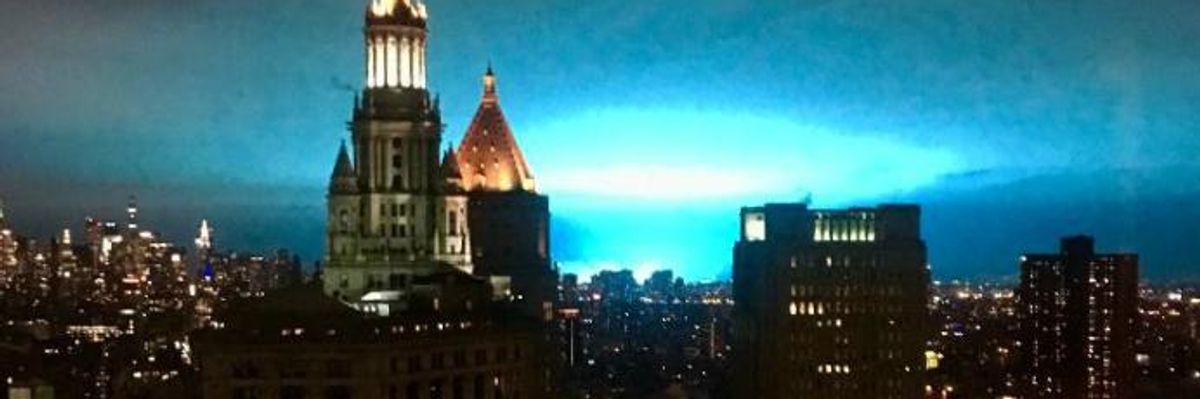
Judith Enck, the former Environmental Protection Agency regional administrator for New York, told the Huffington Post that the "very old and very polluting" Astoria plant "should have been shut down quite a while ago." (Photo: Steve Fine/Twitter)
Though it immediately evoked images of "an alien invasion" or the eerie opening scene of a "monster movie," the explosion that briefly turned New York City's skyline bright blue late Thursday night was actually something rather more conventional, but still cause for serious alarm and action: an electrical blast at one of New York's dirtiest power plants.
"It's a reminder that New York needs to accelerate efforts to phase out fossil fuels."
--Judith Enck, former New York EPA administrator
While state authorities said they are investigating the incident and concluded that no one was injured, the transformer explosion briefly sparked panic and--according to environmentalists--offered yet another glowing reminder of the dire need to transition away from dirty energy.
As the Huffington Post's Alexander Kaufman noted, the Astoria Generating Station--where the Thursday night blast occurred--"burns 3,039,000 gallons of number 6 fuel oil a year." The explosion at the facility, wrote Kaufman, could help call attention to New York City's "dependence on antiquated oil-burning power stations."
Number 6 fuel oil is "considered one of the most polluting energy sources in the world," Kaufman pointed out, and the Astoria power plant has been partly blamed for high air pollution in the surrounding area and the growing levels of asthma that have afflicted residents as a result.
"Last year the city council passed a bill requiring the utility operators to stop using fuel oil number 6 by 2020 and number 4 oil by 2030," Kaufman observed. "But the explosion on Thursday night could add new pressure to go further, phasing out fossil fuel use altogether and converting the stations to renewable sources."
Judith Enck, the former Environmental Protection Agency regional administrator for New York, told the Huffington Post that the "very old and very polluting" Astoria plant "should have been shut down quite a while ago" and replaced with clean electricity sources.
"It's a reminder that New York needs to accelerate efforts to phase out fossil fuels," Enck said of the blast.
Brooklyn-based renewable energy activist Daniela Lapidous agreed, saying it shouldn't be normal "to fear that the way we provide energy endangers the people we love."
"Fossil fuels cause so much danger from climate change and air pollution, but freak accidents like this go to show that moving our energy system to 100 percent renewables is the only way to minimize the threat," Lapidous concluded.
"None of these things happen in a vacuum," Democratic state Sen.-elect Jessica Ramos said in remarks outside the Astoria Generating Station following the transformer explosion. "We need to flip everything on its head and rethink the paradigm of exactly how it is that the city of New York and the state of New York is thinking about our future consumption of energy."
Images and videos of the Thursday night explosion and its aftermath quickly spread on social media, with New York residents expressing astonishment and horror at the bright blue light that illuminated the city sky for several minutes:
According to New York officials, the incident--which resulted in the brief closure of the LaGuardia Airport in Queens--is under control and there are no longer signficant power outages in the surrounding area.
Dear Common Dreams reader, It’s been nearly 30 years since I co-founded Common Dreams with my late wife, Lina Newhouser. We had the radical notion that journalism should serve the public good, not corporate profits. It was clear to us from the outset what it would take to build such a project. No paid advertisements. No corporate sponsors. No millionaire publisher telling us what to think or do. Many people said we wouldn't last a year, but we proved those doubters wrong. Together with a tremendous team of journalists and dedicated staff, we built an independent media outlet free from the constraints of profits and corporate control. Our mission has always been simple: To inform. To inspire. To ignite change for the common good. Building Common Dreams was not easy. Our survival was never guaranteed. When you take on the most powerful forces—Wall Street greed, fossil fuel industry destruction, Big Tech lobbyists, and uber-rich oligarchs who have spent billions upon billions rigging the economy and democracy in their favor—the only bulwark you have is supporters who believe in your work. But here’s the urgent message from me today. It's never been this bad out there. And it's never been this hard to keep us going. At the very moment Common Dreams is most needed, the threats we face are intensifying. We need your support now more than ever. We don't accept corporate advertising and never will. We don't have a paywall because we don't think people should be blocked from critical news based on their ability to pay. Everything we do is funded by the donations of readers like you. When everyone does the little they can afford, we are strong. But if that support retreats or dries up, so do we. Will you donate now to make sure Common Dreams not only survives but thrives? —Craig Brown, Co-founder |
Though it immediately evoked images of "an alien invasion" or the eerie opening scene of a "monster movie," the explosion that briefly turned New York City's skyline bright blue late Thursday night was actually something rather more conventional, but still cause for serious alarm and action: an electrical blast at one of New York's dirtiest power plants.
"It's a reminder that New York needs to accelerate efforts to phase out fossil fuels."
--Judith Enck, former New York EPA administrator
While state authorities said they are investigating the incident and concluded that no one was injured, the transformer explosion briefly sparked panic and--according to environmentalists--offered yet another glowing reminder of the dire need to transition away from dirty energy.
As the Huffington Post's Alexander Kaufman noted, the Astoria Generating Station--where the Thursday night blast occurred--"burns 3,039,000 gallons of number 6 fuel oil a year." The explosion at the facility, wrote Kaufman, could help call attention to New York City's "dependence on antiquated oil-burning power stations."
Number 6 fuel oil is "considered one of the most polluting energy sources in the world," Kaufman pointed out, and the Astoria power plant has been partly blamed for high air pollution in the surrounding area and the growing levels of asthma that have afflicted residents as a result.
"Last year the city council passed a bill requiring the utility operators to stop using fuel oil number 6 by 2020 and number 4 oil by 2030," Kaufman observed. "But the explosion on Thursday night could add new pressure to go further, phasing out fossil fuel use altogether and converting the stations to renewable sources."
Judith Enck, the former Environmental Protection Agency regional administrator for New York, told the Huffington Post that the "very old and very polluting" Astoria plant "should have been shut down quite a while ago" and replaced with clean electricity sources.
"It's a reminder that New York needs to accelerate efforts to phase out fossil fuels," Enck said of the blast.
Brooklyn-based renewable energy activist Daniela Lapidous agreed, saying it shouldn't be normal "to fear that the way we provide energy endangers the people we love."
"Fossil fuels cause so much danger from climate change and air pollution, but freak accidents like this go to show that moving our energy system to 100 percent renewables is the only way to minimize the threat," Lapidous concluded.
"None of these things happen in a vacuum," Democratic state Sen.-elect Jessica Ramos said in remarks outside the Astoria Generating Station following the transformer explosion. "We need to flip everything on its head and rethink the paradigm of exactly how it is that the city of New York and the state of New York is thinking about our future consumption of energy."
Images and videos of the Thursday night explosion and its aftermath quickly spread on social media, with New York residents expressing astonishment and horror at the bright blue light that illuminated the city sky for several minutes:
According to New York officials, the incident--which resulted in the brief closure of the LaGuardia Airport in Queens--is under control and there are no longer signficant power outages in the surrounding area.
Though it immediately evoked images of "an alien invasion" or the eerie opening scene of a "monster movie," the explosion that briefly turned New York City's skyline bright blue late Thursday night was actually something rather more conventional, but still cause for serious alarm and action: an electrical blast at one of New York's dirtiest power plants.
"It's a reminder that New York needs to accelerate efforts to phase out fossil fuels."
--Judith Enck, former New York EPA administrator
While state authorities said they are investigating the incident and concluded that no one was injured, the transformer explosion briefly sparked panic and--according to environmentalists--offered yet another glowing reminder of the dire need to transition away from dirty energy.
As the Huffington Post's Alexander Kaufman noted, the Astoria Generating Station--where the Thursday night blast occurred--"burns 3,039,000 gallons of number 6 fuel oil a year." The explosion at the facility, wrote Kaufman, could help call attention to New York City's "dependence on antiquated oil-burning power stations."
Number 6 fuel oil is "considered one of the most polluting energy sources in the world," Kaufman pointed out, and the Astoria power plant has been partly blamed for high air pollution in the surrounding area and the growing levels of asthma that have afflicted residents as a result.
"Last year the city council passed a bill requiring the utility operators to stop using fuel oil number 6 by 2020 and number 4 oil by 2030," Kaufman observed. "But the explosion on Thursday night could add new pressure to go further, phasing out fossil fuel use altogether and converting the stations to renewable sources."
Judith Enck, the former Environmental Protection Agency regional administrator for New York, told the Huffington Post that the "very old and very polluting" Astoria plant "should have been shut down quite a while ago" and replaced with clean electricity sources.
"It's a reminder that New York needs to accelerate efforts to phase out fossil fuels," Enck said of the blast.
Brooklyn-based renewable energy activist Daniela Lapidous agreed, saying it shouldn't be normal "to fear that the way we provide energy endangers the people we love."
"Fossil fuels cause so much danger from climate change and air pollution, but freak accidents like this go to show that moving our energy system to 100 percent renewables is the only way to minimize the threat," Lapidous concluded.
"None of these things happen in a vacuum," Democratic state Sen.-elect Jessica Ramos said in remarks outside the Astoria Generating Station following the transformer explosion. "We need to flip everything on its head and rethink the paradigm of exactly how it is that the city of New York and the state of New York is thinking about our future consumption of energy."
Images and videos of the Thursday night explosion and its aftermath quickly spread on social media, with New York residents expressing astonishment and horror at the bright blue light that illuminated the city sky for several minutes:
According to New York officials, the incident--which resulted in the brief closure of the LaGuardia Airport in Queens--is under control and there are no longer signficant power outages in the surrounding area.