SUBSCRIBE TO OUR FREE NEWSLETTER
Daily news & progressive opinion—funded by the people, not the corporations—delivered straight to your inbox.
5
#000000
#FFFFFF
To donate by check, phone, or other method, see our More Ways to Give page.
Daily news & progressive opinion—funded by the people, not the corporations—delivered straight to your inbox.
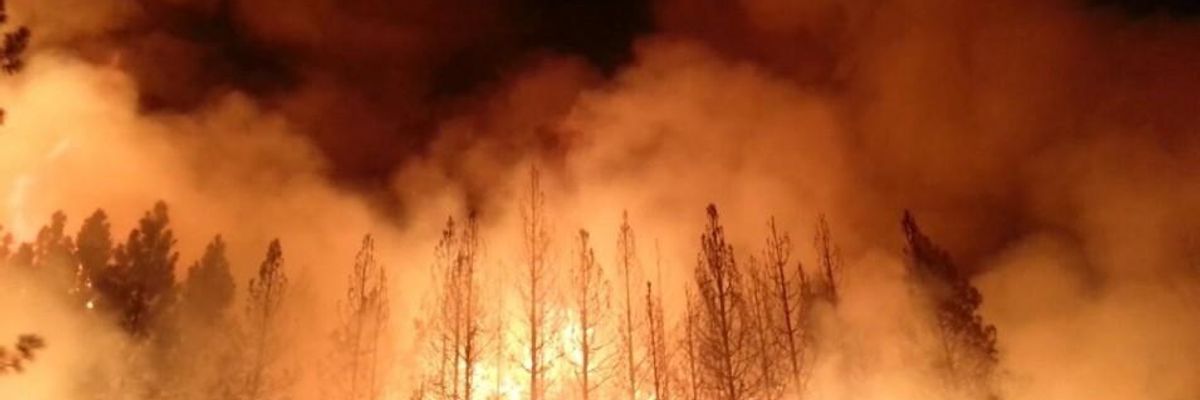
The Camp and Woolsey fires in California cost at least $9-13 billion in damage, according to a Christian Aid report published Thursday. (Photo: U.S. Forest Service)
From heat waves and hurricanes to fires and floods, the 10 costliest extreme weather events of 2018--driven by the global climate crisis--killed thousands of people and caused at least $84.8 billion in damage, according to a new analysis from Christian Aid.
"The world's weather is becoming more extreme before our eyes--the only thing that can stop this destructive trend from escalating is a rapid fall in carbon emissions."
-- Michael Mann, climate scientist
Counting the Cost: A Year of Climate Breakdown (pdf), published Thursday by the London-based group, notes that "extreme weather hit every populated continent in 2018, killing, injuring, and displacing millions, and causing major economic damage."
"All of these disasters are linked with human-caused climate change," it points out. "This report highlights some of the disastrous consequences of this warming that are already striking."
Christian Aid's global climate lead, Kat Kramer, said in a statement that "climate change is something still often talked about as a future problem, not least because we know the consequences of the warming climate are so devastating and don't want to face up to what is already happening." But, he added, as the report clearly shows, "for many people, climate change is having devastating impacts on their lives and livelihoods right now."
Though some figures "are likely to be underestimates" due to data limitations, the report lists the following as the 10 costliest extreme weather events from 2018, the fourth-hottest year on record:
| Event | Estimated Cost (USD) |
| U.S. - Hurricanes Florence & Michael | $32 billion |
| California, U.S. - Camp & Woolsey fires | $9-13 billion |
| Europe - drought | $7.5 billion |
| Japan - floods | $9.3-12.5 billion |
| Argentina - drought | $6 billion |
| China - floods | $9.3 billion |
| Australia - drought | $5.8-9 billion |
| Kerala, India - floods | $3.7 billion |
| Cape Town, South Africa - drought | $1.2 billion |
| Philippines & China - Typhoon Mangkhut | $1-2 billion |
"The impacts of climate change are no longer subtle. We are seeing them play out now, on our television screens, newspaper headlines, and social media feeds," responded renowned Penn State climate scientist Michael Mann. "The world's weather is becoming more extreme before our eyes--the only thing that can stop this destructive trend from escalating is a rapid fall in carbon emissions."
Although the COP24 summit held earlier this month in Katowice, Poland led to the development of a rulebook for the Paris climate accord--an agreement backed by every nation on Earth except the United States under the Trump administration--as studies continue to show the consequences of anthropogenic global warming, including more frequent and powerful extreme weather events, experts emphasize that the international community must be even more ambitious to prevent climate catastrophe.
"We must respond to the warning these disasters are giving us and avert more and worse ones, by accelerating the transition to a zero carbon economy: one run on clean, renewable energy that will deliver a safer climate for everyone."
--Kat Kramer, Christian Aid
As the Christian Aid report warns, "Current plans for controlling emissions put the world on course for catastrophic warming by the end of the century, with the planet heating three to five times as much as it has already," meaning that "the fires, storms, heat waves, floods, and droughts of 2018 would seem insignificant in comparison, with the poorest and most vulnerable communities across the world at the forefront of these disasters."
"Unless governments worldwide increase their ambition and work to cut emissions, the world will fail to prevent this disaster," it continues, calling on every nation to "take their fair share of that global action with wealthier countries supporting the global shift to net-zero emissions through finance and technology, so that less developed countries come out of poverty in a low-carbon and sustainable way."
"History will judge us on how we act now, as there is still a window of opportunity to avert more suffering," Kramer concluded. "We must respond to the warning these disasters are giving us and avert more and worse ones, by accelerating the transition to a zero carbon economy: one run on clean, renewable energy that will deliver a safer climate for everyone."
Dear Common Dreams reader, It’s been nearly 30 years since I co-founded Common Dreams with my late wife, Lina Newhouser. We had the radical notion that journalism should serve the public good, not corporate profits. It was clear to us from the outset what it would take to build such a project. No paid advertisements. No corporate sponsors. No millionaire publisher telling us what to think or do. Many people said we wouldn't last a year, but we proved those doubters wrong. Together with a tremendous team of journalists and dedicated staff, we built an independent media outlet free from the constraints of profits and corporate control. Our mission has always been simple: To inform. To inspire. To ignite change for the common good. Building Common Dreams was not easy. Our survival was never guaranteed. When you take on the most powerful forces—Wall Street greed, fossil fuel industry destruction, Big Tech lobbyists, and uber-rich oligarchs who have spent billions upon billions rigging the economy and democracy in their favor—the only bulwark you have is supporters who believe in your work. But here’s the urgent message from me today. It's never been this bad out there. And it's never been this hard to keep us going. At the very moment Common Dreams is most needed, the threats we face are intensifying. We need your support now more than ever. We don't accept corporate advertising and never will. We don't have a paywall because we don't think people should be blocked from critical news based on their ability to pay. Everything we do is funded by the donations of readers like you. When everyone does the little they can afford, we are strong. But if that support retreats or dries up, so do we. Will you donate now to make sure Common Dreams not only survives but thrives? —Craig Brown, Co-founder |
From heat waves and hurricanes to fires and floods, the 10 costliest extreme weather events of 2018--driven by the global climate crisis--killed thousands of people and caused at least $84.8 billion in damage, according to a new analysis from Christian Aid.
"The world's weather is becoming more extreme before our eyes--the only thing that can stop this destructive trend from escalating is a rapid fall in carbon emissions."
-- Michael Mann, climate scientist
Counting the Cost: A Year of Climate Breakdown (pdf), published Thursday by the London-based group, notes that "extreme weather hit every populated continent in 2018, killing, injuring, and displacing millions, and causing major economic damage."
"All of these disasters are linked with human-caused climate change," it points out. "This report highlights some of the disastrous consequences of this warming that are already striking."
Christian Aid's global climate lead, Kat Kramer, said in a statement that "climate change is something still often talked about as a future problem, not least because we know the consequences of the warming climate are so devastating and don't want to face up to what is already happening." But, he added, as the report clearly shows, "for many people, climate change is having devastating impacts on their lives and livelihoods right now."
Though some figures "are likely to be underestimates" due to data limitations, the report lists the following as the 10 costliest extreme weather events from 2018, the fourth-hottest year on record:
| Event | Estimated Cost (USD) |
| U.S. - Hurricanes Florence & Michael | $32 billion |
| California, U.S. - Camp & Woolsey fires | $9-13 billion |
| Europe - drought | $7.5 billion |
| Japan - floods | $9.3-12.5 billion |
| Argentina - drought | $6 billion |
| China - floods | $9.3 billion |
| Australia - drought | $5.8-9 billion |
| Kerala, India - floods | $3.7 billion |
| Cape Town, South Africa - drought | $1.2 billion |
| Philippines & China - Typhoon Mangkhut | $1-2 billion |
"The impacts of climate change are no longer subtle. We are seeing them play out now, on our television screens, newspaper headlines, and social media feeds," responded renowned Penn State climate scientist Michael Mann. "The world's weather is becoming more extreme before our eyes--the only thing that can stop this destructive trend from escalating is a rapid fall in carbon emissions."
Although the COP24 summit held earlier this month in Katowice, Poland led to the development of a rulebook for the Paris climate accord--an agreement backed by every nation on Earth except the United States under the Trump administration--as studies continue to show the consequences of anthropogenic global warming, including more frequent and powerful extreme weather events, experts emphasize that the international community must be even more ambitious to prevent climate catastrophe.
"We must respond to the warning these disasters are giving us and avert more and worse ones, by accelerating the transition to a zero carbon economy: one run on clean, renewable energy that will deliver a safer climate for everyone."
--Kat Kramer, Christian Aid
As the Christian Aid report warns, "Current plans for controlling emissions put the world on course for catastrophic warming by the end of the century, with the planet heating three to five times as much as it has already," meaning that "the fires, storms, heat waves, floods, and droughts of 2018 would seem insignificant in comparison, with the poorest and most vulnerable communities across the world at the forefront of these disasters."
"Unless governments worldwide increase their ambition and work to cut emissions, the world will fail to prevent this disaster," it continues, calling on every nation to "take their fair share of that global action with wealthier countries supporting the global shift to net-zero emissions through finance and technology, so that less developed countries come out of poverty in a low-carbon and sustainable way."
"History will judge us on how we act now, as there is still a window of opportunity to avert more suffering," Kramer concluded. "We must respond to the warning these disasters are giving us and avert more and worse ones, by accelerating the transition to a zero carbon economy: one run on clean, renewable energy that will deliver a safer climate for everyone."
From heat waves and hurricanes to fires and floods, the 10 costliest extreme weather events of 2018--driven by the global climate crisis--killed thousands of people and caused at least $84.8 billion in damage, according to a new analysis from Christian Aid.
"The world's weather is becoming more extreme before our eyes--the only thing that can stop this destructive trend from escalating is a rapid fall in carbon emissions."
-- Michael Mann, climate scientist
Counting the Cost: A Year of Climate Breakdown (pdf), published Thursday by the London-based group, notes that "extreme weather hit every populated continent in 2018, killing, injuring, and displacing millions, and causing major economic damage."
"All of these disasters are linked with human-caused climate change," it points out. "This report highlights some of the disastrous consequences of this warming that are already striking."
Christian Aid's global climate lead, Kat Kramer, said in a statement that "climate change is something still often talked about as a future problem, not least because we know the consequences of the warming climate are so devastating and don't want to face up to what is already happening." But, he added, as the report clearly shows, "for many people, climate change is having devastating impacts on their lives and livelihoods right now."
Though some figures "are likely to be underestimates" due to data limitations, the report lists the following as the 10 costliest extreme weather events from 2018, the fourth-hottest year on record:
| Event | Estimated Cost (USD) |
| U.S. - Hurricanes Florence & Michael | $32 billion |
| California, U.S. - Camp & Woolsey fires | $9-13 billion |
| Europe - drought | $7.5 billion |
| Japan - floods | $9.3-12.5 billion |
| Argentina - drought | $6 billion |
| China - floods | $9.3 billion |
| Australia - drought | $5.8-9 billion |
| Kerala, India - floods | $3.7 billion |
| Cape Town, South Africa - drought | $1.2 billion |
| Philippines & China - Typhoon Mangkhut | $1-2 billion |
"The impacts of climate change are no longer subtle. We are seeing them play out now, on our television screens, newspaper headlines, and social media feeds," responded renowned Penn State climate scientist Michael Mann. "The world's weather is becoming more extreme before our eyes--the only thing that can stop this destructive trend from escalating is a rapid fall in carbon emissions."
Although the COP24 summit held earlier this month in Katowice, Poland led to the development of a rulebook for the Paris climate accord--an agreement backed by every nation on Earth except the United States under the Trump administration--as studies continue to show the consequences of anthropogenic global warming, including more frequent and powerful extreme weather events, experts emphasize that the international community must be even more ambitious to prevent climate catastrophe.
"We must respond to the warning these disasters are giving us and avert more and worse ones, by accelerating the transition to a zero carbon economy: one run on clean, renewable energy that will deliver a safer climate for everyone."
--Kat Kramer, Christian Aid
As the Christian Aid report warns, "Current plans for controlling emissions put the world on course for catastrophic warming by the end of the century, with the planet heating three to five times as much as it has already," meaning that "the fires, storms, heat waves, floods, and droughts of 2018 would seem insignificant in comparison, with the poorest and most vulnerable communities across the world at the forefront of these disasters."
"Unless governments worldwide increase their ambition and work to cut emissions, the world will fail to prevent this disaster," it continues, calling on every nation to "take their fair share of that global action with wealthier countries supporting the global shift to net-zero emissions through finance and technology, so that less developed countries come out of poverty in a low-carbon and sustainable way."
"History will judge us on how we act now, as there is still a window of opportunity to avert more suffering," Kramer concluded. "We must respond to the warning these disasters are giving us and avert more and worse ones, by accelerating the transition to a zero carbon economy: one run on clean, renewable energy that will deliver a safer climate for everyone."